Showing posts with label urban. Show all posts

Saturday, July 18, 2026

Commodifying Hope

I had high expectations for the recent Generation Regeneration online summit last weekend, July 10-12. While it was not wholly without merit, I found it disappointing and somewhat misleading. We definitely need a vastly different approach to our human enterprises and existence on this planet, but I remain unconvinced that most proposed solutions will work. What I can do here is share my impressions of the event, the majority of which I attended, and why I am having this negative reaction.

The Generation Regeneration online summit was sponsored by Future of Cities, and hosted by Tony Cho. It turns out that FOC and Tony Cho are essentially the same thing. I learned about the event through a Facebook advertisement that promised I could reserve my free seat for the live event. I signed up.

Why was I interested in this at all? My next book, provided I can find a publisher, will be a collection of essays centered on urban natural history. Not in the usual sense of squirrels, raccoons, and pigeons, but on the most common urban animal: Homo sapiens. I want to be able to offer readers some concrete examples of successful innovation and social progression, and hoped to find that in this summit.

The first....red flag, if you can call it that, was that while I did receive confirmation of my reservation, it did not include a link to what I had assumed was a Zoom call. Turns out it was streamed on a handful of platforms. I chose YouTube. The post-conference assessment from Future of Cities boasted an attendance of 20,000 viewers. I was one of no more than eight (8) on YouTube, at any one time. Maybe there were 20,000 participating via Instagram. I don't know, I do not have an Instagram account. I'm skeptical.

The second annoying correspondence suggested that I should upgrade to the "VIP Experience," for a mere $99, which would include a copy of Tony's forthcoming book, in press now, and access to the recordings of the presentations/conversations/interviews making up the summit, for a longer period than if I retained my free registration. This seems to me to be a classic bait-and-switch marketing tactic, and it was a real turn-off.

Then there was, in the aftermath, the "but wait, there's more," an invitation to enroll in the "Co-design Cohort," an online course, for $555 until midnight tonight (July 13), before the price jumps to $1,111 thereafter. Now I can see this for what it is, mostly: an economic engine for Future of Cities.

What is a shame is that there were some truly important featured guests at the summit, who are doing critical and successful work. Majora Carter is an urban rivitalization strategist, a MacArthur Fellow, Peabody Award winning broadcaster, and author of Reclaiming Your Community: You Don't Have to Move Out of Your Neighborhood to Live in a Better One. Her conversation alone would have been worth the VIP package. Same with Atossa Soltani, Director of Global Strategy for the Amazon Sacred Headwaters Alliance, and founder and President of Amazon Watch. Dr. Dominique Hes was another outstanding interview. She is a Director at Greenfleet, in Melbourne, Australia. She helped engineer and execute a paddock project, implementing eco-inviting components in a human-centered development, with exciting results.

See what I am gravitating towards, here? I wanted more Indigenous and other minorty voices. There were at least many women featured, which is a great start, but it still felt like it came up a little short.

Then there were people we have heard from before, and now consider largely irrelevant, like Marianne Williamson. There were self-help gurus, people who Tony Cho met at Burning Man....Some even admitted that what they do, and/or subscribe to, is often viewed as "woo-woo," new age mumbo-jumbo. Whether there is any validity to such things is largely irrelevant when public opinion is mixed at best. The last thing we need right now is any more devisiveness.

We do not need catchphrases like "regenaisance" (seriously, this is what Tony Cho is calling this). We don't need more self-appointed leaders trying a bit too hard to be fashionable and progressive. We definitely don't need to prioritize the accommodation of capitalism. Cho repeatedly asserted that the regenaisance does not seek the elimination of capitalism. There were a few too many guests in relatively fancy offices sipping vendor coffees, at least for my taste. The entire event resembled a series of infomercials in many instances, punctuated by truly meaningful content.

At least I can now go directly to some of these individuals, and their organizations, to learn more and get recommendations for other people to investigate and learn from. I can appreciate Tony Cho for collecting all of these people, even if I find only a few of them relevant to my own projects.

Thursday, June 20, 2019

In Praise of "Weeds"

You have been sold a bill of goods if you believe that all "weeds" are created equal. Weeds is in quotation marks because the majority of what we call weeds are simply native wildflowers and grasses that volunteer themselves in our carefully orchestrated urban and suburban landscapes. Allow me to explain.

A primrose sprouts defiantly from a sidewalk crack

We create villains to open opportunities for the invention and marketing of products and services to kill them. Meanwhile, the actual villains are exotic plants propagated by the nursery and landscaping industries, which then escape cultivation to wreak havoc on natural ecosystems. Everybody in the business sector wins, but you are out of pocket for a good deal of expense, and natural habitats are abused or at least compromised, in the process.

Lawn services and weed killers should be trending down by now

This is not a conspiracy as much as it is a marketing strategy that has gone so far as to encourage legislation of local municipal ordinances that may explicitly prohibit homeowners from allowing their property to revert to any semblance of a natural ecosystem. Ostensibly, these "nuisance laws" were created in an effort to ensure public health and safety, seeking to eliminate refuges of "vermin," pests, pathogens, and excessive pollen, and mitigate fire risks. The stereotypical weed ordinance is one which prohibits grasses or brushy vegetation to exceed a specified height. The junk vehicle discovered while mowing the lawn is a running joke.

Home Owners Associations (HOAs) have taken this to a whole new level, with their attention to minutiae rooted in preservation and enhancement of property values. In the case of the authority my spouse and I are under with our townhouse, this has resulted in removal of some trees, replacement of juniper hedges with rock substrates, and continued embracing of water-guzzling lawns. Keeping up appearances means more to these organizations than enhancing the health of local ecosystems.

Clover is a bee magnet and fixes nitrogen: Win-win!

What we should be doing is advocating what I call "weed tolerance." Even naturalized plants have their benefits. Dandelion is among the first plant to bloom in spring, offering a vital nectar and pollen resource to butterflies, bees, and other insects when nothing else is flowering. The clover in your lawn is a bee magnet, plus the plant is fixing nitrogen so you don't need to fertilize as often, if at all.

Ok, Chinese Clematis is a genuine noxious weed

In fairness, there truly are weeds that have no place in the landscape. You can find them as state-listed noxious weeds. The United States Department of Agriculture has conveniently compiled a database of these most-wanted (maybe most-despised is a better term) plants for you to use in determining which plants you need to eliminate from your yard and garden, or avoid when shopping for plants. This is an ever-changing list as more information is gathered about the impact of each commercially available plant. It was not until recently that Bradford Pear and Butterfly Bush (Buddleja davidii) became enemies instead of friends in the landscaping community. Keep tabs on the list for more additions.

Wild rose, with more open blossoms, is friendlier to bees than cultivars are

Increasingly, more attention is being paid to providing for native pollinating insects, and supplying breeding birds with the insects necessary to raise a brood of chicks. You can search endlessly online for resource after resource, but you may wish to start with books like Bringing Nature Home, by Douglas Tallamy. Dr. Tallamy and his colleagues and students have worked tirelessly to demonstrate conclusively the differences in ecological impact between native plants and exotic plants. Native plants, including many species we currently define as "weeds," sustain far more species of insects and other wildlife, as they are already adapted to soils, precipitation, and other variables where they thrive naturally. This makes the plants hardier, better able to withstand heavy impacts from herbivores, diseases, and other agents that affect plant health.

Yellow and white composites are favorites with bees and butterflies

Want help that is even more localized and informative? Join your state's Native Plant Society. Here is a list of them in the U.S. and Canada. Also avail yourself of the Cooperative Extension Service, typically associated with your state's land grant university. There is usually at least one office in each county, located in the county seat.

The tide does appear to be turning, even with those weed ordinances. While some cities have begun relaxing their codes, other municipalities have reversed course completely, actively encouraging citizens to "go native" with revised laws and financial incentives. Use these success stories to argue your case locally for similar innovative strategies.

Don't forget about evening- and night-blooming flowers like blazingstars when landscaping

Lately I have been enjoying the weeds that have been flourishing here in Colorado Springs thanks to an exceptionally wet, cool spring. There are flowers blooming that I have never seen before now. How do I translate my appreciation for vegetative rebellion into something meaningful to those who have bought into the neat and tidy vision of the marketplace?

Penstemon growing in a vacant lot in Colorado Springs

Saturday, May 4, 2019

Lessons From The City Nature Challenge

This year, Colorado Springs joined the ranks of those metropolitan areas participating in the fourth annual City Nature Challenge, which started in 2016 as a contest between Los Angeles and San Francisco to see which city could find the most species of wild organisms inside their municipal boundaries. Today it is a global event.

Blue Jay spotted during City Nature Challenge

Why The Nature Challenge Matters

Professional scientists cannot be everywhere at once, so "citizen scientists" are needed to help understand if animal and plant populations are healthy or declining. Unless an organism has an economic impact, positive or negative, chances are we know very little about it. We do not even know all the geographic areas certain species are found in. Your observations are critical and valuable.

Buttercup

Logistics of the City Nature Challenge

The City Nature Challenge is recorded on iNaturalist, an online platform that also has a smart phone app. Participants register on iNaturalist for free, look for their town's City Nature Challenge project, and subscribe to it. Observations of wild organisms (no people, pets, livestock, or cultivated plants, please) taken with phone or camera are then uploaded to the project. Observations are made in a four-day window, Friday through Monday. After that, you can still upload any observations made during that period, but most of that following week is devoted to identifying the animals, plants, fungi, and other living things already uploaded. City "winners" at the end of the project include most participants, most observations, and most species seen.

Black Swallowtail female

Limits and Pitfalls

At one point, the home page for iNaturalist gave the following disclaimer:

"iNaturalist had record levels of activity this week due to the City Nature Challenge, so notifications of activity such as identifications and comments are delayed. You may receive notifications out of sequence as we work through the backlog as quickly as possible. We apologize for the inconvenience and thank you for your patience."

That the website did not crash completely is a testament to its server capacity. This aspect of the City Nature Challenge seems to be in good order. Other problems remain, however.

  1. Participation. Recruiting people willing to make more than a casual effort, if that, appears to be the greatest shortcoming of the City Nature Challenge. Here in Colorado Springs, we maybe had one brief announcement on a television newscast. We had a total of 142 participants, many of them "accidental," in a city of roughly 800,000 people.
  2. Automatic suggestions for identification. iNaturalist has image recognition software that will "suggest" a species, family, order, or other level of taxonomy for the image you post. These suggestions are often wildly inaccurate and lead people to identify a North American insect as something from Africa, for example. Users should ignore this feature and instead assign the most obvious level of recognition, such as "grasshopper."
  3. Little or no crossover with other apps. One thing my wife and I noticed was a lack of birders making observations for City Nature Challenge. The avian-inclined prefer the app e-Bird. There is no excuse for not having e-Bird observations during the City Nature Challenge export automatically to iNaturalist. The technology is surely there. Likewise, other apps should be compatible with iNaturalist, at least for bioblitzes and the City Nature Challenge.
Many-lined Skink

Have a Plan of Attack

One thing I personally learned was that it would help to have a plan of attack, or at least a "plan B" if the weather is uncooperative. What can you count on for observations? Bird nests? Insect galls? Mealybugs on the houseplants? You would be surprised by the biodiversity indoors, in your basement, garage, or tool shed. Make a list to remind yourself of those places you can look, or species you know can be found reliably at a given location.

Yellow-rumped Warbler

Beyond The City Nature Challenge

If this is the first you have heard of City Nature Challenge, no worries. See if your city participated this year. No? Contact your parks department, local museum, or nature center and ask that they initiate an effort for next year. Meanwhile, you might want to make a habit of participating in other citizen science projects through iNaturalist and similar portals like Project Noah. You will make friends, learn much, and contribute positively to our understanding of planet Earth in the process. The idea that nature-watching can be a social activity is slowly catching on, and that common, widespread interest is what will ultimately protect and restore wild places.

Gilled fungi on a tree

Wednesday, November 21, 2018

Kudzu Ate The Off-ramp: A Brief Visit to Tennessee

View from Roan Mountain

Over the river and through the woods, our Garmin has gone astray....No, seriously, in Roan Mountain State Park, the GPS had us traversing the forest on the other side of the stream instead of the perfectly good road we were actually on. Such is life in east Tennessee, but well worth the effort you put into making it a destination.

My wife and I found ourselves there as a result of a conference she was attending in Knoxville. I had to occupy myself while she was at the gathering, but we took an extra few days together in truly rural east Tennessee afterwards. We can now attest to the legend that is southern hospitality, and are likely to return for further explorations if we can avoid the tourist traps, which are equally legendary, from Gatlinburg to Dollywood.

We arrived by plane on a Sunday, got the rental car, and headed into downtown Knoxville, spending the whole ride trying to find something other than an on-air church service over the radio. Good luck with that. Our trusty GPS guided us to at least two restaurants that were closed, so we finally just parked (for free on weekends) in a big lot and set out on foot. We settled on The Crown & Goose, a well-patronized establishment, practically an institution if you ask around. The hostess greeted us by welcoming us to the restaurant's last day of existence. I wish I were making this up, but it was true. The place was closing to make way for part of some much larger development on the horizon. I think I recall something about a new sports complex and entertainment district, the kind of thing that often signals the death knell for local businesses in favor of chains.

We learned of this by striking up a conversation with another couple, their son and ("hopefully") soon-to-be daughter-in-law. We were all enjoying the warm sun outside while waiting for seating inside because despite the sun it was pretty chilly. You cannot say that about the people, though, as everyone is warm and friendly and will talk to you like they have known you all their lives. This stereotypical aspect of the south is most welcome, and something other regions should strive for. Sure, it was a Sunday, and just about anyone is more laid back on the weekend, but still.

Volunteer Landing, downtown Knoxville

Downtown Knoxville is perhaps not quite as vibrant as some city centers, but you will not go hungry or lack for entertainment, or visual stimulation thanks to the mix of history and architecture and public art. Nothing is overwhelming, and it says great things about the city that they are not prone to overstatement....except for the University of Tennessee. Lots of orange, lots of orange, but I digress. I thought my hometown of Portland, Oregon was clean, but Knoxville, and for that matter every other place we went, may get polished daily. I remember maybe one piece of litter in over a week, and given my tendency to spy trash while looking for birds and other wildlife, that is saying something. Other cities bent on beautification projects should put Knoxville on the "must visit" list.

U.S. Courthouse, downtown Knoxville

It is virtually impossible to find fault with anything in east Tennessee. I mean, I got nothin'. Seriously. You have to have been a long-term resident to have complaints, and they do have complaints, mostly about traffic and construction, and sometimes disrespecting human and natural history in their haste to put up a new housing development or something. Gentrification is an issue everywhere, and apparently the Knoxville area is not immune. Ok, we were there during an election cycle, and politics are ugly there, too, judging from the campaign advertisements.

Farther afield, toward Johnson City and more rural hamlets, you might not be able to get a quorum to reach a consensus of complaints. Unless and until you stop in at a diner, it is easy to imagine that everyone is on their own up in the hills and hollers. Abandoned houses, barns, and outbuildings are quickly overwhelmed by kudzu, and I can only wonder what would happen if you didn't leave your home for a couple of days. Would you still be able to open the front door? No matter, the locals no doubt turn every obstacle and negative event into a running joke. You just get that vibe that there is nothing that can't be overcome with a little ingenuity and a lot of laughter.

Blackberry Blossom Inn, Unicoi

Friday, August 17, 2018

The Kinds of (Landscaping) Codes We Really Need

© Naplesgov.com, Naples, Florida

I have reached wit's end with code enforcement in cities, towns, and other municipalities. Do not even get me started on homeowner's associations (HOAs). The emphasis is clearly cosmetic and does more harm to our environment than even simple neglect of yards and gardens in this age of climate change. We need a total overhaul of the statutes.

Were I a conspiracy theorist, I would be claiming that local governments were in cahoots with landscapers to create standard urban and suburban landscapes that feed the landscaping industry, as well as pesticide, herbicide, and fertilizer manufacturers. Why do we continue to insist on models of landscaping that are no longer sustainable, if they ever were to begin with? The only thing "sustainable" about lawns and exotic shrubs, trees, and flowers is the heavy upkeep they require simply to stay alive. That usually necessitates contracting with lawn care services and other businesses that feed our addiction to showy gardens and pristine lawns.

Let's face it, lawns alone have become a status symbol, especially in the western U.S. A large, uniform expanse of grass says that you have the large sum of money needed to cover the water bill, and pay for a landscaper. What that speaks to me is an attitude of "I don't give a damn about water scarcity, native vegetation, or the future of the planet." You would rather spend money creating what amounts to an advertisement of your wealth. Wow. How responsible of you.

Meanwhile, municipal code enforcement tends to center on "weeds," many of which are actually native wildflowers that sustain pollinators and other desirable wildlife. If your grass gets too high it is subject to fines until you are in compliance. Tall grass and herbs are ironically considered a haven for mosquitoes and other disease vectors, as well as being "unsightly." This, in my opinion, is an overblown argument, if not even fallacious. You have undesirable rodents, for example, in urban areas lacking any vegetation. Feral pets are more likely to carry diseases than most wild animals, save for skunks, the odd raccoon and, sometimes, bats.

Were I writing the codes, they would be almost the polar opposite of what is in place now. I would limit the size of lawns to a percentage of your total outdoor landscape. I would enforce strict outdoor water use limitations, regardless of the current weather conditions because most regions are becoming more arid, with no end in sight for that trend. I would mandate that a percentage of landscape plants be native, drought-tolerant, and wildlife-friendly. I might require a permit for the use of any chemical treatment outdoors. This may be an area where contractors could really benefit because leaving chemical applications as do-it-yourself (DIY) has accident-waiting-to-happen written all over it. Failure to follow label instructions for applying pesticides and herbicides is a leading cause of household poisonings, let alone environmental hazards.

I would raise fines for feeding wildlife other than birds, and require anyone in bear habitat take down their feeders every night. I would raise fines for neglect of swimming pools and other water features, even including bird baths, as stagnant water is a breeding environment for mosquitoes and other biting flies. I would reduce outdoor lighting to prevent the interruption of normal behavior by nocturnal animals. Using wildlife-proof waste disposal containers would discourage raccoons, opossum, and other mammals from doing damage and maybe even frequenting urban areas at all. Ok, that is probably wishful thinking.

No entity raises my ire more than HOAs. They are entirely consumed with keeping up appearances, and have complete disregard for the mental health of residences and the environmental health of their communities. Raising property values is their bottom line, even if it means tearing out everything green except lawns, as our own townhouse property management agency is in the process of doing. HOAs put forth arguments for "improved security" as justification for removal of shrubbery and increased outdoor lighting. Baloney. You want increased security? Hold informal events so everyone can get to know their neighbors. Enforce codes of personal conduct instead of landscaping rules.

We need to collectively begin calling for changes to codes that begin to address what could be called environmental impoverishment. We deserve better, more diverse landscapes in our communities, but that cannot happen without some major alterations in governmental mindsets.

Saturday, April 28, 2018

In Praise of Vacant Land

Growing up in Portland, Oregon in the 1960s and 1970s, I spent my lonely childhood exploring the forests, fields, and vacant lots around our neighborhood. Maybe it was the time period, maybe it was the culture, but I was allowed to roam freely for the most part. Not today. Our vacant parcels of land, whatever their size, have gone from implicit invitations to traverse them to extreme possessiveness and a clearly uninviting nature full of fences and other explicit boundaries and "no tresspassing" postings. I long for the good ol' days.

It would be an interesting exercise to plot a timeline of American land use over the centuries, from the frontier to current efforts to shrink public lands. Some things stand out from my own education, both formal and subsequently informed by "alternative media." We clearly usurped indigenous peoples in our effort to conquer the wild landscape and settle what were apparently chaotic ecosystems prior to our arrival as European colonists. Resource extraction went from individual mining claims during the Gold Rush to mountaintop removal for coal, to fracking done by faceless corporations. We tamed forests through logging and fire suppression.

If you believe that to have value, a given parcel of land must provide an economic return, then you are starting with the wrong premise.

Eventually, individuals with great foresight and appreciation of wilderness brought us the concept of parks, wildlife refuges, and roadless wilderness. Then came Aldo Leopold's land ethic, and Garrett Hardin's The Tragedy of the Commons. Our population boomed in post war celebration, and prosperity seemed boundless. The interstate highway system replaced the railroad as the way to move freely about the country, unfettered by fears of peak oil. Everyone could have everything, including their own piece of real estate. We could feed ourselves, recreate, work, and live, all in different locations. Sprawl was not the name for subdivisions back then.

Where once land was appreciated on several levels, today there is but one consideration: financial gain. If you believe that to have value, a given parcel of land must provide an economic return, then you are starting with the wrong premise. Land already has value as the ecosystem engine that keeps us breathing, keeps us grounded, keeps our minds resilient and stokes our creativity, awe, and curiosity. The idea that human activities enhance the value of land is a corruption of economics that ignores biology. I have personally never seen a natural landscape improved by the addition of a strip mall or suburban housing project. Indeed, such projects diminish the value of land at best.

Undeveloped acreage is protected the way ranchers protect their cattle before they take them to the slaughterhouse. The average lot is merely reserved for something "better" at some future date.

Today, the vacant lands of my youth are protected from children, and all other innocent and worthwhile interests. Undeveloped acreage is protected the way ranchers protect their cattle before they take them to the slaughterhouse. The average lot is merely reserved for something "better" at some future date. I ask what could be better than wildflowers, the hum of bees and songs of birds? What could be better than an unofficial playground for our wonderfully wild, exuberant children? I never got curious about illicit drugs because I was curious about insects and reptiles and other wildlife. I was able to satisfy my inquisitive nature precisely because I had places I could go, safe or not, where I could find and observe other organisms. This is saying something considering that I am an only child who was raised mostly by an overprotective single mother.

Vacant lots are only as much of a blight as we allow them to be, at least in urban settings. Why not take that weedy block and turn it into a butterfly and bird garden, or even a community garden that feeds people as well as wild things? Grow something other than another concrete and steel building. Density and infill are not dirty words. Apply them humanely and shrink your city's sprawl. Leave the larger pieces alone or manage them for all the biological services they provide us. Leave them for the kids.

Friday, May 3, 2013

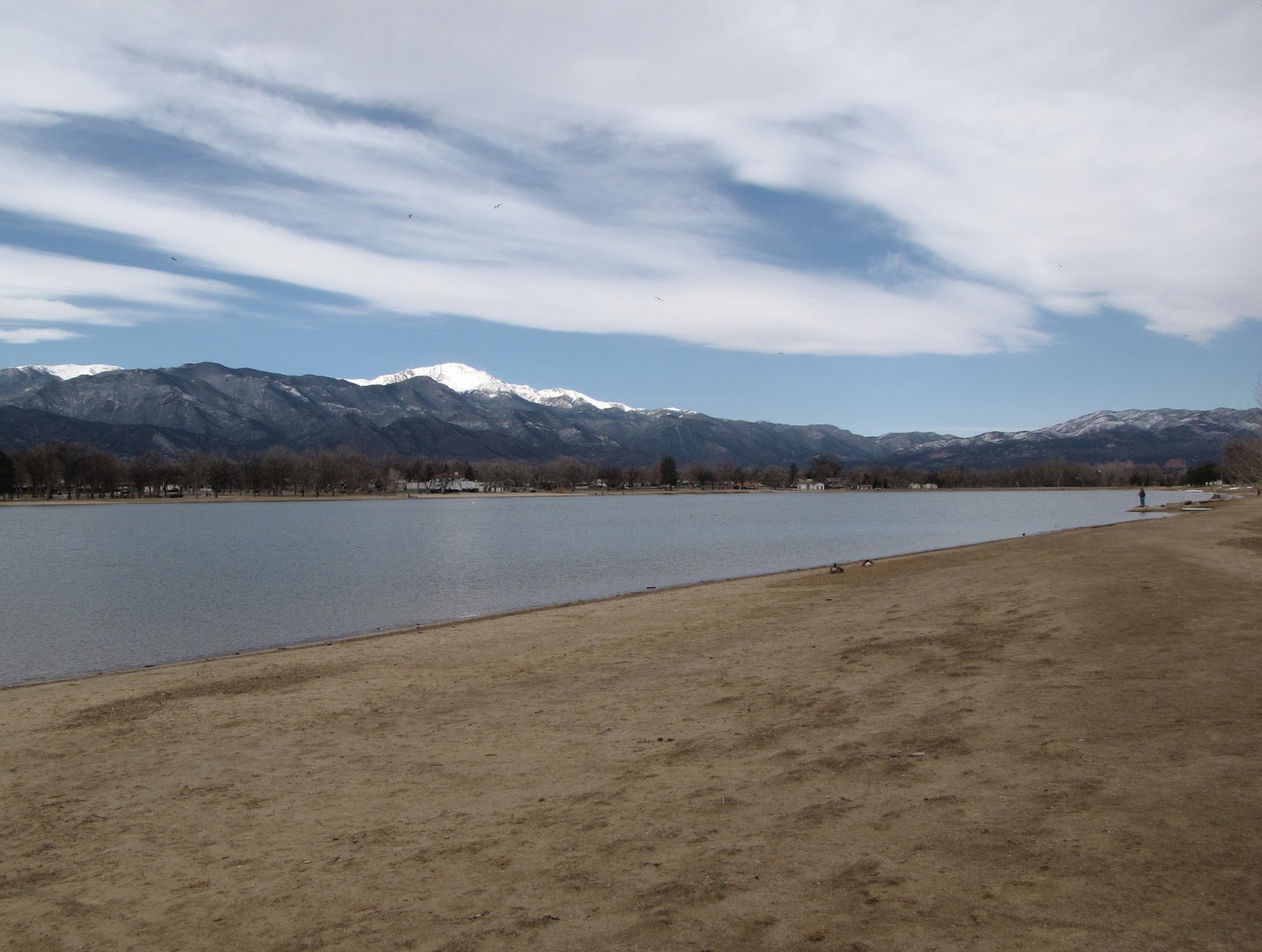
Prospect Lake

I had dismissed Prospect Lake in Memorial Park as just another fake lake in the urban landscape, not worth my time if I wanted to find any wildlife other than Rock Pigeons or European Starlings. Thanks to a Facebook group for the Colorado Field Ornithologists, I found out my assumptions had no validity whatsoever.

About the middle of last month, posts to the group included sightings of the most improbable birds you could imagine: American Avocet, Mountain Bluebird, even American White Pelican. Grebes of at least four species were common. There were pictures of several species to back up the claims.

It is embarrassing to admit that Memorial Park is only about three miles from my home, near downtown Colorado Springs. Yes, Prospect Lake is a large, artificial reservoir, dutifully stocked with trout for fishermen, and with boat ramps to facilitate water skiing, but the water level is low right now, and the boathouse is not yet open for business. I should have paid closer attention.


American White Pelicans

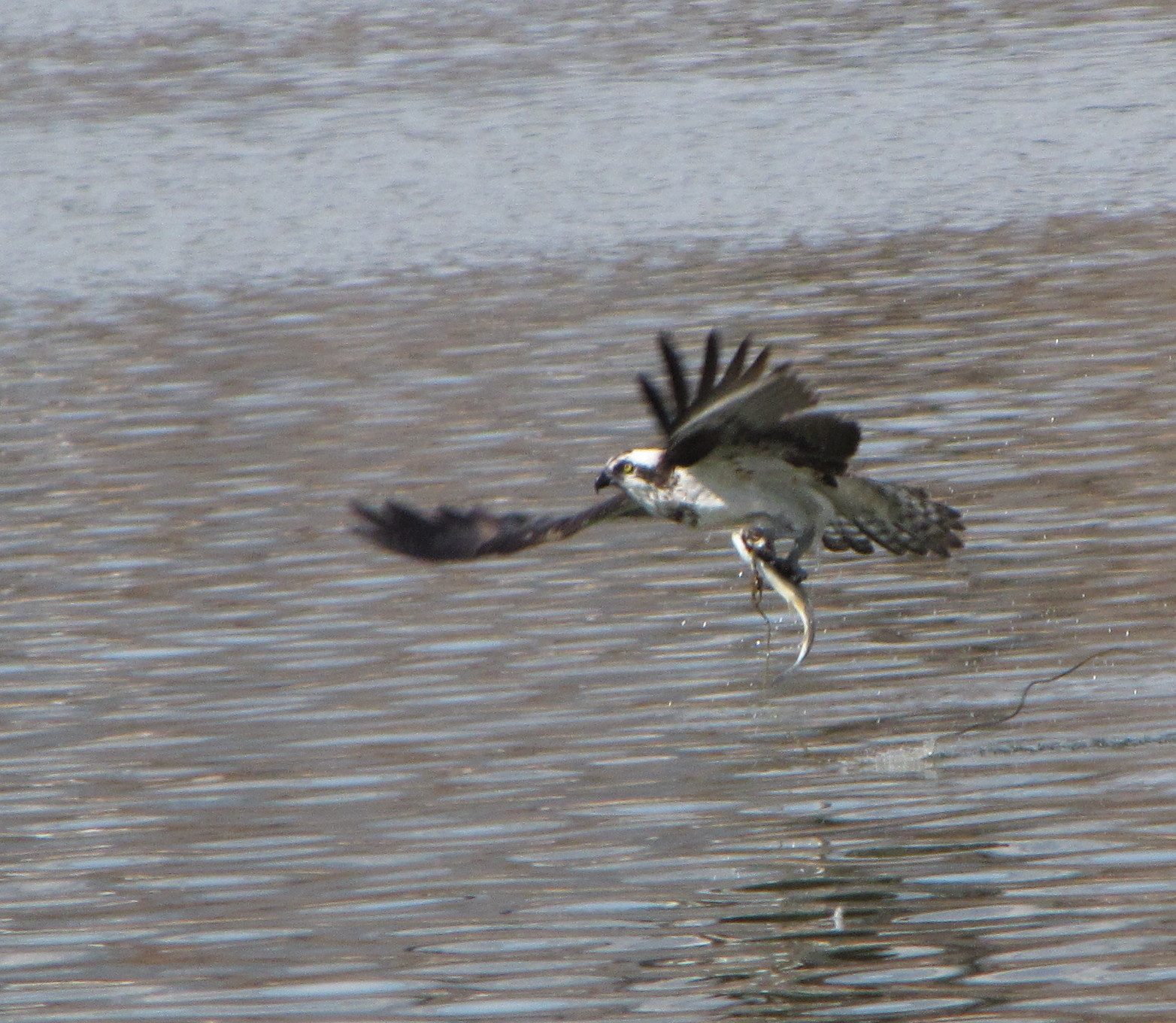
After reading the posts to the ornithology group with my jaw on the floor, I decided I needed to see for myself all the bird diversity. Apparently, on April 19, I was one day too late for the midge hatch that had attracted the large number of birds the previous day. I was still impressed even so. The pelican flock was still there, plus more waterfowl and gulls than I could count. At one point I counted six Ospreys in the air at once. It was like they were lining up and taking turns at the trout….at least until the Bald Eagle showed up and frightened everybody else away.

The land that is now Memorial Park was donated to the city by General William Jackson Palmer in 1890. Prospect Lake was excavated shortly thereafter. Initially, the reservoir was used to supply water to the Evergreen Cemetery, but that need expired in 1950. The water that fills the lake is extracted from the nearby Fountain Creek, a local watershed. A Naval Reserve station occupied the southwest corner of the lake from the late 1940s until the late 1980s. Plans to turn the entire lake over to naval training exercises in 1950 were thwarted by locals who enjoyed recreating on the rest of the lake. The Colorado Springs Fire Department used the armory for training after naval training facilities moved to Fort Carson, but after 2001 all the buildings were abandoned and demolished.

The lake began losing water at a high rate in 2002 when the pipeline supplying the lake was shut off, a severe drought was happening, and the liner for the lake became torn. A movement to add Prospect Lake to the National Register of Historical Places was successful, and spurred action to replace the liner. The lake was refilled and again stocked with fish in 2005, and it remains a vibrant center of recreation today.

The lake is surrounded today by playgrounds, including the state-of-the-art “Swing High” totally accessible playground, plus lawns, ornamental pine, cottonwood, and other trees, ballfields, residential neighborhoods, and commercial real estate. Despite all the hustle and bustle, birds seem to enjoy the area, at least in migration this year.

My own trips to the park on April 21, 26, 27, and 29 yielded a combined tally of the following species:

  1. Mallard
  2. American Wigeon
  3. Blue-winged Teal
  4. Northern Shoveler

    Northern Shovelers
  5. Lesser Scaup
  6. Redhead
  7. Bufflehead
  8. Ruddy Duck
  9. Canada Goose
  10. American Coot
  11. Pied-billed Grebe
  12. Horned Grebe
  13. Eared Grebe
  14. Western Grebe

    Western Grebe
  15. Clark’s Grebe
  16. Double-crested Cormorant
  17. American White Pelican
  18. Ring-billed Gull
  19. California Gull
  20. Franklin’s Gull
  21. Osprey
  22. Bald Eagle
  23. Cooper’s Hawk
  24. Great Blue Heron
  25. Great Egret
  26. Killdeer
  27. American Avocet

    American Avocets
  28. Spotted Sandpiper
  29. Lesser Yellowlegs
  30. Willet
  31. Wilson’s Phalarope
  32. Rock Pigeon
  33. Belted Kingfisher
  34. Downy Woodpecker
  35. Northern Flicker
  36. Tree Swallow
  37. Violet-green Swallow
  38. Say’s Phoebe
  39. American Robin
  40. American Pipit
  41. American Crow

    Osprey
  42. Black-capped Chickadee
  43. White-breasted Nuthatch (heard)
  44. Yellow-rumped Warbler
  45. European Starling
  46. Common Grackle
  47. Brown-headed Cowbird
  48. House Sparrow
  49. Chipping Sparrow
  50. Lark Sparrow
  51. Savannah Sparrow
  52. Dark-eyed Junco
  53. House Finch

I am a novice birder, and I know other species were seen, and have been seen since. Warblers, for example, are only now starting to appear. It just goes to show that you can still be surprised by nature close to home. Really, really close to home.

Sources: Galas, Judith, and Cindy West. 1997. Walking Colorado Springs. Helena, Montana: Falcon Guides (Pequot Press). 233 pp.
Tankersley, Teila. 2010. “Some Interesting Pieces of Trivia on Prospect Lake in Colorado Springs,” Fresh Ink

Saturday, March 3, 2012

Leap Day 2012

February twenty-ninth comes around only once every four years, so we should probably make the most of the “extra” day. As luck would have it, the weather was just gorgeous here in Colorado Springs. The high for the day was 58° F, with occasional light breezes. I decided to explore one of the urban trails and was glad I did.

Murray Boulevard runs north and south in front of my apartment complex, and I can walk south for about a mile when it intersects the Homestead Trail paralleling the west fork of Sand Creek. Sand Creek is dry most of the year, and much of it is channelized, but wildlife seems to like it anyway. One of the first birds I saw when I set foot on the trail was a new one for me: a Townsend’s Solitaire. I thought it was some kind of flycatcher, but Jeffrey Gordon, President of the American Birding Association, was kind enough to correct me from the image (below) I e-mailed to him.

The Homestead Trail is short, and soon intersects the Rock Island Trail at Constitution Avenue. Here is the view you get looking west down the Rock Island Trail. Pretty nice, eh? Yes, that is Pike’s Peak in the background.

Most of the trails in the city are paved, in order to better accommodate bicycles, runners, and the handicapped. Many people also use the broad paths to walk their dogs. Where trails intersect streets, there are usually underpasses for pedestrians so that one does not have to cross traffic. The traffic signals also tend to be unusually long, so the underpasses help you maintain your pace and momentum.

The warm weather made for some surprising entomological encounters. I stopped to photograph a plant, and heard the unmistakable sound of a grasshopper making a crepitation flight. Certain adult grasshoppers can generate in-flight noise at will. The sound has a crackling quality and is easily audible, sometimes downright loud. It took me awhile, but I finally tracked down one of these insects. It turned out to be the Speckle-winged Rangeland Grasshopper, Arphia conspersa. Here are a pair of males:

Back in November I had seen nymphs of this species. I wasn’t expecting to see adults until April or so. Maybe this mild winter has accelerated their metamorphosis. I also was shocked to see adult Podalonia wasps out looking for cutworm caterpillars already. One was digging a burrow, which means she had already secured her prey and stashed it somewhere.

Spiders were also on the prowl. I spied a ground crab spider (Xysticus sp., family Thomisidae), and a running crab spider (Thanatus sp., family Philodromidae) scouring the surface of the soil for potential prey.

Beetles, too, were out and about. A Eusattus darkling beetle was scrounging for detritus, while nearby a tiny ground beetle (Carabidae family) was struggling to negotiate the shifting, sandy soil to get out of my footprint.

Going west, the Rock Island Trail eventually dead-ends at the Shooks Run Trail. As one approaches that point, the Rock Island Trail enters a heavily industrialized brownfield area frequented by the homeless (and a melanic squirrel, see below).

The Shooks Run Trail travels south, and meanders through the “Old North End” of Colorado Springs. This is an eclectic mix of old homes, new homes, and periodic commercial enterprises. Imagine my surprise at coming upon an antiquarian bookstore, right off the trail! I was delighted to find Doug Clausen, the proprietor of Clausen Books, to be friendly, informative, and, most importantly, negotiable. I left with a collection of small entomology books for a pittance. I’ll be back.

Farther down the trail I happened upon Dog Tooth Coffee. How sweet is that? A bookstore and a coffee house? Heaven. I left Dog Tooth with a mocha “Snow Dog,” one of those blended ice drinks with lots of calories.

Just behind the coffee house was a cohousing community called Casa Verde Commons. This unique, tiny neighborhood features a wonderful community garden, among other sustainable attributes. I am pleased to see that Colorado Springs has such innovative social enterprises.

Next week the weather is supposed to be even warmer, so I will have to find other trails to follow; or go back down these. Here’s to you finding your own paths of discovery in the coming weeks and months.

Wednesday, October 12, 2011

The Trouble With Tucson

Ecologically and economically, Tucson, Arizona may be one of the worst western cities.

I moved from Tucson to Colorado Springs, Colorado to be with my girlfriend, but I probably would have left anyway given the clash between my lifestyle and the realities of this Sonoran Desert city. I must preface this critique by admitting I am spoiled. I grew up in Portland, Oregon and also lived eleven years in Cincinnati, Ohio. Those two cities rank one and two in per capita greenspace of all U.S. cities. If only Tucson was even on the radar in this regard.

False Advertising
Don’t let the tourism machine fool you. The city of Tucson has essentially no natural areas. The renowned Arizona-Sonora Desert Museum is west of Tucson, on the other side of the Tucson Mountains. Sabino Canyon, a very popular destination for hikers and tourists is located north of the city limits by about six miles. Neither of these attractions is serviced by public transit. You must have a vehicle to access truly wild habitats, including the many life zones along the Mount Lemmon (Catalina) Highway.

Tohono Chul Park actually is serviced by Sun Tran (the city bus system), though it is just outside the city boundary in the far northwestern corner. Unfortunately, Tohono Chul is a private park that charges a rather substantial admission, whether or not you park a car there. They do provide superior natural history interpretation, including the best presentation on reptiles I have seen anywhere.

Where is the Wild?
The city itself has made almost no effort to provide natural parks. I frequented Greasewood Park on the extreme western fringe by Pima Community College West Campus. There are picnic tables, one central ramada (shelter), and trails, but the park is notorious as a meeting place for gay men to have trysts. Kennedy Park on the southeast side has a few trails and backs up against the truly wild Tucson Mountain Park, but it also has a “lake” stocked with fish, and the requisite ball fields, even an amphitheatre.

Indeed, the county parks are the truly natural parks, but again, they are inaccessible by public transportation. Roy P. Drachman Agua Caliente Regional Park is a unique, albeit heavily managed, wetland frequented as much by birdwatchers as the average family wanting a barbecue venue. There is also an art gallery and the local Audubon Society chapter has a presence there.

The Sonoran Desert Conservation Plan
I got all excited when I first arrived in Tucson back in 2001 because I learned of the Sonoran Desert Conservation Plan, a county blueprint designed to protect critical habitat for vulnerable species like the Cactus Ferruginous Pygmy Owl. I attended a meeting full of enthusiasm only to learn that the entire City of Tucson was exempted from the plan. This would never be tolerated in Portland, and probably not Cincinnati, either. The Tucson Audubon Society is finally addressing the idea of urban wildlife habitats and corridors, but their emphasis still seems to be on leading birding trips to other areas of southeast Arizona.

Jobs, or Lack Thereof
”You get paid in sunshine” is a recurring excuse for the low wages of Tucson. True, the cost of living is fairly low there, but you can’t get ahead, either. There is an almost complete absence of mid-level jobs. It is either literally “rocket science,” with high-end optics, defense (weapons) contractors, and bio-engineering demanding a highly-educated workforce, or “Do you want fries with that?” While immigrants, illegal or legal, probably don’t impact the availability of jobs, the insistence on catering to non-English speakers means that if you are not bilingual your chances of landing many types of jobs is slim.

Sprawl
Maybe the most overriding and bleakest aspect of Tucson is its sprawling nature. Tucsonans are quick to point to Phoenix as a sprawling, smog-shrouded city to be avoided at all costs, but they don’t have much room to argue sitting in the Old Pueblo. Long ago Tucson decided you couldn’t build anything over two or three stories so as not to obscure your neighbors’ view of the Santa Catalina Mountains, but the price of this has been low-density development and a horizontal expansion that shows no signs of even slowing, let alone stopping. Meanwhile, the economic decline has resulted in many, many vacant storefronts that breed graffiti and other forms of vandalism. Litter swirls in the dust devils. The homeless occupy alleys and city parks.

So Long
While I truly love the friends I made while living in Tucson (and it took a long time to find them given the odd demographics), I can’t say I’m sorry to bid farewell to the town itself. I don’t know yet whether Colorado Springs will be much better, but I’m more optimistic. Tucson *might* be able to turn itself around, but it will take some strong-willed visionaries, and a lot of time. Good luck with that.

Monday, February 21, 2011

Surprise!

It was a normal end of the day routine: go to the bus stop, wait. Glance up to see what birds are on the wires overhead at the corner of Grant Road and Alvernon Way in central Tucson, Arizona, hoping the time will pass more quickly. Saw a lone bird atop a utility pole. You know how you have those conversations with yourself, trying to talk yourself into one identification versus another? Well, mine went something like this:

Me: “It must be another pigeon. Has to be.”
Myself: “But it’s so white, and it looks a little bigger than the other Rock Doves across the street.”
Me: “Nah, it’s just all puffed up, showing off, you know.”
I: “What is it doing all by itself, then?”
Me: “Well, it’s too small to be a hawk if that’s what you’re thinking.”
Myself: “You’ve got your camera with you, zoom in on it.”
Me: “I’d have to get it out of my backpack, and out of the case….Oh, here comes the bus anyway.”
I: “I guess we’ll never know now….”

I boarded the bus, and once inside still looked longingly out the window at the mystery bird that surely must be a Rock Dove with an inflated ego. Then my thoughts were interrupted…..
Bus Driver to another passenger: “Do you need to use the lift?”
Me: “Well, if we’re going to be here another three minutes boarding this person, I might as well train my camera on that silly bird….”
SFX: Unpacking camera, turning it on, zooming in….click, click, click.

I then reviewed the images, zooming in on the white blob in the middle of the picture….
Me: “What the….No way!....Are you kidding me?!

I could hardly believe what I was seeing, but it soon became undeniably obvious that the “pigeon” was an adult Peregrine Falcon.
Me (audibly, to the other passengers as I clicked away): “That’s a falcon on top of that light pole out there.”
Bus passengers in reply: Ok, pretty much crickets chirping….

Peregrine falcons are not exceptionally rare in Tucson, so seeing one is not necessarily cause for celebration all by itself, but this incident taught me something about myself: I shouldn’t dismiss the careful observations of Me, and I should listen to Myself more when he pesters Me to look a little more closely, verify my suspicions, and satisfy My curiosity. Trust your own instincts, too. It could pay off with a sweet surprise!

Thursday, February 17, 2011

Urban Wildlife in the News

The subject of urban wildlife has always been near and dear to my heart because of my own experiences with various birds, mammals, herps, and invertebrates in the various cities where I have lived. I am delighted that more focus is being directed to our wild neighbors lately, as evidenced by a couple of articles brought to my attention recently by friends on Facebook.

Dr. Douglas Tallamy, a professor at the University of Delaware, made ”A Call For Backyard Biodiversity” in a recent issue of American Forests. The article is a condensed version of Tallamy’s brilliant book, Bringing Nature Home, where he makes the case for landscaping with native plants. He then articulates a strategy for creating wildlife corridors by linking backyard habitats.

Another recent article in the New York Times highlights the surprising diversity of mammals and birds to be found in both urban areas and natural forests. The surprising subject of this study is the Fisher, a large mammal in the weasel family that had for decades been on the decline due to excessive trapping and conversion of its habitat to agriculture and subdivisions. A secretive predator, it is apparently now adapting to human presence and reclaiming some of its historical distribution patterns.

All this causes me to reminisce about the days when I was part of a volunteer team at the Audubon Society of Portland (Oregon) that worked together to publish a quarterly magazine called The Urban Naturalist. I joined the effort in about 1984 at the invitation of the editor, Mike Houck. Mike was already a friend and mentor, so I welcomed the chance to contribute to what became an award-winning journal. I wrote and illustrated articles on insects, and occasionally short pieces on a specific park or greenspace.

The Urban Naturalist frequently had themes for a particular issue, so I wasn’t always able to get a story in, but I always felt respected and welcomed at editorial meetings. Eventually the “staff” all went our separate ways and the publication ceased to exist. It was not soon to be forgotten, though.

In the late 1990s, the Oregon Historical Society approached us with the idea of compiling some of our best essays in a book. Wild in the City: A Guide to Portland’s Natural Areas was published in 2000. I was honored to have several of my stories included, and also some new illustrations to complement articles authored by other people.

At some point I will be sharing some of those old stories in this blog and my “Bug Eric” blog. I also hope to make available species lists for insects and arachnids I have observed and collected in Portland, Cincinnati, and Tucson. I encourage my readers to do the same. Your observations over time can be of great significance. The National Phenology Network can certainly make good use of them.

Wednesday, July 21, 2010

Blow to Hell

Last July I was complaining about the towns in western Massachusetts being overly zealous in their tendency to mow down all vegetation in vacant areas (“Mow to Hell”). Well, here in Arizona there is an equal disdain for “weeds” and other plants, but folks mostly take weed-whackers to them rather than running mowers over them. They clean up the debris with a truly evil machine, however: The leaf blower

It appears that leaf blowers are standard equipment for landscape companies here (along with electric hedge trimmers and chainsaws for the palm trees). When I was working I dreaded the day the landscaping crew came to do the annual clean-up. It was noisy, dusty, and left the little “garden” a wreck until it grew back. So much for the butterflies and bees for awhile.

Oh, I understand the use of forced air to herd leaves and errant pebbles and such. Using a hose to do that here is a much greater sin than assaulting our eardrums. Wasting water probably is an actual crime in Tucson. Nevertheless, those leaf blowers run on gasoline, so you could argue that they are at the least a waste of energy. Add the air pollution from their emissions, and the noise pollution they generate, and you really have to question whether this is the best way to do the job.

Now, let it not be said that Eric Eaton ever complains about such things without offering a solution, and I do have one in this case. You see, there is this very handy, portable, and efficient device called a BROOM! You’d think nobody here had ever heard of such a thing! I can personally attest to the wonders that a broom can do on sidewalks, driveways, and parking lots.

Oh, and for tougher surfaces, like lawns and flowerbeds, there is this other invention called (are you ready for this?) a RAKE. No kidding! A series of tines that deftly separate dead leaves from tender green grass. Imagine that! Wonders never cease.

The history of the invention of leaf blowers is a bit sketchy, with dates ranging from the late 1950s (Wikipedia) to the 1970s (NoNoise.org). However, there is widespread agreement that shortly after they were made available to consumers, people wanted them banned. Carmel, California became the first city to ban leaf blowers, in 1975. Since then several other California municipalities have also banned the noisemakers.

I am not quite as amped-up in my plea for an end to leaf blowers as the gentleman who wrote the online essay ”Leaf Blowers Must Die, but I am quickly approaching that threshold. I think it comes down to that overarching category of Things We Can Do Without, especially given the alternatives available.

Monday, June 28, 2010

In Praise of Shade

The city of Tucson, Arizona could use many things, like mid-level jobs to fill that void between rocket science and “Do you want fries with that?” Another crying need for people and wildlife alike is a Shade Initiative. During the searing heat of late spring and summer, there is nary a place to escape to. Sunscreen only does so much for Homo sapiens, and other animals take refuge where they can find it.

Many desert animals have simply become nocturnal, hiding in burrows or crevices in rocks by day. Even creatures that don’t actively dig will use the abandoned burrows of animals that do. Rattlesnakes will hole up in an old ground squirrel tunnel. Sometimes occupant and interloper will grudgingly share space, such as the many mammals, birds, other reptiles, and invertebrates that are frequently found cozying up to desert tortoises in their dens.

My own experience has showed that even insects will seek respite from the midday heat. One recent excursion to an artificial riparian area in Fort Lowell Park revealed an amazing spectrum of sheltering insects among the dense stands of cattails along the edge of the lower pond. Even butterflies like the Leda Ministreak, Great Purple Hairstreak, Empress Leilia, and Fiery Skipper work their way into the cool heart of the emergent vegetation.

Other insects present include an abundance of bees, wasps, and flies. You have to look closely. The wasps and bees are often tiny. On this day, June 21, 2010, I tallied wasps in the families Bethylidae, Chalcididae, Braconidae, Ichneumonidae, and Sphecidae. Sweat bees, especially males in the genus Lasioglossum (family Halictidae) were also common.

In the past I have observed fair numbers of “tarantula hawk” wasps, and even cicada killers in the ranks of roosting Hymenoptera.

The habit of seeking midday shelter does not escape the predators of these insects. Robber flies (family Asilidae) weave their way in and out of the cattails and pounce on unsuspecting prey of all kinds. Meanwhile, jumping spiders prowl each leaf and lynx spiders (Oxyopidae) lie in ambush to catch unsuspecting flies and other insects.

As I leave the park, I try and stay in the shade, but the mesquite, cottonwood, and ornamental pecan and eucalyptus trees are planted sparsely in the landscaped lawns. Once out of the park altogether, shade is even harder to find. There is no mandate to plant shade trees here, though Tucson Clean and Beautiful is perhaps slowly changing that through its ”Trees for Tucson” and Home Shade Tree programs.

The hot sidewalk, where there is a sidewalk, nearly melts the soles of my shoes. I grow hot and thirsty quickly. I pass by a sign in the flowerbeds warning not to drink the “reclaimed” water from the drip irrigation system. Fine, but then give me a public drinking fountain every few blocks. The bus stop is one of the few that do offer meager shelter. Most have no shelters, or the shelters are oriented such that “shelter” is rendered meaningless. I make a note to myself to consider leaving Tucson and relocating to a place with both shade and water.

Friday, January 22, 2010

Squirrel Appreciation Day


Thanks to my more savvy friends on Facebook, it has come to my attention that yesterday (January 21) was “Squirrel Appreciation Day.” Who knew? How do people learn of these things anyway? Why on Earth would anyone proclaim a day for squirrels?

I guess when you are unemployed, things like “Talk Like a Pirate Day” and whatnot seem pretty trivial. Well, this year there is the massive earthquake in Haiti, too (and I’d really be surprised to find out there is an “earthquake appreciation day”). Come to think of it, the weather lately has not been friendly to many organisms, least of all squirrels that must have their acorns buried under several feet of snow in many places.

It turns out that we have Christy Hargrove, a wildlife rehabilitator in Asheville, North Carolina, to thank for this day of Sciuridae recognition. The inaugural tribute was in 2001.

The National Wildlife Federation was on top of the event this year, issuing a special message on their website. Humorist Dave Barry also commented on his blog.

Don’t get me wrong, I do find squirrels to be admirable, and certainly entertaining. They may be the only form of mammalian wildlife in our inner city parks, and their adaptability is a lesson to us humans, too, in learning to make the best of where we are. Hm-m-m, what would an unemployed squirrel do?

Thursday, July 9, 2009

Mow to Hell

Remember those foxes living behind my residence that I showed you about a month ago? Fat chance I’ll ever see them again. They are (were?) living at the edge of an enormous vacant area that is the former site of a pickle factory, long since torn down. The weeds, wildflowers, and sapling trees had grown up fairly tall, perhaps owing to the large amounts of rain we’ve been getting here in South Deerfield, Massachusetts. Well, apparently we can’t have any of that. Tonight I discovered that somebody in a tractor (the tracks were evidence of that) mowed the entire area. That act has effectively ruined my after-work life of exploring in these days when the sun lingers until around 8:30 PM.

Citizens of the United States have become entirely too good at destroying urban, suburban (and increasingly, rural) wildlife habitat in the name of cosmetic appearance and liability issues. It is this latter notion that has really gone over the top. God forbid that a mosquito carrying West Nile virus, or a tick harboring Lyme disease should be lurking in the tall grass waiting for some poor soul to walk by. We certainly can’t afford to have a dead tree fall on a parked vehicle, or the roots of a living one buckle the sidewalk where a person could trip and fall. We collectively no longer tolerate risk of any kind from natural sources.

Meanwhile, our culture celebrates stupid risk, be it the stock market, legalized gambling, or extreme sports. Nature must be conquered in eco-challenge reality shows, but the natural world must not be allowed to fight back.

Neighborhood associations and government municipalities are also keen on instituting codes of uniformity for the appearance of yards, gardens, lawns, playground structures, and the exterior of homes and buildings. The result is a sterilization of nature, the introduction of hoards of exotic ornamental plants and their associated insect pests, and the release of who knows how many chemicals into the environment from the application of fertilizers and pesticides.

Weed ordinances provide for stiff penalties if your grass exceeds a certain height, or the clover, daisies, and Queen Anne’s lace compromise the integrity of your lawn. Well, I am here to tell you that one man’s weed is another man’s wildflower. The clover actually benefits your lawn, by the way, by fixing nitrogen and making it available to the grass. As far as I’m concerned, though, the “weeds” are those very lawns, a blight of turf in a land meant for meadows and and glades

I have an idea for a cartoon I want to draw and submit somewhere. It starts with a panel depicting a man sitting on his front porch watching a conflagration in his yard. The next panel shows his neighbor rushing to the fence and screaming “Your lawn is on fire!” In the final panel, the man casually replies “It’s a prairie.” That will be the day my friends.

Monday, May 18, 2009

The Dust Bunny National Wildlife Refuge

I am not a messy housekeeper. Instead, I am promoting biodiversity. Hey, where will all those molds and mildews go when disinfectants have scoured everywhere else? Why not spare the dust mites the vacuum, at least for awhile? We are helpless to exclude nature completely from our lives anyway, so acceptance may be in our best mental and philosophical interest.

Obsessive-compulsive personalities need no help in exaggerating the threat of “germs” and other health hazards, real or imagined, but the rest of us need substantial coaxing. The commercial media are only too happy to oblige, bombarding us with advertisements for all manner of caustic chemicals, air filters, and disposable cleaning gadgets. Since by themselves microbes are relatively innocuous, they must be digitally morphed into something more menacing, anthropomorphosized into growling, English-speaking monsters that make overt threats to life and limb. It would be comical were it not so crass.

Perhaps I am blessed with a good immune system, but I have decided that the threat from bacteria in the bath and kitchen is grossly overrated. As an entomologist, I have known for a long time that cockroaches are, at least at normal population levels, little more than a cosmetic nuisance, a reminder that you are leaving too many crumbs about, and not doing the dishes frequently enough. I approach fast food restaurants with far more trepidation than I do my own crusty basin and range. At my present apartment in Tucson, Arizona, a Mediterranean house gecko once happily devoured the German cockroaches. How cool is that, having a food chain on the premises that does not involve you and the refrigerator?

Mind you, I am not one to live in total filth. When the opportunity to entertain others presents itself, I do make an effort to cull the herds of dust bunnies that normally roam freely. As stewards of real estate indoors and out, we do have an obligation to “wildlife management.”

It is not a stretch to consider a dust bunny a living creature. They seem to reproduce quickly, lending a serious argument to the theory of “spontaneous generation.” They even come with their own parasites, as it were: dust mites. There are at least two types. One feeds primarily on the tiny flakes of dead skin cells that we humans (and our pets, also) shed constantly. The other dust mite preys on the former dust mite.

My bathroom tends to breed its own flora and fauna. Molds and mildews are rather problematic, even in an ostensibly dry climate like Tucson’s. Still more astounding, I have found that tiny creatures called springtails regularly appear in my shower. These are certifiably moisture-loving organisms. I would not have thought that even daily showers would create such a hospitable habitat for something so dependent on water. Oddly, I rarely see moth flies, those ubiquitous little flying furballs usually seen perched on the side of the bathroom sink, or a wall. Their larvae develop in the residue of the drain trap, and probably do a better job of preventing clogs than any dose of Draino. Now and then I see root gnats, little black flies that inevitably commit suicide by diving into the soapdish.

The kitchen must be domestic ecosystem central. After all, it is where the food is prepared. I am constantly astonished by the ability of mold to overtake refrigerated bread, invade the last dregs of the sour cream and salsa, and almost instantaneously rot a tomato. I love bananas, but must share them with the pomace flies (“fruit flies” to most folks, but a different creature entirely) that hover around the bunch. Knowing that these flies have contributed greatly to our fundamental understanding of genetics makes it easier to tolerate their appearance at breakfast.

As my rent goes up annually, and my wages stagnate, it occurs to me that it may be time to seek public assistance. Considering the menagerie of organisms I sustain and manage, it seems that compensation is due. Perhaps it is time to apply for federal recognition of my apartment as a wildlife refuge. Depending on your definition of “dependent,” I could probably take a tax write-off already.

I am convinced that if more people felt honored to host a diversity of living things in their own homes, sheds, yards, gardens and garages, then there would be a collectively different attitude towards biodiversity in general, one that embraced all manner of creatures. A true reverence for life does not exclude things that are ugly, or mischievous, or that are simply products of our own fears and biases. Removing the stigma of an untidy abode, a weedy lawn, or a yard planted with mundane but native flora would go a long way to improving the health of the Earth as a whole.

Tuesday, April 28, 2009

Dove City

Tucson, Arizona must be the Dove Capital of North America. There are at least four species that can be seen now, and throughout the warmer months, right in the heart of residential neighborhoods.

There is, of course, the ubiquitous “rock dove,” better known, if only dismissively, as the domestic pigeon, Columba livia. Native to Europe, but domesticated around the globe, this species can form large flocks of multi-colored individuals. The standard plumage is shown here. They are not unattractive birds really, especially when the light reveals the iridescent nature of their neck feathers. Still, the most obvious and obnoxious result of their presence is their excrement. Lack of rains to wash away this mess means that the guano can breed all manner of pathogens, easily stirred up by wind gusts. Further, many of the electrical and telephone wires in Tucson stretch directly above the pedestrian sidewalks. I’d really like to strangle the idiots who designed and installed this arrangement.

The next most abundant member of the family Columbidae is the almost equally widespread mourning dove, Zenaida macroura. These are sleek, handsome birds, generally very tolerant of humans approaching them closely. Their nuzzling behavior during courtship is also endearing. I spotted this female on her nest in Greasewood Park, a city park on the very western edge of Tucson. You do find mourning doves in those natural habitats where apparently the pigeons fear to tread.

Perhaps the most elegant of our local doves is the white-winged dove, Zenaida asiatica. Despite the name, this is a decidedly native species, but it only strays north of Mexico during the warmer months, usually appearing in Tucson sometime in April, and leaving again in the autumn. I know it is spring when I see my first white-winged dove. They are striking in flight, as that narrow, white edge to their wings at rest becomes a broad white band as they fly away from you. They occur all over town in a variety of settings, but are perhaps most obvious when perched atop a blooming saguaro cactus, their heads buried deep in the flowers as they sip the rich nectar.

Last, and appropriately least, is the diminutive Inca dove, Columbina inca. They resemble small mourning doves at first glance, until startled, when they take flight from almost under foot, making a distinctive noise with their rapid wingbeats. The rusty red patches on the wings immediately identify them when they go airborne. At rest, the scaly appearance of their plumage helps you to recognize them. Kenn Kaufman says that he has rarely seen this species outside of cities and towns. Indeed, this pair was in a “utility easement” (read “alley”) between and behind houses in my own midtown neighborhood.

Who knew that such diversity could be found amongst what many consider “trash” birds? I’m delighted to learn that Tucson holds some secrets that only the persistent observer can decipher.