I have to start by thanking Kim Moore and Emile Fiesler for offering their expertise on our hikes through various southern California parks last month. As promised, here is a little sample of the wildflowers we saw at Charmlee Wilderness Park in Malibu.

Besides the profusion of Bush Monkeyflower, Mimulus aurantiacus, perhaps the most abundant, and certainly fragrant, flowering plant was Purple Sage, Salvia leucophylla. The scent was quite overwhelming, but in a pleasant, intoxicating way. It can bloom anytime between May and July (our hike was on May 19), and is commonly seen in coastal sage scrub habitat, oddly enough.

This was not the only species of sage to be found at Charmlee, either. The amazing Crimson Pitcher Sage, Salvia spathacea, also goes by the name Hummingbird Sage. Indeed, the red flowers must be a real draw for those nectar-feeding birds. It blooms from March to May in chaparral, coastal sage scrub, and oak woodlands. Sages are in the mint family, by the way.

Another fairly common plant was Spreading Phlox, Phlox diffusa. These are pretty large flowers compared to what I think of when I think of a Phlox. This species blooms between May and August on dry slopes and flats.
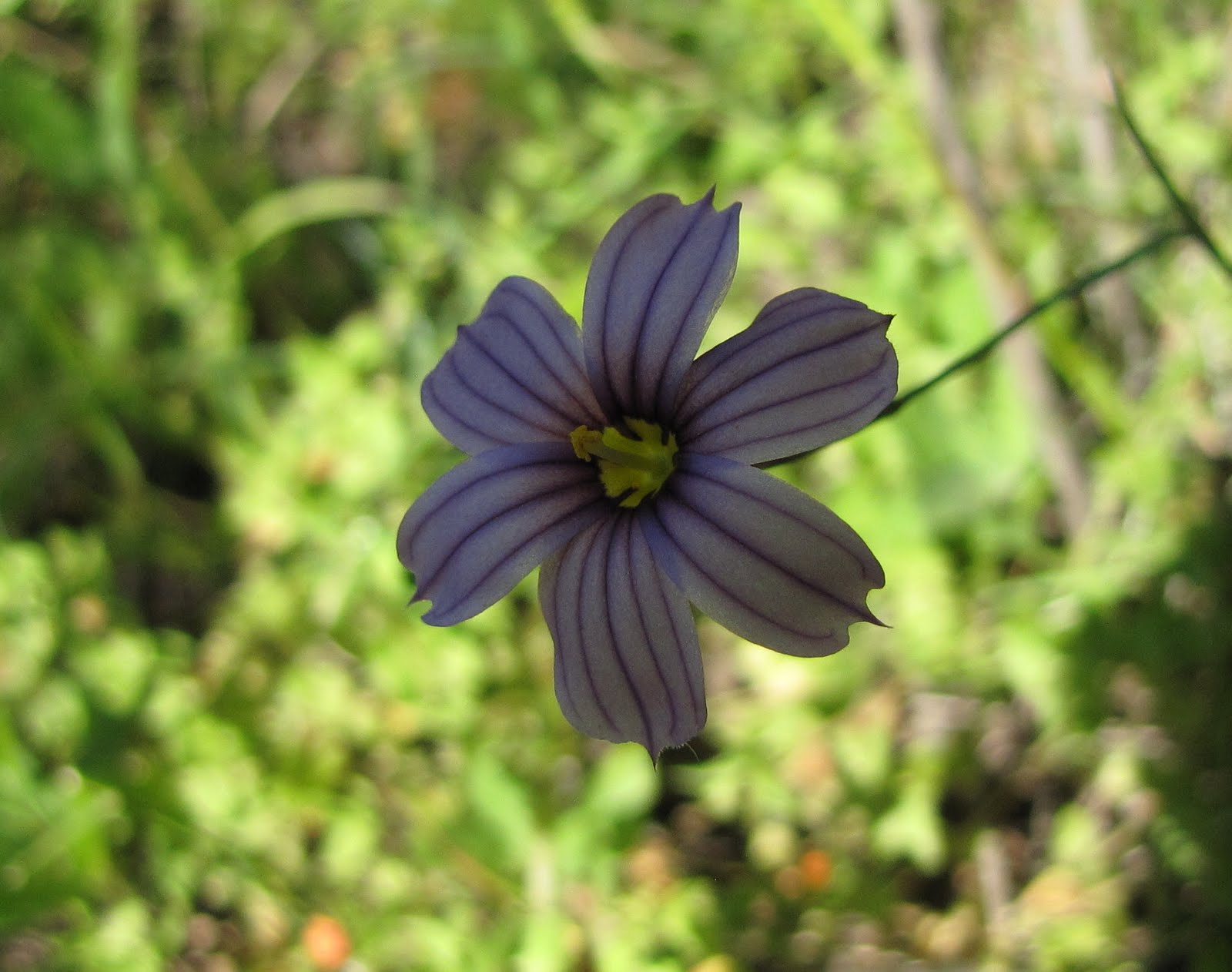
Blue-eyed Grass, Sisyrinchium bellum, is not really a grass at all, but it does have long, narrow leaves that look like grassblades. It also grows in meadow habitats. Blooming between March and May, the flowers are a composition of three petals and three sepals fused at the base. They can vary greatly in color, and probably by age. This one was pale enough that in bright sunlight I could not get a detailed image. So, I shadowed the flower in order to get the “pinstripes” to show.

Coast Paintbrush (“Indian Paintbrush”), Castilleja affinis, was also blooming. Its flowering period is generally March to May, and it occurs in drier habitats up to 3, 500 feet elevation. Paintbrushes are in the figwort family Scrophulariaceae.

I am familiar with globemallows here in southern Arizona, where they can sometimes be viewed as “weeds,” but I was blown away by the Bush Mallow, Malacothamnus fasciculatus. This perennial can grow to be a fifteen foot tall shrub! It blooms from April to July and like its relatives can occupy disturbed habitats as well as dry, pristine native niches up to 2, 500 feet.

Different flowers are to be found in the more moist, shady, wooded sections of Charmlee. The most conspicuous flower we came across there was the Canyon Sunflower, Venegasia carpesioides. The large and profuse blossoms can’t be missed. They have a long blooming period, too, from February to September.

Wedge-leaf Horkelia, Horkelia cuneata, is in the rose family, though I never would have guessed that. It is characteristic of the ecotone where the woodland meets the drier, more exposed parts of the coastal sage scrub habitat; it blooms between April and September.

Last but not least, Leafy California Buckwheat, Eriogonum fasciculatum foliolosum, was especially prominent near the park entrance and restroom facilities. It may bloom anytime between May and November. It is a favorite with some bees, including honeybees that can create a good honey from the nectar they harvest from these flowers.
There are certainly more wildflowers to be found in Charmlee and in the surrounding mountains. A good website for identifying most of them is Wildflowers and Other Plants of Southern California by Michael L. Charters. It does help to know at least what family the plant is in, however, as there is no color-coded search option for this comprehensive website.


