Showing posts with label North America. Show all posts

Friday, January 23, 2026

Creepy Cooper's, Sinister Sharpie

Last month we had two predatory birds visit our yard in Leavenworth, Kansas, USA. While they were thrilling to observe, they gave me a bit of the shivers. Cooper's Hawk, and Sharp-shinned Hawk, are both accipiters, well-known for ambushing songbirds at feeders, much to the consternation of birders. These raptors don't give up easily, either, as I learned from the two I witnessed.

Profile of a regal killer.

My first look at the Cooper's Hawk.

On December 8, at about 12:15 PM, I got up abruptly from my chair in the living room, having remembered a household chore I needed to do. Glancing up, I saw, through the open blinds over our backdoor windows, the largest bird I had ever seen in our backyard. It was an adult Cooper's Hawk (COHA if you are a fan of banding codes), perched atop the shepherd's hook from which our feeders are suspended. Since I was startled myself, I fully expected it to fly off immediately, but went to get my camera anyway.

Oh, no, it's leaving?

The bird did indeed launch itself a short time later, but merely glided to the back section of our fence, where it came to rest once again. I was delighted to get more opportunities for photos from between the slats of the blind, through the entirely too-dirty windows.

Still here!

Three minutes later, the hawk flew to another section of the fence, closer still. A minute later, it returned to its previous spot on the rear section of fence. From there it moved to the fencepost that abuts our detached garage, and beneath a non-functional light fixture. We need to have that looked at, but I digress. The bird was staring intently at the brush pile I erected to offer cover to songbirds for situations just like this one.

At twelve-thirty, the Cooper's Hawk flew onto the brush pile itself, perching low, on one of the more exposed limbs. A minute later it was back atop the back section of fence. A moment later it was on the side fence again. What it did next was unexpected.

Prowling on the ground.

The hawk flew down to the ground into our backyard. It proceded to skulk around our forty gallon, prefabricated pond, and crawl through the dense, weedy thicket that is our vague attempt at a pollinator garden.

At this point, I became unsure whether I was watching a hawk, a Greater Roadrunner, or even a weasel. The alert, thorough searching of this predator was truly remarkable.

Searching in the weeds.

At twelve thirty-eight, the hawk returned to the brush pile. This time, it dove right in, scouring every inch of the labyrinth for potential prey. Creepy. Literally. Another minute or two later, the hawk flew away for good, headed in the direction of the federal penitentiary, an embarrassing block-and-a-half to the north, beyond the back section of our fence.

Exploring the brushpile.

The whole encounter seemed to last much longer than the twenty or so minutes between the time stamps on my first and last photo. I would have expected the hawk to conceal itself in the brush pile, and simply wait for the House Sparrows, House Finches, Dark-eyed Juncos, and maybe other birds, to return to the feeder, unaware of the potential danger. Not so. This was active hunting, and it took me completely by surprise.

On December 15, just before one o'clock PM, I stepped out the backdoor to top off the feeder. A bird about the size of a dove, maybe slightly larger, rocketed out of the brush pile, nearly giving me a heart attack. Miraculously, I could tell immediately that it was another accipiter, but definitely not the Cooper's Hawk from the previous week.

I was able to follow the flight of this smaller raptor and, amazingly, it came to alight atop a neighbor's fence about thirty yards away or so. I went back inside the house to retrieve my camera.

Even more surprisingly, the hawk was still there when I returned. I was too excited, and too vertically-challenged, to get a sharp (no pun intended) photo of what I suspected was a Sharp-shinned Hawk (SSHA banding code), over three layers of fences, at distance, but I tried anyway.

Sharp-shinned Hawk.

Separating Cooper's Hawks from Sharp-shinned Hawks is a challenging exercise even for seasoned birders. You caannot use size as a reliable difference because there is overlap between a small male Cooper's Hawk and a large female Sharpie. Both species are clad in nearly identical colors, though the back of the neck is colored the same as the top of the head and back of the bird in Sharp-shinned Hawk. The back of the neck is vaguely paler in Cooper's Hawk, giving it a black-capped appearance.

In my limited experience, I have noted that sharpies, when perched, look like they have no neck at all, the head tapering immediately into the rest of the body. Their beaks are very short and comparatively delicate compared to a Cooper's Hawk.

Profile of the Sharpie.

More experienced birders note that the eyes of a Sharp-shinned Hawk are larger in proportion to the head, such that they appear to be "bulging." The tip of the tail in a sharpie is straight-edged, whereas it is rounded in a Cooper's Hawk. This last trait can be unreliable, though, or at least difficult to properly perceive.

I wish I had not flushed the sharpie, and been able to observe whether it behaved similarly to the Cooper's Hawk. Maybe I can train my brain to recall these encounters before I abruptly and absent-mindedly throw open the back door again. It could be months, if not a year or more, before we get another visit, though. I suspect the hunting territory of these hawks encompasses a pretty large area.

You are invited to share your own stories of accipiter encounters in the comments here. I moderate input at least once per week. I will try and not be envious if you have seen a Northern Goshawk on your property.

Tuesday, May 6, 2025

2025 City Nature Challenge Recap for Kansas City Metro (Vertebrates and Plants)

The City Nature Challenge is an annual event that I always look forward to, when I have no conflicting engagements. I tend to plan around it, in fact. This year’s edition was held from Friday, April 27, through Monday, April 30.

Prothonotary Warbler at Wyandotte County Lake Park, Kansas.

Some background is in order for those unfamiliar with this urban bioblitz. What began in 2016 as a friendly challenge between the California cities of San Francisco and Los Angeles has blossomed into a global project. The intent is to generate public interest in native urban flora and fauna, document as many species as possible during the event period, and build a database useful for assessing environmental trends both locally and globally.

A young Common Five-lined Skink under a chunk of wood, Wyandotte County Lake Park.

Here in Kansas City, I am fortunate that the official map area includes counties a fair distance from the city. It is mostly rural in Leavenworth County, Kansas, where we live, but the town itself is at least suburban. Heidi and I usually travel to other areas, too, like Wyandotte County, Kansas, and Platte County, Missouri.

Louisiana Waterthrush at Weston Bend State Park, Missouri.

The weather this year was less than optimal, overcast virtually the entire time, cool temperatures in the low sixties (Fahrenheit), and occasional rain. Perhaps that is why public engagement was low. The stats are still coming in to iNaturalist, the web platform that hosts the observations for the event, but we had less than 300 people who contributed sightings. As a percentage of the human population, that is pretty dismal.

Blooming Mayapple in Havens Park, Leavenworth, Kansas.

Still, there is a current total of 3,744 observatios of 1,084 species (however iNaturalist defines that term, and it probably varies by taxon). Help in identifying observations has come from 349 individuals, from all over the globe. The border of Kansas and Missouri represents the eastern fringe of the Great Plains meeting the western edge of the eastern deciduous forest, so we have some diverse and interesting habitats.

Virginia Springbeauty, Weston Bend State Park, Missouri.

Personally, given the inclement weather, I looked at plants more heavily than I usually do. It helped that I now have an iPhone that takes photos which are comparable in quality to those produced by my Canon PowerShot SX70 camera. I think it performs better than the camera in some instances.

Blue Phlox, Wyandotte County Lake Park, Kansas.

When Heidi and I went out together, we focused on birds. This was especially true at Wyandotte County Lake Park in Kansas, and at Weston Bend State Park in Missouri. Both parks are heavily forested, with a large reservoir at one, and small streams running through the other.

A flock of six female Red-breasted Mergansers was a wonderful surprise at Wyandotte County Lake Park.

I don’t like that the City Nature Challenge brings out my competitive nature, but I feel compelled to demonstrate to other local citizens that insects and spiders are worth looking at. Consequently, I had the most observations for the Greater Kansas City Metro Area, and the second highest species tally. You can find the results for everyone at this link.
Swainson's Thrush at Wyandotte County Lake Park.

It is a good thing that the nature challenge was not a week later. I went back to Havens Park here in Leavenworth yesterday, May 5, to find that a new gravel road had been laid, right through a small, ephemeral wetland, and over glade habitat at the top of the park. I am devastated and angry. Rumor has it that it will eventually be another paved trail for cyclists, dog walkers, and others. I am all for accessibility, when it does not compromise ecosystems. I don’t know that I will go back to the park now, but there is nothing similar within walking distance of our home (I don’t ride a bike, nor drive any longer, and we only have one car anyway). Pretty much everything else here is lawns.

A male Summer Tanager, Havens Park, Leavenworth, Kansas.

One thing that appears sorely lacking for the City Nature Challenge is widespread publicity. There is a wonderful team of individuals at the Los Angeles County Museum of Natural History that organizes the event each year, but they can only do so much. They have to register cities, for example, which is a demanding chore all by itself. It is up to the individual metropolitan areas to do their own marketing.

A male Northern Parula at Wyandotte County Lake Park, Kansas.

Did you participate this year? Have you done so in years past? Please feel free to share your experiences in the comments. Meanwhile, you can find my insect and spider observations from City Nature Challenge over on my Bug Eric blog.

Monday, October 2, 2023

Not How I Expect to Get Life Birds

Better birding through climate change? Is that where we are at now? A few weeks ago, when it became clear that hurricane Idalia had flung Caribbean Flamingos (aka American Flamingos) far from their regular haunts, I generated one of those Facebook “marked himself safe from” memes for the wayward birds. It was a joke at the time, because it still seemed unlikely that one would show up anywhere near us here in Kansas, USA. I was wrong. My experience yesterday causes me to reflect today on what my expectations and responsibilities should be when it comes to the welfare of other species.

My partner, Heidi, is an avid birder, and keeps a close eye on rare bird alerts, and what is being seen in general within reasonable proximity to our home in Leavenworth, Kansas. Earlier in the week she learned of a Caribbean Flamingo being observed at Chase State Fishing Lake near Cottonwood Falls, in the Flint Hills of Chase County, Kansas. This information came in Thursday. Since Heidi works at an elementary school, we would not be able to travel the two-and-a-half hours until Saturday. The bird had been spotted closer to us on Wednesday, at Smithville Lake in Missouri, so we expected it to keep traveling.

Stiff and persistent winds from the south over the next two days may have deterred the flamingo from flying, and sure enough we received confirmation it was still at Chase State Fishing Lake on Saturday morning. Near record high temperatures may have helped to make it feel somewhat at home, too. It had been observed feeding in the shallows, treating what we would imagine as an otherworldly experience with a surprisingly casual attitude.

The irony of “chasing” the bird in Chase County did not escape us. Once we arrived, I found myself asking the few other birders which of them had come the farthest, themselves or the flamingo. At least one individual had driven seven hours from Illinois. Others were from Manhattan, Kansas, Wichita, or from Missouri.

More to the point, there is the question of our respective carbon footprints in reaching the bird. Are we not contributing to the very problem that spawns megastorms, or at least increases their frequency? Where do we draw the line on what is an acceptable distance for such a (fools?) errand? It is surely a matter of individual choice, but what informs our decisions?

An article in USA Today gave some interesting historical background into the residency and distribution of the Caribbean Flamingo, and it turns out that records of “stray” birds date back decades earlier. Ornithologists believe that all the birds being sighted now, far from Florida, originated from the Yucatan Peninsula in Mexico. This speaks to the remarkable durability of these seemingly delicate animals.

One can view these events in one of two ways. They can be symptomatic of cataclysmic changes to global climate, or emblematic of the ability of organisms to adapt to those changes. Thanks to improving technologies, and an increasing public awareness and appreciation of birds and other animals, we are rapidly gaining insights into shifting behavioral patterns in response to climate change and habitat fragmentation. That is a good thing.

What I find myself asking today is whether I can be content to stay out of the fray, to be satisfied viewing the images of others on social media. Can I simply live vicariously through observations on iNaturalist? Those people certainly have better photography skills and equipment. As it stands, I will likely resist airline travel, knowing what I know now.

What are your thoughts on all of this? There are no right or wrong answers, and I am not asserting personal “holier-than-thou” principles. I enjoy meeting others who are passionate about the natural world and advocate for its protection. Rare instances like this can generate renewed hope, broaden one’s circle of friends, and otherwise be exceptionally positive experiences. Heidi welcomed the opportunity to share views through her spotting scope with others, especially children, yesterday. Let us rejoice in another’s wild encounters, learn from them, and look forward to crossing trails with each other.

Wednesday, November 21, 2018

Kudzu Ate The Off-ramp: A Brief Visit to Tennessee

View from Roan Mountain

Over the river and through the woods, our Garmin has gone astray....No, seriously, in Roan Mountain State Park, the GPS had us traversing the forest on the other side of the stream instead of the perfectly good road we were actually on. Such is life in east Tennessee, but well worth the effort you put into making it a destination.

My wife and I found ourselves there as a result of a conference she was attending in Knoxville. I had to occupy myself while she was at the gathering, but we took an extra few days together in truly rural east Tennessee afterwards. We can now attest to the legend that is southern hospitality, and are likely to return for further explorations if we can avoid the tourist traps, which are equally legendary, from Gatlinburg to Dollywood.

We arrived by plane on a Sunday, got the rental car, and headed into downtown Knoxville, spending the whole ride trying to find something other than an on-air church service over the radio. Good luck with that. Our trusty GPS guided us to at least two restaurants that were closed, so we finally just parked (for free on weekends) in a big lot and set out on foot. We settled on The Crown & Goose, a well-patronized establishment, practically an institution if you ask around. The hostess greeted us by welcoming us to the restaurant's last day of existence. I wish I were making this up, but it was true. The place was closing to make way for part of some much larger development on the horizon. I think I recall something about a new sports complex and entertainment district, the kind of thing that often signals the death knell for local businesses in favor of chains.

We learned of this by striking up a conversation with another couple, their son and ("hopefully") soon-to-be daughter-in-law. We were all enjoying the warm sun outside while waiting for seating inside because despite the sun it was pretty chilly. You cannot say that about the people, though, as everyone is warm and friendly and will talk to you like they have known you all their lives. This stereotypical aspect of the south is most welcome, and something other regions should strive for. Sure, it was a Sunday, and just about anyone is more laid back on the weekend, but still.

Volunteer Landing, downtown Knoxville

Downtown Knoxville is perhaps not quite as vibrant as some city centers, but you will not go hungry or lack for entertainment, or visual stimulation thanks to the mix of history and architecture and public art. Nothing is overwhelming, and it says great things about the city that they are not prone to overstatement....except for the University of Tennessee. Lots of orange, lots of orange, but I digress. I thought my hometown of Portland, Oregon was clean, but Knoxville, and for that matter every other place we went, may get polished daily. I remember maybe one piece of litter in over a week, and given my tendency to spy trash while looking for birds and other wildlife, that is saying something. Other cities bent on beautification projects should put Knoxville on the "must visit" list.

U.S. Courthouse, downtown Knoxville

It is virtually impossible to find fault with anything in east Tennessee. I mean, I got nothin'. Seriously. You have to have been a long-term resident to have complaints, and they do have complaints, mostly about traffic and construction, and sometimes disrespecting human and natural history in their haste to put up a new housing development or something. Gentrification is an issue everywhere, and apparently the Knoxville area is not immune. Ok, we were there during an election cycle, and politics are ugly there, too, judging from the campaign advertisements.

Farther afield, toward Johnson City and more rural hamlets, you might not be able to get a quorum to reach a consensus of complaints. Unless and until you stop in at a diner, it is easy to imagine that everyone is on their own up in the hills and hollers. Abandoned houses, barns, and outbuildings are quickly overwhelmed by kudzu, and I can only wonder what would happen if you didn't leave your home for a couple of days. Would you still be able to open the front door? No matter, the locals no doubt turn every obstacle and negative event into a running joke. You just get that vibe that there is nothing that can't be overcome with a little ingenuity and a lot of laughter.

Blackberry Blossom Inn, Unicoi

Tuesday, April 3, 2018

The Eagle and the Flycatcher

Taking to the road in search of birds is usually a rewarding, relaxing experience, but sometimes it can be a roller-coaster of emotions. Such was the case on April first when my wife and I set out over the plains east of Colorado Springs in mid-afternoon to take advantage of a sunny, cool, day. We had no idea what was in store for us.

More on him later

We drove south down Interstate 25, and took the exit for Hanover Road, as we have done countless times. We quickly got one of our target birds, our first Turkey Vultures of the year for El Paso County. A whole kettle of them was circling over fields adjacent to Fountain Creek. The rolling shortgrass prairie here is studded with cholla cacti, which are sometimes so thick as to create a stubby forest of the spiny succulents.

Farther out on Hanover Road we saw a vehicle pulled over on the shoulder, and a woman looking at what first appeared to be a chunk of retread from a truck tire. We slowed, and I noticed that the rubber debris had feathers. "Oh, wow, that's and eagle" I said to Heidi, and we pulled over ourselves. Walking back, I greeted the woman and asked if she was a wildlife officer or someone assigned to pick up deceased raptors. She said no, she lived in the area and had seen the Golden Eagle flying in this vicinity earlier in the day. She had found it in the middle of the road, as indicated by residual downy feathers still adhered to the pavement by dried bird blood. She had placed the corpse where it now lay.

Maybe my coping mechanism for tragedies like this is to immediately begin thinking of how to make the best of a bad situation. It was an adult bird, as I could best determine by lifting a wing and finding no white patch like the juveniles have. We hoped it was not on a nest, but at this time of year that is a distinct possibility. This was a freshly-killed bird, no rigor, though it had clenched talons on one foot.

Note: Possession of a dead bird of prey, especially an eagle, or even its feathers, is a federal offense. Taking the bird ourselves, even with the best intentions for depositing it, was not an option. Ever the quick-thinker, Heidi suggested we call a friend who has experience with this kind of thing. Miraculously, out in the middle of nowhere, we had a cell phone signal. I dialed our friend and luckily she picked up. She promised to do her best to track down a state official to go and fetch the body. She would call back with a verdict one way or the other. My phone did not ring. Heidi found she did have a voicemail message, and we listened to that. Success! There was no Colorado Parks & Wildlife person on duty, but the state police would find someone and we would get a call from whomever it was.

A couple minutes later my phone rang and an off-duty officer was on the other end. We described our location, even with GPS coordinates thanks again to Heidi, and he told us it would take him at least twenty minutes to get there. Bear in mind this is Easter Sunday. I told him we would wait....

Surprisingly, traffic was not entirely absent from this rural stretch of two-lane road, and we wondered if each approaching vehicle was "the guy." Most cars and trucks barely slowed, some rushing past at speeds well in excess of the posted limit. That might explain the dead eagle, and I wondered to myself why no one bothered to ask if we were broken down. Check that, one older gentleman in a pick-up did pull up next to us to make sure we were all right.

About thirty minutes after my phone conversation with the wildlife officer, another truck, approaching from the opposite direction we expected our hero to come from, slowed down and pulled a u-turn behind us. I asked if he was here for the bird and he confirmed it, displaying his badge upon exiting his vehicle. He had brought his wife with him. She is even more experienced with birds than himself, he informed us. So began "CSI: Ornithology."

One thing that puzzled us all was that the entire tail of the eagle was missing. The wildlife officer suspected that someone had yanked the tail feathers, which are prized in Native American cultures for ceremonial dress and rituals. There was a blood trail. More feathers on the other side of the road, but the bird's wings appeared to be almost undamaged, so there was another head-scratcher. Examining the carcass revealed just how extensive the damage was. A broken leg. Massive injuries where one wing joined the body. The blood on the bird's hooked beak could well be its own.

Much to our surprise, another birder friend of ours pulled up, having recognized us and being curious as to what all the commotion was about. She greeted us warmly but quickly breathed a sigh of sorrow at the reason for our roadside gathering. As we wrapped up our crime scene investigation and climbed into our car, Heidi told me that our birder friend was returning from seeing another spectacular bird, this one still living, just down the road.

"They saw a Vermilion Flycatcher?" I asked incredulously. Yep, a male, too. This is a pretty common bird....in southeast Arizona, along the Rio Grande, and the Gulf Coast. This far north? Not so much. The bird was hanging out behind the fire station in Hanover. It had been there pretty much all day. We arrived to find one of Colorado's foremost birders on hand with a spotting scope, dutifully pointing out the bright red bird to the steady parade of "chasers" who flocked to the location for their own viewing pleasure. This gentleman is absurdly generous with his time. He has more patience than a saint.

Heidi and I could have had a supremely awful afternoon had our most memorable experience been coming across that eagle. We owe it to friends, and the bird gods, for providing us with an exhilarating "upper" to end our day. No one promises that pursuing your passion is always going to be a positive thing, but if you do the right thing in the face of the worst circumstances your favorite pastime can deliver, then you will still be rewarded. It may not always turn out the way our Easter excursion did, but you can at least sleep well in the aftermath.

Wednesday, January 11, 2017

Letters to....Colorado Parks & Wildlife Re: Predator Control

Our Colorado Parks and Wildlife have recently made public a plan to hunt bear and mountain lion in select areas of the state in an effort to increase populations of deer for hunters. The period for public comment is apparently still open and I took it upon myself to draft the following letter to the commission at dnr_cpwcommission@state.co.us. I encourage others to make their voices heard as well.

Dear Commissioners:

I hope this comment in opposition to the proposed predator control strategy for bear and cougar does not come too late in the process.

While I support the hunting of game animals, and understand the occasional need to put down a "nuisance bear" or other individual predator, I am vehemently opposed to hunting non-game wildlife otherwise. It is my opinion that we do not have adequate knowledge of predator populations to ensure that hunting would not cause undo harm, not simply in decreasing populations beyond a viable threshold, but also by weakening the gene pool. This may already be happening with game animals because human hunters tend to target the healthiest, most robust specimens while natural predators go after weak, diseased, elderly, and young prey.

Secondly, for better or for worse, the cat is out of the bag, so to speak, in terms of our current understanding of the biology of predators. Research by state and federal agencies, universities, and private organizations and individuals has revealed these animals to be far more complex and admirable than previously recognized. Documentary filmmakers have turned public sentiment in favor of fostering populations of predators. Whether or not you decry anthropomorphism, you have to recognize that the public is now going to oppose hunting predators in most instances. In fact, there is widespread support for increasing predator populations to balance what is seen as a surplus of deer, elk, and other prey species.

The idea that predator control is necessary for deer and other game animals to prosper has been disproven time and again since the days of Aldo Leopold and his land ethic. I know that I am not saying anything you do not know already, I respect your individual and collective intelligence, knowledge, and experience. However, we have reached a point in history where politics no longer has a place at the table.

Hunters may have a strong lobby, but that does not mean those who pursue wildlife in a non-consumptive fashion to watch, photograph, paint, and otherwise take away experiences that do not involve killing an animal, do not have rights as well. They are simply not as organized, in many cases not as wealthy, and are certainly a lot less quantifiable. This does not mean their numbers are small, or their voices should be ignored. I am quite confident I speak for hundreds if not thousands.

The one case you could make is that aside from state park fees, and tax check-offs, wildlife "watchers" pay little towards conservation and management. I am certainly open to help crafting ways to change that so that we are helping instead of complaining and otherwise responding without participating in a material fashion.

Thank you for your attention and consideration of the points made above.

Sincerely,
Eric R. Eaton

This is a $4.5 million plan that will be executed in the Piceance Basin and along the Upper Arkansas River, involving trapping as well as shooting puma and Black Bear. There is no question there is a disconnect between rural residents (and hunters) and urban populations in how each view predators. Those who make their livelihood "in the woods" and on ranches deal with real, live predators on a regular basis, with real, live consequences. City-dwellers are mostly exposed to carnivores in television documentaries and at the zoo. Predators tend to be an abstract concept from the safety of your living room or from the safe side of a fence or moat.

We need to start a dialogue between all public and private stakeholders before situations like this arise that needlessly pit one group against another.

Friday, September 9, 2016

Frack Off

© Propublica.org (Canada)

I was already aggravated by the incessant television commercials here in Colorado that are promoting fracking, a method of natural gas and oil extraction that uses pressurized chemicals to fracture bedrock in order to "free" the desired natural resource. This week, we get Gale Norton (yes, that Gale Norton) stumping for Protect Colorado, the greenwashed front for the oil and natural gas industry. This raises my degree of ire even higher.

Gale Norton is the former Secretary of the Interior. You heard me correctly, this woman once oversaw the National Park Service, BLM, and other public land management bodies. Even when she was appointed by George W. Bush to serve as the 48th Secretary of the Interior (2001-2006), her ties to the energy lobby elicited vocal criticism.

She also served as Colorado's State Attorney General, 1991-1999, and has returned here where she is apparently her own corporation, Norton Regulatory Strategies. She also served as general counsel to "Royal Dutch Shell Unconventional Oil, 2007-2010. She was a member of Shell’s global legal leadership team, and handled legal, regulatory and governmental issues for Shell’s oil shale and in-situ oil sands projects, primarily in Colorado and Alberta." That according to her Norton Regs website.

Norton has managed, successfully, to greenwash herself, masquerading as someone who truly cares about the environment and sustainable energy, thanks in large part to her former employment overseeing public lands. No wonder Protect Colorado finds her to be such a perfect spokesperson.

Understand that we are treated to at least one pro-fracking television commercial in prime time every single night. It is the industry's right, of course, to exercise their free speech. They are paying handsomely for the chance to broadcast their message, but that is exactly my point. They can afford to make their case publicly, night after night. Not so for any group opposing them. Just because you are the loudest voice, doesn't mean you should be the only voice.

It is common courtesy to allow both sides to have their voice in debate of an issue. In my opinion, it should be the law. On issues as contentious as this one, both views should be granted equal time to make their case. This is also why the Supreme Court case of Citizens United needs to be overturned. The essential outcome of that decision was the "money equals free speech" doctrine that now dominates public discourse, certainly skewing the course of said discourse.

Advocacy groups involved in issues of free speech need to brainstorm another way to circumvent Citizens United until we get a constitutional amendment stripping corporations from the overwhelming advantage they have in the court of public opinion on issues like fracking that threaten public and environmental health.

Can you imagine where we would be today if oil and natural gas corporations were not so greedy in pursuit of profit, seeking from day one the elimination of competing, renewable, energy industries like solar and wind? It isn't just energy, either. The automobile industry has steadfastly opposed funding for public transit, while garnering huge government subsidies and outright bailouts. The cotton, pulp and paper, and plastics industries have all convinced us that hemp is a drug threat needing regulation if not prohibition, when in reality hemp is nothing but a more durable and preferred alternative in the manufacture of products from clothing to acid-free paper.

Back to Norton and her spokesperson role. We have apparently not yet graduated as a culture from the era of snake oil salesmen and other con artists. In fact, we are now appointing them to office and allowing them to swindle our faith in those who govern. It is up to us not only as consumers, but as citizens, to do a background check on those who purport to have our best collective interests at heart.

Saturday, February 27, 2016

Land Swapping in the Springs

A proposed land swap is in the works between the City of Colorado Springs and the Broadmoor Hotel. The following is my personal assessment of the deal based on my own experiences with the parties involved.

Full disclosure: I have been interacting with the City Parks department and Trails and Open Spaces Working Group to try and get a large parcel of land in my own neighborhood designated as an Open Space. I have found department personnel and committee members to be very receptive to citizen initiatives; and I have nothing but good things to say about them.

Unfortunately, I have no nice things to say about the Broadmoor, which is owned by the Anschutz Corporation, a large conglomerate headquartered in Denver. Since I have lived here, the Broadmoor has demonstrated nothing but arrogance, bullying, and whining when it doesn't get its way.

The company put its name on the World Arena, a venue for many entertainment acts and sports events. "World Arena" was a fine name all by itself, if you ask me, and everyone knew the Broadmoor before that publicity anyway.

The Broadmoor later exerted leverage to essentially turn the public Bear Creek Regional Park into its own private trail-riding club. The kicker here is that the Broadmoor already owns riding stables up on Cheyenne Mountain. Neighborhoods around Bear Creek fought back, and the idea has been tabled.

When the Broadmoor does not get what it wants, it often throws editorial temper-tantrums in the Colorado Springs Gazette, which....surprise, surprise, is also owned by the Anshutz Corporation. Gee, I wonder how critical that newspaper is going to be concerning the proposed land swap.

City and county officials paint a glowing picture of this land exchange proposal, consistently repeating how the City is getting more acreage than the Broadmoor wants in exchange, and at how the property being acquired is worth more than what is being sacrificed. We are assured that this will make all the trail connections seamless now, with any future extensions much easier to carry out with the new rights-of-way.

Were it not for the Friends of North Cheyenne Cañon, and the recently-created Save Cheyenne, we would not know what we stand to lose in this transaction. Locals know the 189-acre parcel slated to be turned over to the Broadmoor as "Strawberry Fields." I'd never heard of it, but many people who are long-time residents haven't, either. It may be the most scenic piece of real estate in the Front Range foothills, and perhaps the closest thing to true wilderness this close to the city.

Aside from my contempt for the Broadmoor, I have two additional concerns. The City puts an overwhelming emphasis on "active" recreation, which I prefer to call "speed recreation" since it mostly means trail runners and mountain bikers. One "perk" of the land swap being touted by the City is that the trade will still preserve access to Hully Gully, an ice-climbing route. The City would also get to finally claim the "Incline," a nearly mile-long, almost vertical (2,000 ft. elevation gain) staircase of railroad ties that is immensely popular with the athletic crowd.

What about those of us who like to hike leisurely, without being run over by runners or mountain bikers? In fairness, the majority of mountain bikers I have encountered are conscientious, and observant, and will stop if they see me taking pictures of a bird or something. Some are even genuinely interested in what caught my eye. Still, there are those blind curves where cyclist and pedestrian risk colliding. And then there is the erosion issue.

Lastly, I am unaware of any natural heritage inventory to inform us as to what may be compromised in terms of natural resources should this deal go through. The Broadmoor has thusfar not declared what developments will happen on the Strawberry Fields property, or where they would happen. There is the promise of a picnic shelter where the Parks Department can conduct fundraising events free of rental charges. The Broadmoor may or may not want stables and a riding arena. They will certainly build equestrian trails for their use only.

My bottom line is that I would really, really hate to see Strawberry Fields become yet another playground for the wealthy, forever closed to those who cannot afford to visit. Further, enacting this plan would continue the practice of the Mayor and City Council putting the interests of corporations and wealthy individuals ahead of the public good. You have a chance to make your own voice heard via an online response form at Speak Up! COS, but there is not a lot of latitude for "freestyle" comments, and you have to create an account to participate. Still, I recommend it.

Sources:Hazlehurst, John. 2016. "Broadmoor land swap proposal divides southwest neighborhood," The Colorado Springs Business Journal

Tuesday, January 5, 2016

The Malheur Incident

Imagine my dismay to learn, while trying to spend quality time with my spouse's family, that one of my favorite places on the planet is being occupied by an armed militia in apparent retaliation for a perceived unjust jury sentence for ranchers convicted of arson. There is so much conflicting information, and such visceral reaction to this incident, that it is difficult to know where to start. I can only speak for myself, so here it goes.

© Bev Wigney

I have visited the Malheur National Wildlife Refuge a handful of times. It is located in extreme southeast Oregon, and is so remote that it is a long haul from anywhere. The Center Patrol Road is just about guaranteed to give you a flat tire every time you drive it. Still, it is worth the effort and trouble to go. The birds and other wildlife are astounding in their diversity and abundance.

Malheur NWR hosts a wide variety of birds like White-faced Ibis and Great Egret
© Bev Wigney

My gut-level reaction to hearing of the takeover of the (at the time vacant) headquarters building was "Get the hell off of my refuge!" It is, of course, your refuge, too, but thanks to this "protest," the refuge is closed until further notice. You are being deprived of your right to visit a public facility paid for with your tax dollars.

Refuge headquarters contains instructive dioramas like this one....
© Bev Wigney

That, I believe, is the essence of this whole conflict. The protest is selfishly motivated, hostile, and pits private interests against the public good. This is not what I would classify as domestic terrorism, yet, but there are better ways to publicly appeal a court verdict, if that is what this is really about, and certainly better venues. This is only the tip of the iceberg, though.

....and fragile, historically important collections like these eggs
© Bev Wigney

The uneasy truce between the Bureau of Land Management, U.S. Fish and Wildlife Service, U.S. Forest Service, and other federal agencies and private landowners is our current American model for averting what is known as the "tragedy of the commons." This principle dates back perhaps to Aristotle, but certainly to English economist William Forster Lloyd in 1833. His pamphlet was the genesis of the recognition of the potential for abuse of common resources. It was ecologist Garrett Hardin who popularized the term "tragedy of the commons" in 1968 in his essay of that title in the journal Science.

The gist of the argument is that when access to a common resource, such as a cattle pasture, is granted to several stakeholders, each person will act in their own best, short-term interests, such as increasing the number of their own herd. This leads inexorably to the deterioration of that resource.

It can be argued that the leasing of federal lands to ranchers for cattle grazing has prevented irreparable damage to rangeland as a whole by expanding the acreage available for grazing. This is not without consequence, naturally, and success hinges on the cooperation of lessees in the proper, agreed-upon management of the resource.

Violation of laws regarding burning of invasive plants led to the charge of arson when a burn on private land expanded into public land. That much seems to be acknowledged by both parties involved here. What happened in the aftermath is debatable. Here is one side's argument. I would hesitate to call the occupation of refuge headquarters "civil disobedience." It is anything but civil, especially when guns are involved.

It should be noted that your taxes dollars also subsidize the grazing of privately-owned cattle on public land....and at a fraction of the cost a private landowner would charge for grazing. See this story for more about the great deals ranchers get as part of our "socialist" government practices.

The folks holed up in the refuge headquarters building are not terrorists. They are mostly whining cry-babies with guns who think they are getting a raw deal when in fact the feds bend over backwards to appease them. They are hopelessly confusing their "rights" with the privilege of using federal lands for private gain. Yes, ranching is a risky business, but a minority of ranchers do not wish to assume any risk. It is telling that not one of the local communities near the refuge has come out in unanimous support of what is happening. Those engaged in this misguided occupation are clearly extremists.

© Bev Wigney

Do governments have all the answers when it comes to managing resources like rangeland? Of course not. But this kind of behavior threatens to backfire. I can see a day when an incident like this results in the revocation of grazing permits for individuals who participate in unlawful protests; repossession of equipment purchased with government loans; and even more "aggressive" government expansion of public lands as these protestors accuse the feds of doing already. Frankly, at this point, I'd be all for it.

Friday, May 3, 2013

Prospect Lake

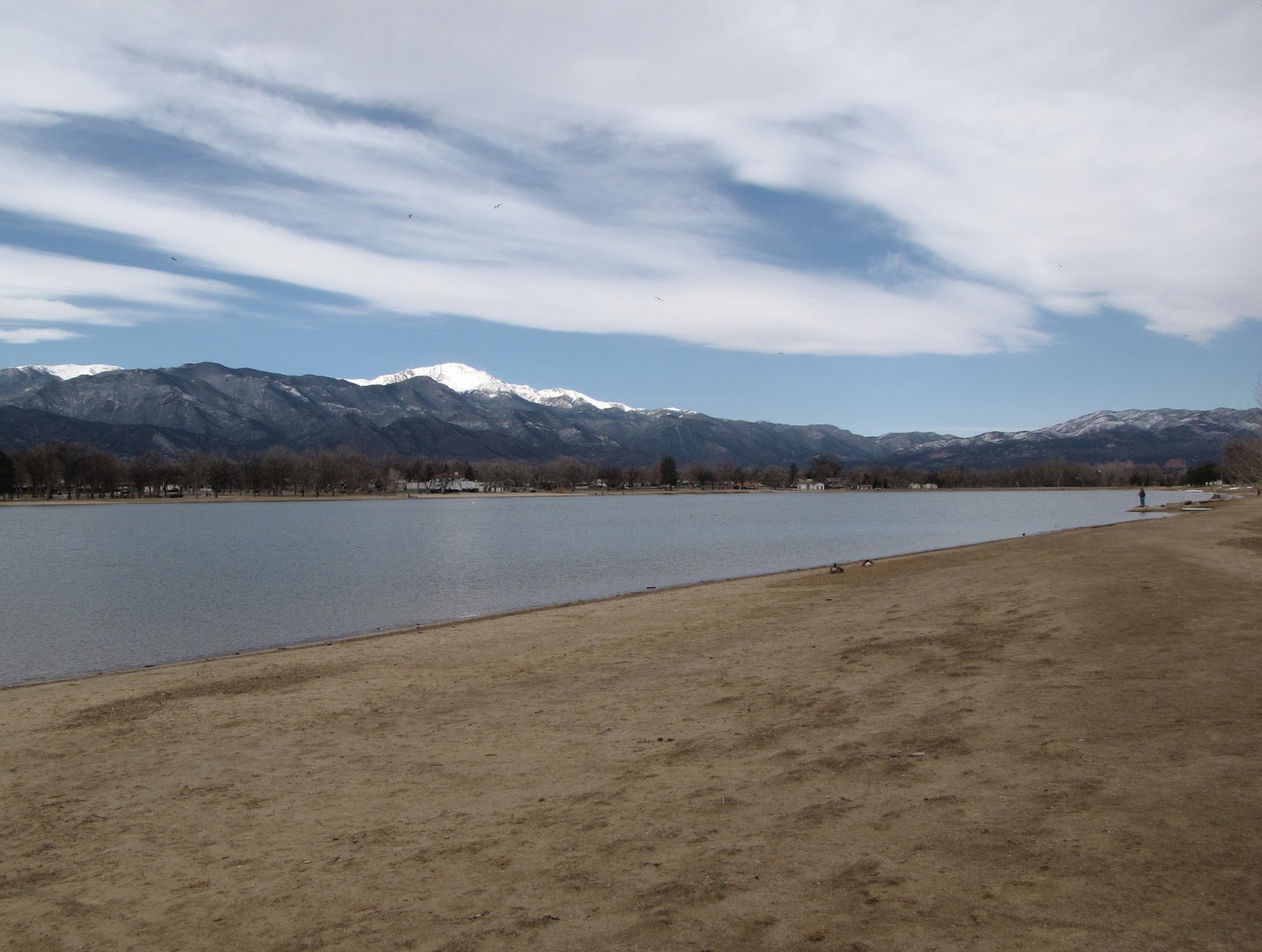
I had dismissed Prospect Lake in Memorial Park as just another fake lake in the urban landscape, not worth my time if I wanted to find any wildlife other than Rock Pigeons or European Starlings. Thanks to a Facebook group for the Colorado Field Ornithologists, I found out my assumptions had no validity whatsoever.

About the middle of last month, posts to the group included sightings of the most improbable birds you could imagine: American Avocet, Mountain Bluebird, even American White Pelican. Grebes of at least four species were common. There were pictures of several species to back up the claims.

It is embarrassing to admit that Memorial Park is only about three miles from my home, near downtown Colorado Springs. Yes, Prospect Lake is a large, artificial reservoir, dutifully stocked with trout for fishermen, and with boat ramps to facilitate water skiing, but the water level is low right now, and the boathouse is not yet open for business. I should have paid closer attention.


American White Pelicans

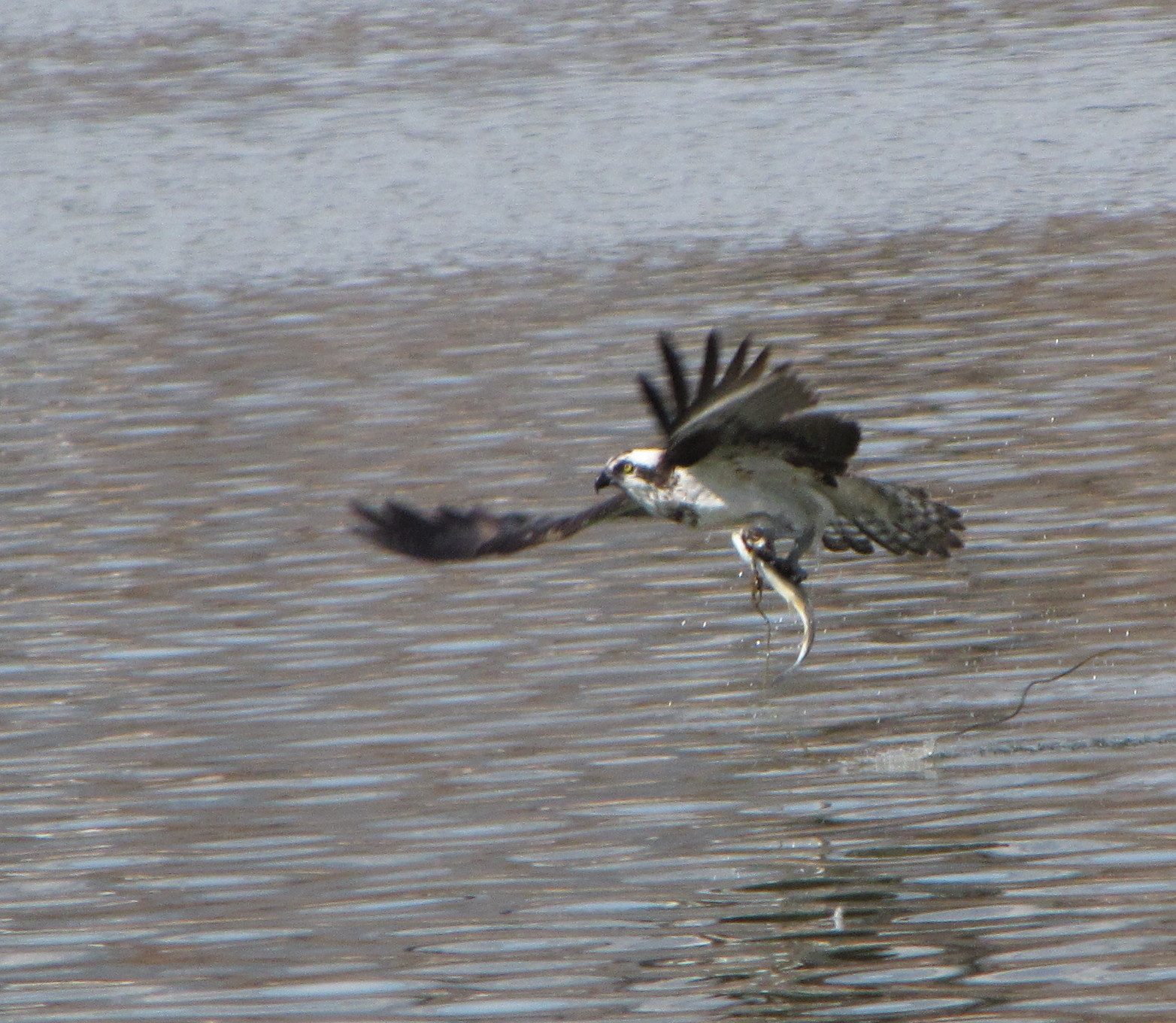
After reading the posts to the ornithology group with my jaw on the floor, I decided I needed to see for myself all the bird diversity. Apparently, on April 19, I was one day too late for the midge hatch that had attracted the large number of birds the previous day. I was still impressed even so. The pelican flock was still there, plus more waterfowl and gulls than I could count. At one point I counted six Ospreys in the air at once. It was like they were lining up and taking turns at the trout….at least until the Bald Eagle showed up and frightened everybody else away.

The land that is now Memorial Park was donated to the city by General William Jackson Palmer in 1890. Prospect Lake was excavated shortly thereafter. Initially, the reservoir was used to supply water to the Evergreen Cemetery, but that need expired in 1950. The water that fills the lake is extracted from the nearby Fountain Creek, a local watershed. A Naval Reserve station occupied the southwest corner of the lake from the late 1940s until the late 1980s. Plans to turn the entire lake over to naval training exercises in 1950 were thwarted by locals who enjoyed recreating on the rest of the lake. The Colorado Springs Fire Department used the armory for training after naval training facilities moved to Fort Carson, but after 2001 all the buildings were abandoned and demolished.

The lake began losing water at a high rate in 2002 when the pipeline supplying the lake was shut off, a severe drought was happening, and the liner for the lake became torn. A movement to add Prospect Lake to the National Register of Historical Places was successful, and spurred action to replace the liner. The lake was refilled and again stocked with fish in 2005, and it remains a vibrant center of recreation today.

The lake is surrounded today by playgrounds, including the state-of-the-art “Swing High” totally accessible playground, plus lawns, ornamental pine, cottonwood, and other trees, ballfields, residential neighborhoods, and commercial real estate. Despite all the hustle and bustle, birds seem to enjoy the area, at least in migration this year.

My own trips to the park on April 21, 26, 27, and 29 yielded a combined tally of the following species:

  1. Mallard
  2. American Wigeon
  3. Blue-winged Teal
  4. Northern Shoveler

    Northern Shovelers
  5. Lesser Scaup
  6. Redhead
  7. Bufflehead
  8. Ruddy Duck
  9. Canada Goose
  10. American Coot
  11. Pied-billed Grebe
  12. Horned Grebe
  13. Eared Grebe
  14. Western Grebe

    Western Grebe
  15. Clark’s Grebe
  16. Double-crested Cormorant
  17. American White Pelican
  18. Ring-billed Gull
  19. California Gull
  20. Franklin’s Gull
  21. Osprey
  22. Bald Eagle
  23. Cooper’s Hawk
  24. Great Blue Heron
  25. Great Egret
  26. Killdeer
  27. American Avocet

    American Avocets
  28. Spotted Sandpiper
  29. Lesser Yellowlegs
  30. Willet
  31. Wilson’s Phalarope
  32. Rock Pigeon
  33. Belted Kingfisher
  34. Downy Woodpecker
  35. Northern Flicker
  36. Tree Swallow
  37. Violet-green Swallow
  38. Say’s Phoebe
  39. American Robin
  40. American Pipit
  41. American Crow

    Osprey
  42. Black-capped Chickadee
  43. White-breasted Nuthatch (heard)
  44. Yellow-rumped Warbler
  45. European Starling
  46. Common Grackle
  47. Brown-headed Cowbird
  48. House Sparrow
  49. Chipping Sparrow
  50. Lark Sparrow
  51. Savannah Sparrow
  52. Dark-eyed Junco
  53. House Finch

I am a novice birder, and I know other species were seen, and have been seen since. Warblers, for example, are only now starting to appear. It just goes to show that you can still be surprised by nature close to home. Really, really close to home.

Sources: Galas, Judith, and Cindy West. 1997. Walking Colorado Springs. Helena, Montana: Falcon Guides (Pequot Press). 233 pp.
Tankersley, Teila. 2010. “Some Interesting Pieces of Trivia on Prospect Lake in Colorado Springs,” Fresh Ink