Showing posts with label flora. Show all posts

Friday, May 15, 2026

Guest Post: Letting Habitat Restore Itself

It is a rare occasion when I invite someone to guest post here, but when I read the following social media post by Justin Thomas, I knew I needed to share his message formally. I will have a few comments at the end, but here let us first hear his experience, without edits.


”Here are the woods by my house near Springfield, Missouri, USA, after six years of doing absolutely nothing but letting nature order itself over time.

© Justin Thomas, May 9, 2026, 6:05 PM.

A brief history: This is the crest of a north facing slope that drops off dramatically in the background (photo facing northwest). The road you can see is called "Bluff Drive," because of the steep slope. To the south the hill flattens for 60 meters or so and then becomes a large flat grown over field. The field was obviously plowed historically and the woods, on the edge of the field, were cut-over, but not likely ever plowed. The earliest aerial photography I've seen is from the early 1960s, and the woods between the road and the field (the woods in the photo) had begun to grow back and are now some of the oldest woods within many miles. They were probably grazed until the mid-1970s when the houses on this dead-end street (now a mile outside of city limits) were built.

The woods are largely early successional trees like Black Walnut and Hackberry that germinated after the grazing and probably brush-hogging, or Euro-American burning. There are also large Black Oaks, Maple-Leaved Oaks, and Chinquapin Oaks that are likely sucker sprouts from the stumps of the original woods, or sprouts from the stumps of the sprouts of an earlier cut, that though the same size as the early successional trees, are decades older. This last point is important because though there are big oaks, they are not yet colonizing, nor can they because the damaged system is not what they colonize into. Still, I suspect in the next 20-30 years, left to their own devices, they will recruit back into the system.

© Justin Thomas, May 7, 2020, 6:07 PM.

The woods in the above photo (taken in 2020) are full of Buckbrush, Missouri Gooseberry, Clustered Black Snakeroot (Sanicula ordorata), and little else. These are hallmark species of former grazing, especially in woods. My family and I moved onto the property in 2016 and I immediately expressed my desire, my NEED, to get in and cut all the Buckbrush in order to open the woods for floral diversity. My wife asked me to leave enough to maintain the privacy it provided us and our neighbors. That's how thick it was. I was too busy and, let's face it, too lazy, to ever do it.

Turns out laziness has many rewards. In the spring of 2020, and the reason I took the photo, I noticed that there was less Buckbrush and Gooseberry than the year prior. Over the next couple of years that decline increased substantially every year. Six years later the Buckbrush, Missouri Gooseberry, and Clustered Black Snakeroot are almost completely gone. As these short-lived shrubs died of old age, and minus any further ecological damage that would allow their seeds to germinate and replace their parents, slowly more and more sedges, grasses, and forbs colonized the woods.

Let me rephrase that, because the sedges, grasses, and forbs were already there, just at very low densities (as is usually the case in such places). What I should have written was: as the woods became less suitable to Buckbrush and Gooseberry it became more suitable for the sedges, grasses, and forbs that had been eking out their existence at very low densities in the micro-scale nooks and crannies that had not been highly impacted. These kinds of population lulls also afford many species an escape from pathogens, so when they do have the opportunity to recolonize, their metabolisms are more geared toward reproduction than defense.

While this was going on, young saplings, and some larger trees that were suppressed under the larger trees, also could not maintain their metabolic needs and they died. This further opened the canopy and midstory, allowing light to power the ground flora metabolisms. Simultaneously, with less canopy and midstory, air moves around more and the site dries out faster, decreasing the fungal load (fungi are the number one seed predators), increasing insect activity, and aiding both wind and insect pollination.

The point of this story is that no human did anything to increase any of the wonderful clockwork things that happened and that are happening. The only human part of the story is the negative impact and subsequent abandonment. The powerline cut in the background, just before the road, has Bush Honeysuckle, Japanese Honeysuckle, Multiflora Rose, and Eastern Red Cedar. They, too, are declining. Why? Because this is what nature does. Damaged systems are colonized by species that thrive in the damage (largely driven by nutrient availability). When damage/disturbance stops, the nutrient availability declines and eventually the system becomes the sort of place where damage-dependent species cannot persist. This is why most damage-dependent species have short lives, long distance dispersal mechanisms, make lots of seeds, and have seeds that bank longer than stability-dependent species. It is a core natural phenomenon inherent to all living systems.

I'm sharing this because it isn't a freak occurrence. I see this everywhere, and I hope that after reading this you may see it, too. It is so beautifully encouraging to realize that so much of what we worry about in conservation/ecology comes from a lack of understanding of how magical living systems actually are. When we understand how they work, there is so much less to worry about (and so much less "work" to do).

This is my 30th year as a botanist/ecologist and the greatest joy of doing it this long is revisiting sites I've known for decades, and seeing them benefit vastly more from no human intervention than from too much human intervention. I don't see these healthful trends and trajectories in many places that are "managed". Sorry, I won't pretend that I do.

This idea is going to upset people. This is not the conventional perspective. I was resistant to it myself, but as someone whose job it has been to collect data and monitor ecological management, from thinning and fire to controls, this is a vastly overlooked truth of the natural world: that it can do it better without us.

Maybe that isn't fair. I'll rephrase: it can do it better when we appreciate and understand how it can do it better without us, AND we follow its lead and offer a bit of assistance. Not to get political, but when you love something correctly you ask for consent and anticipate your love's needs, rather than telling it what YOU like, what it likes, and forcing it to comply. Love, patience, understanding, and compassion are ecological principles, not freaky hippie nonsense.

I know a lot of woods that look like the 2020 photo. I'm so excited to see them when they hit the point of transcendence, and so happy to know that I don't have to do anything for it to happen.”


--------------

What struck me from reading this is the concept of “disturbance-dependent” flora; and the idea that further disturbing a parcel of land, even in the act of removing invasive species, frequently makes things worse, or prevents reversion to natural conditions. Is this true in every ecological situation? No. Should it be considered in designing and implementing restoration and mitigation efforts? Definitely.

This is also the kind of philosophy we should be using in addressing all kinds of environmental, economic, and social problems. We have to start questioning the validity of the systems that are dictating certain ways of acting, and suppressing alternative methods. We cannot continue to use only profit and costs to determine the best solutions. “Scaling up” is not necessarily the best way to go. In fact, it might exacerbate the problem.

This blog respects dissent as well as validation, so please do not hesitate to enter your own thoughts into the comments, in a respectful fashion. Share *your* experiences. Thank you.

Justin Thomas is the co-founder and Science Director of NatureCITE, and the co-founder and Director of the Institute of Botanical Training. He has a BS from the University of Missouri and an MS in botany from Miami University – Ohio. He has 30 years of experience conducting ecological and taxonomic research, instructing plant identification workshops, and serves as a scientific advisor to several conservation organizations in the central and eastern United States.

Tuesday, May 6, 2025

2025 City Nature Challenge Recap for Kansas City Metro (Vertebrates and Plants)

The City Nature Challenge is an annual event that I always look forward to, when I have no conflicting engagements. I tend to plan around it, in fact. This year’s edition was held from Friday, April 27, through Monday, April 30.

Prothonotary Warbler at Wyandotte County Lake Park, Kansas.

Some background is in order for those unfamiliar with this urban bioblitz. What began in 2016 as a friendly challenge between the California cities of San Francisco and Los Angeles has blossomed into a global project. The intent is to generate public interest in native urban flora and fauna, document as many species as possible during the event period, and build a database useful for assessing environmental trends both locally and globally.

A young Common Five-lined Skink under a chunk of wood, Wyandotte County Lake Park.

Here in Kansas City, I am fortunate that the official map area includes counties a fair distance from the city. It is mostly rural in Leavenworth County, Kansas, where we live, but the town itself is at least suburban. Heidi and I usually travel to other areas, too, like Wyandotte County, Kansas, and Platte County, Missouri.

Louisiana Waterthrush at Weston Bend State Park, Missouri.

The weather this year was less than optimal, overcast virtually the entire time, cool temperatures in the low sixties (Fahrenheit), and occasional rain. Perhaps that is why public engagement was low. The stats are still coming in to iNaturalist, the web platform that hosts the observations for the event, but we had less than 300 people who contributed sightings. As a percentage of the human population, that is pretty dismal.

Blooming Mayapple in Havens Park, Leavenworth, Kansas.

Still, there is a current total of 3,744 observatios of 1,084 species (however iNaturalist defines that term, and it probably varies by taxon). Help in identifying observations has come from 349 individuals, from all over the globe. The border of Kansas and Missouri represents the eastern fringe of the Great Plains meeting the western edge of the eastern deciduous forest, so we have some diverse and interesting habitats.

Virginia Springbeauty, Weston Bend State Park, Missouri.

Personally, given the inclement weather, I looked at plants more heavily than I usually do. It helped that I now have an iPhone that takes photos which are comparable in quality to those produced by my Canon PowerShot SX70 camera. I think it performs better than the camera in some instances.

Blue Phlox, Wyandotte County Lake Park, Kansas.

When Heidi and I went out together, we focused on birds. This was especially true at Wyandotte County Lake Park in Kansas, and at Weston Bend State Park in Missouri. Both parks are heavily forested, with a large reservoir at one, and small streams running through the other.

A flock of six female Red-breasted Mergansers was a wonderful surprise at Wyandotte County Lake Park.

I don’t like that the City Nature Challenge brings out my competitive nature, but I feel compelled to demonstrate to other local citizens that insects and spiders are worth looking at. Consequently, I had the most observations for the Greater Kansas City Metro Area, and the second highest species tally. You can find the results for everyone at this link.

Swainson's Thrush at Wyandotte County Lake Park.

It is a good thing that the nature challenge was not a week later. I went back to Havens Park here in Leavenworth yesterday, May 5, to find that a new gravel road had been laid, right through a small, ephemeral wetland, and over glade habitat at the top of the park. I am devastated and angry. Rumor has it that it will eventually be another paved trail for cyclists, dog walkers, and others. I am all for accessibility, when it does not compromise ecosystems. I don’t know that I will go back to the park now, but there is nothing similar within walking distance of our home (I don’t ride a bike, nor drive any longer, and we only have one car anyway). Pretty much everything else here is lawns.

A male Summer Tanager, Havens Park, Leavenworth, Kansas.

One thing that appears sorely lacking for the City Nature Challenge is widespread publicity. There is a wonderful team of individuals at the Los Angeles County Museum of Natural History that organizes the event each year, but they can only do so much. They have to register cities, for example, which is a demanding chore all by itself. It is up to the individual metropolitan areas to do their own marketing.

A male Northern Parula at Wyandotte County Lake Park, Kansas.

Did you participate this year? Have you done so in years past? Please feel free to share your experiences in the comments. Meanwhile, you can find my insect and spider observations from City Nature Challenge over on my Bug Eric blog.

Monday, July 25, 2011

Madrona Marsh

Freshwater wetlands in southern California have been shrinking for a long time, ever since draining them for development became profitable. Kudos, then, to the city of Torrance, California for preserving, and even enhancing, a wildlife haven called Madrona Marsh. The city park is named not for any madrone trees on the property, but for a neighborhood road, one of many named after various types of trees.

I had the pleasure of visiting the park on May 17 with my friends Kim Moore and Emile Feisler. Emile has been documenting the flora and fauna of the park in images for several years. We managed to add at least one new organism to his list while on our outing.

Like most parks in the Greater Los Angeles area, this one comes complete with a nature center. The displays were museum quality, and the building also had meeting space, a library, and offices. Across the street from the nature center is the actual preserve, fenced at present, the gate locked in off-hours.

The morning started under overcast skies leftover from rain the night before, but the clouds eventually gave way to a bright, sunny afternoon. Inclement weather by human standards is often just perfect for other organisms, though, and we found plenty of insects, birds, and other animals. One of the first birds we saw was a female Blue Grosebeak, in fact.

The marsh is actually a vernal wetland, fed by rains in the winter and spring. By the end of August the pan is dry, and remains so until the rains resume. This cyclic phenomenon means plants and animals must adapt to annual extremes of wet and dry. The area is also a “back dune” habitat that is part of the extensive El Segundo Sand Dune System. You would be hard pressed to find any physical feature resembling a dune, however.

Unfortunately, the preserve is not immune from non-native species, and in fact that is what dominates the landscape in many places. Argentine Ants have displaced most of the native ants, for example. There is also a leaf beetle from Australia that feeds voraciously on the equally-invasive eucalyptus trees.

The human history of the marsh has been varied. Native Americans and early settlers utilized the natural resources of the area. Since the 1920s, the marsh was used for oil recovery (southern California is studded with tar pits, not just the famous La Brea Tar Pits). Ironically, petroleum salvaging kept the area protected from commercial development. The Friends of Madrona Marsh, a non-profit organization established in 1971, worked with other community groups to galvanize support for saving the marsh as a wildlife habitat and passive recreation site. Lobbying efforts and legal wrangling paid off with the dedication of of 35 acres. Later, state funds were allocated to purchase another eight-and-a half acres. The City of Torrance took over stewardship of the park in 1986, helping to stave-off development as part of Park del Amo.

I highly recommend visiting Madrona Marsh. Keep an eye out for waterfowl and other birds, as well as Pacific Treefrogs, dragonflies and damselflies, and Fox Squirrels among the other wild animals that call this place home.

Thursday, June 9, 2011

Wildflowers of Charmlee

I have to start by thanking Kim Moore and Emile Fiesler for offering their expertise on our hikes through various southern California parks last month. As promised, here is a little sample of the wildflowers we saw at Charmlee Wilderness Park in Malibu.

Besides the profusion of Bush Monkeyflower, Mimulus aurantiacus, perhaps the most abundant, and certainly fragrant, flowering plant was Purple Sage, Salvia leucophylla. The scent was quite overwhelming, but in a pleasant, intoxicating way. It can bloom anytime between May and July (our hike was on May 19), and is commonly seen in coastal sage scrub habitat, oddly enough.

This was not the only species of sage to be found at Charmlee, either. The amazing Crimson Pitcher Sage, Salvia spathacea, also goes by the name Hummingbird Sage. Indeed, the red flowers must be a real draw for those nectar-feeding birds. It blooms from March to May in chaparral, coastal sage scrub, and oak woodlands. Sages are in the mint family, by the way.

Another fairly common plant was Spreading Phlox, Phlox diffusa. These are pretty large flowers compared to what I think of when I think of a Phlox. This species blooms between May and August on dry slopes and flats.

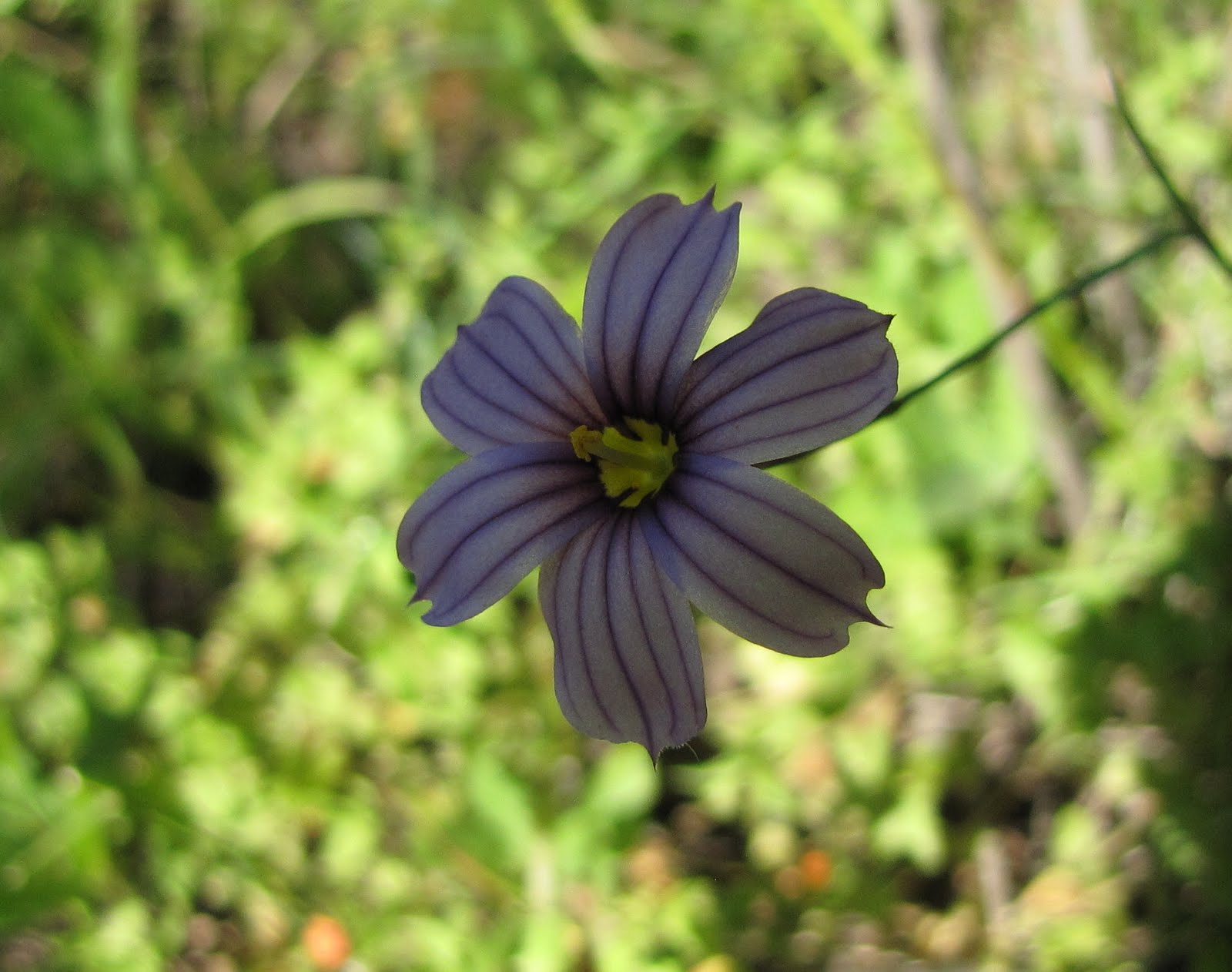
Blue-eyed Grass, Sisyrinchium bellum, is not really a grass at all, but it does have long, narrow leaves that look like grassblades. It also grows in meadow habitats. Blooming between March and May, the flowers are a composition of three petals and three sepals fused at the base. They can vary greatly in color, and probably by age. This one was pale enough that in bright sunlight I could not get a detailed image. So, I shadowed the flower in order to get the “pinstripes” to show.

Coast Paintbrush (“Indian Paintbrush”), Castilleja affinis, was also blooming. Its flowering period is generally March to May, and it occurs in drier habitats up to 3, 500 feet elevation. Paintbrushes are in the figwort family Scrophulariaceae.

I am familiar with globemallows here in southern Arizona, where they can sometimes be viewed as “weeds,” but I was blown away by the Bush Mallow, Malacothamnus fasciculatus. This perennial can grow to be a fifteen foot tall shrub! It blooms from April to July and like its relatives can occupy disturbed habitats as well as dry, pristine native niches up to 2, 500 feet.

Different flowers are to be found in the more moist, shady, wooded sections of Charmlee. The most conspicuous flower we came across there was the Canyon Sunflower, Venegasia carpesioides. The large and profuse blossoms can’t be missed. They have a long blooming period, too, from February to September.

Wedge-leaf Horkelia, Horkelia cuneata, is in the rose family, though I never would have guessed that. It is characteristic of the ecotone where the woodland meets the drier, more exposed parts of the coastal sage scrub habitat; it blooms between April and September.

Last but not least, Leafy California Buckwheat, Eriogonum fasciculatum foliolosum, was especially prominent near the park entrance and restroom facilities. It may bloom anytime between May and November. It is a favorite with some bees, including honeybees that can create a good honey from the nectar they harvest from these flowers.

There are certainly more wildflowers to be found in Charmlee and in the surrounding mountains. A good website for identifying most of them is Wildflowers and Other Plants of Southern California by Michael L. Charters. It does help to know at least what family the plant is in, however, as there is no color-coded search option for this comprehensive website.

Friday, April 2, 2010

Catalina State Park

My friend Margarethe Brummermann was kind enough to invite me to join her for a hike in Catalina State Park last Tuesday, March 30. I had never visited this park in spring before, and this year is so spectacular that I couldn’t pass up the chance to see what the landscape looked like.

Catalina State Park actually lies within the Coronado National Forest, and is known for the nearly 5,000 saguaro cacti within its boundaries. Indeed, there are some truly magnificent specimens of this giant to be found there.

The park was slated to become a housing development in the early 1970s, known as “Rancho Romero.” However, a petition to re-zone the land for this purpose met with stiff public resistance. State Representative Charles King of Tucson then requested a feasibility study to assess the options for protecting the scenic and historical area. Though it was found the acreage met the criteria for a state park, a vote by the Arizona Parks Board on December 10, 1973 was against that idea.

Subsequent grassroots efforts and coalitions of non-profit groups ultimately led to King submitting House Bill 2280 to the 1974 session of the state legislature. It passed, and was signed into law by then-Governor Jack Williams on May 1, 1974.

The park’s master plan was crafted by many players, including students at the University of Arizona. It was approved on December 9, 1977. Still, the park’s current status was not fully achieved until April 22, 1991 when the last land exchanges became final.

Today, park visitors can enjoy all manner of passive recreation, from hiking to horseback riding, camping and picnicking. A day at the park costs $7 per vehicle, or $3 for an individual on foot or bicycle. Thankfully, despite closure of most state parks in Arizona due to a government budget crisis, Catalina State Park remains open, at least for now.

What can you expect to see in the park, besides saguaros? Well, how about some of the more than 150 species of birds that have been seen there? I can also attest to lizards, butterflies, and a seemingly endless variety of wildflowers that call the place home. You can see a few of them over at my Flickr photostream.

Thanks again to Margarethe for the great company, and sharing her own knowledge of flora and fauna.

Friday, April 10, 2009

Big Bad Giant Cane...No, Giant Reed!


I wanted to publish a blog entry on giant cane, a plant that has been deemed an invasive species here in Arizona, but could only find glowing descriptions of that native bamboo, with no state west of Texas being in its range. Silly me, I got confused between giant cane, a largely beneficial domestic grass, and giant reed, apparently the epitome of foreign evil.

Who can fault me? As if the common names aren’t confusing enough, even the genus names are nearly identical: Arundinaria for giant cane, and Arundo for its reed counterpart. The similarities seem to end there.

Giant reed, Arundo donax, is thought to be native to east Asia, but has been so widely cultivated, for thousands of years, in that region, southern Europe, northern Africa, and the Middle East, that its point of origin is difficult to ascertain. The plant was (surprise, surprise) imported to North America as an ornamental from the Mediterranean. It arrived in Los Angeles sometime in the early 1800s. Its popularity ensured its spread, and it now occurs in feral populations across most of the southern U.S. north to Missouri and West Virginia.

What is a wetland plant doing in our Arizona desert? Deep roots can reach water tables near the surface of even ephemeral watersheds. Once established, two- to three-year-old stands of giant reed are remarkably drought-resistant. North American populations reproduce via rhizomes that sprout clones stretching over several acres in some cases. The rhizomes themselves can assume the form of dense mats over a meter thick. Flooding events break off chunks of those mats, and carry the species to new territories downstream.

Giant reed appears to have almost no redeeming qualities. Unlike the native cane, giant reed is not palatable to livestock or wildlife. It is, in fact, full of vile, poisonous compounds like cardiac glycosides, sterols, and alkaloids.

Further, giant reed is arguably a fire hazard, and it is for this reason more than any other that its presence causes so much consternation. Not only can it fuel a wildfire, but the plant won’t be killed in the process. There are accounts of scorched rhizome mats sprouting new shoots two feet high only two weeks after some California fire events.

So, is it any wonder that there is even a volunteer army dedicated to ridding Tucson of this botanical menace? Just check out the Tucson Arundo Removal website for more information. See also the U.S. Forest Service Plant Database, where I gleaned much of the information for this profile. Is it giant cane or giant reed? Donax, don’t tell I say.