Showing posts with label ecology. Show all posts

Saturday, July 18, 2026

Commodifying Hope

I had high expectations for the recent Generation Regeneration online summit last weekend, July 10-12. While it was not wholly without merit, I found it disappointing and somewhat misleading. We definitely need a vastly different approach to our human enterprises and existence on this planet, but I remain unconvinced that most proposed solutions will work. What I can do here is share my impressions of the event, the majority of which I attended, and why I am having this negative reaction.

The Generation Regeneration online summit was sponsored by Future of Cities, and hosted by Tony Cho. It turns out that FOC and Tony Cho are essentially the same thing. I learned about the event through a Facebook advertisement that promised I could reserve my free seat for the live event. I signed up.

Why was I interested in this at all? My next book, provided I can find a publisher, will be a collection of essays centered on urban natural history. Not in the usual sense of squirrels, raccoons, and pigeons, but on the most common urban animal: Homo sapiens. I want to be able to offer readers some concrete examples of successful innovation and social progression, and hoped to find that in this summit.

The first....red flag, if you can call it that, was that while I did receive confirmation of my reservation, it did not include a link to what I had assumed was a Zoom call. Turns out it was streamed on a handful of platforms. I chose YouTube. The post-conference assessment from Future of Cities boasted an attendance of 20,000 viewers. I was one of no more than eight (8) on YouTube, at any one time. Maybe there were 20,000 participating via Instagram. I don't know, I do not have an Instagram account. I'm skeptical.

The second annoying correspondence suggested that I should upgrade to the "VIP Experience," for a mere $99, which would include a copy of Tony's forthcoming book, in press now, and access to the recordings of the presentations/conversations/interviews making up the summit, for a longer period than if I retained my free registration. This seems to me to be a classic bait-and-switch marketing tactic, and it was a real turn-off.

Then there was, in the aftermath, the "but wait, there's more," an invitation to enroll in the "Co-design Cohort," an online course, for $555 until midnight tonight (July 13), before the price jumps to $1,111 thereafter. Now I can see this for what it is, mostly: an economic engine for Future of Cities.

What is a shame is that there were some truly important featured guests at the summit, who are doing critical and successful work. Majora Carter is an urban rivitalization strategist, a MacArthur Fellow, Peabody Award winning broadcaster, and author of Reclaiming Your Community: You Don't Have to Move Out of Your Neighborhood to Live in a Better One. Her conversation alone would have been worth the VIP package. Same with Atossa Soltani, Director of Global Strategy for the Amazon Sacred Headwaters Alliance, and founder and President of Amazon Watch. Dr. Dominique Hes was another outstanding interview. She is a Director at Greenfleet, in Melbourne, Australia. She helped engineer and execute a paddock project, implementing eco-inviting components in a human-centered development, with exciting results.

See what I am gravitating towards, here? I wanted more Indigenous and other minorty voices. There were at least many women featured, which is a great start, but it still felt like it came up a little short.

Then there were people we have heard from before, and now consider largely irrelevant, like Marianne Williamson. There were self-help gurus, people who Tony Cho met at Burning Man....Some even admitted that what they do, and/or subscribe to, is often viewed as "woo-woo," new age mumbo-jumbo. Whether there is any validity to such things is largely irrelevant when public opinion is mixed at best. The last thing we need right now is any more devisiveness.

We do not need catchphrases like "regenaisance" (seriously, this is what Tony Cho is calling this). We don't need more self-appointed leaders trying a bit too hard to be fashionable and progressive. We definitely don't need to prioritize the accommodation of capitalism. Cho repeatedly asserted that the regenaisance does not seek the elimination of capitalism. There were a few too many guests in relatively fancy offices sipping vendor coffees, at least for my taste. The entire event resembled a series of infomercials in many instances, punctuated by truly meaningful content.

At least I can now go directly to some of these individuals, and their organizations, to learn more and get recommendations for other people to investigate and learn from. I can appreciate Tony Cho for collecting all of these people, even if I find only a few of them relevant to my own projects.

Friday, May 15, 2026

Guest Post: Letting Habitat Restore Itself

It is a rare occasion when I invite someone to guest post here, but when I read the following social media post by Justin Thomas, I knew I needed to share his message formally. I will have a few comments at the end, but here let us first hear his experience, without edits.


”Here are the woods by my house near Springfield, Missouri, USA, after six years of doing absolutely nothing but letting nature order itself over time.

© Justin Thomas, May 9, 2026, 6:05 PM.

A brief history: This is the crest of a north facing slope that drops off dramatically in the background (photo facing northwest). The road you can see is called "Bluff Drive," because of the steep slope. To the south the hill flattens for 60 meters or so and then becomes a large flat grown over field. The field was obviously plowed historically and the woods, on the edge of the field, were cut-over, but not likely ever plowed. The earliest aerial photography I've seen is from the early 1960s, and the woods between the road and the field (the woods in the photo) had begun to grow back and are now some of the oldest woods within many miles. They were probably grazed until the mid-1970s when the houses on this dead-end street (now a mile outside of city limits) were built.

The woods are largely early successional trees like Black Walnut and Hackberry that germinated after the grazing and probably brush-hogging, or Euro-American burning. There are also large Black Oaks, Maple-Leaved Oaks, and Chinquapin Oaks that are likely sucker sprouts from the stumps of the original woods, or sprouts from the stumps of the sprouts of an earlier cut, that though the same size as the early successional trees, are decades older. This last point is important because though there are big oaks, they are not yet colonizing, nor can they because the damaged system is not what they colonize into. Still, I suspect in the next 20-30 years, left to their own devices, they will recruit back into the system.

© Justin Thomas, May 7, 2020, 6:07 PM.

The woods in the above photo (taken in 2020) are full of Buckbrush, Missouri Gooseberry, Clustered Black Snakeroot (Sanicula ordorata), and little else. These are hallmark species of former grazing, especially in woods. My family and I moved onto the property in 2016 and I immediately expressed my desire, my NEED, to get in and cut all the Buckbrush in order to open the woods for floral diversity. My wife asked me to leave enough to maintain the privacy it provided us and our neighbors. That's how thick it was. I was too busy and, let's face it, too lazy, to ever do it.

Turns out laziness has many rewards. In the spring of 2020, and the reason I took the photo, I noticed that there was less Buckbrush and Gooseberry than the year prior. Over the next couple of years that decline increased substantially every year. Six years later the Buckbrush, Missouri Gooseberry, and Clustered Black Snakeroot are almost completely gone. As these short-lived shrubs died of old age, and minus any further ecological damage that would allow their seeds to germinate and replace their parents, slowly more and more sedges, grasses, and forbs colonized the woods.

Let me rephrase that, because the sedges, grasses, and forbs were already there, just at very low densities (as is usually the case in such places). What I should have written was: as the woods became less suitable to Buckbrush and Gooseberry it became more suitable for the sedges, grasses, and forbs that had been eking out their existence at very low densities in the micro-scale nooks and crannies that had not been highly impacted. These kinds of population lulls also afford many species an escape from pathogens, so when they do have the opportunity to recolonize, their metabolisms are more geared toward reproduction than defense.

While this was going on, young saplings, and some larger trees that were suppressed under the larger trees, also could not maintain their metabolic needs and they died. This further opened the canopy and midstory, allowing light to power the ground flora metabolisms. Simultaneously, with less canopy and midstory, air moves around more and the site dries out faster, decreasing the fungal load (fungi are the number one seed predators), increasing insect activity, and aiding both wind and insect pollination.

The point of this story is that no human did anything to increase any of the wonderful clockwork things that happened and that are happening. The only human part of the story is the negative impact and subsequent abandonment. The powerline cut in the background, just before the road, has Bush Honeysuckle, Japanese Honeysuckle, Multiflora Rose, and Eastern Red Cedar. They, too, are declining. Why? Because this is what nature does. Damaged systems are colonized by species that thrive in the damage (largely driven by nutrient availability). When damage/disturbance stops, the nutrient availability declines and eventually the system becomes the sort of place where damage-dependent species cannot persist. This is why most damage-dependent species have short lives, long distance dispersal mechanisms, make lots of seeds, and have seeds that bank longer than stability-dependent species. It is a core natural phenomenon inherent to all living systems.

I'm sharing this because it isn't a freak occurrence. I see this everywhere, and I hope that after reading this you may see it, too. It is so beautifully encouraging to realize that so much of what we worry about in conservation/ecology comes from a lack of understanding of how magical living systems actually are. When we understand how they work, there is so much less to worry about (and so much less "work" to do).

This is my 30th year as a botanist/ecologist and the greatest joy of doing it this long is revisiting sites I've known for decades, and seeing them benefit vastly more from no human intervention than from too much human intervention. I don't see these healthful trends and trajectories in many places that are "managed". Sorry, I won't pretend that I do.

This idea is going to upset people. This is not the conventional perspective. I was resistant to it myself, but as someone whose job it has been to collect data and monitor ecological management, from thinning and fire to controls, this is a vastly overlooked truth of the natural world: that it can do it better without us.

Maybe that isn't fair. I'll rephrase: it can do it better when we appreciate and understand how it can do it better without us, AND we follow its lead and offer a bit of assistance. Not to get political, but when you love something correctly you ask for consent and anticipate your love's needs, rather than telling it what YOU like, what it likes, and forcing it to comply. Love, patience, understanding, and compassion are ecological principles, not freaky hippie nonsense.

I know a lot of woods that look like the 2020 photo. I'm so excited to see them when they hit the point of transcendence, and so happy to know that I don't have to do anything for it to happen.”


--------------

What struck me from reading this is the concept of “disturbance-dependent” flora; and the idea that further disturbing a parcel of land, even in the act of removing invasive species, frequently makes things worse, or prevents reversion to natural conditions. Is this true in every ecological situation? No. Should it be considered in designing and implementing restoration and mitigation efforts? Definitely.

This is also the kind of philosophy we should be using in addressing all kinds of environmental, economic, and social problems. We have to start questioning the validity of the systems that are dictating certain ways of acting, and suppressing alternative methods. We cannot continue to use only profit and costs to determine the best solutions. “Scaling up” is not necessarily the best way to go. In fact, it might exacerbate the problem.

This blog respects dissent as well as validation, so please do not hesitate to enter your own thoughts into the comments, in a respectful fashion. Share *your* experiences. Thank you.

Justin Thomas is the co-founder and Science Director of NatureCITE, and the co-founder and Director of the Institute of Botanical Training. He has a BS from the University of Missouri and an MS in botany from Miami University – Ohio. He has 30 years of experience conducting ecological and taxonomic research, instructing plant identification workshops, and serves as a scientific advisor to several conservation organizations in the central and eastern United States.

Thursday, January 5, 2023

Book Review: The Home Place: Memoirs of a Colored Man’s Love Affair With Nature

I cannot help but see the irony in writing a review of a book written by a self-described “odd bird” in a blog entitled Sense of Misplaced. Perfect. What author J. Drew Lanham manages to convey brilliantly is that biophilia is a desirable affliction that transcends all colors of human diversity. The Home Place is a clarifying window into what it means to be an outsider among the privileged Caucasians who dominate the fields of biology, ecology, and wildlife conservation. Even casual birding presents challenges, but Lanham offers hope for a more integrated future.

Dr. Lanham and I are close in age, so it was intriguing to see what similarities of experience we shared given graphic differences in our home places. He is a Black man. I am not. He has siblings, and now children of his own. I do not. His upbringing was rural, mine urban. I am certain, however, that we both colored the same mimeographed songbird outlines in our respective elementary schools, even though there are no Northern Cardinals, Blue Jays, or Rose-breasted Grosbeaks in western Oregon. No “markingbirds,” either. Ok, end of anything “me,” here, though a literary memoir would fail miserably if it did not spark memories in the reader’s mind, and evoke empathy and agreement.

The ecosystems of place, time, family, faith, academia, economy, and wild nature are all woven together seamlessly in The Home Place. Each one influences all the others, none standing alone. Through it all, Lanham expresses an ethical philosophy and physical and emotional vulnerability that is obviously authentic. He would never call himself brave, let alone heroic, but in many ways he is exactly that. Lanham carries a reverence for life that applies to every aspect, from familial relationships to hunting, birding, and conservation research.

The book is organized along the trajectory of Lanham’s personal and professional life, beginning as a member of a familial “flock,” and progressing through “fledgling” to full-blown “flight.” Today, Dr. Lanham is positively soaring, having recently received a MacArthur Foundation fellowship, recipient one of the prestigious “genius grants” the foundation awards to exceptional individuals. Indeed, Lanham is one of those rare birds able to effortlessly navigate both the creative and scientific realms, bringing a unique perspective to both academic and public spheres.

No one would fault the author for having an angry tone given past and present injustices to their demographic. Instead, Lanham manages to tread that fine line between justified hostility and denial that historical and personal transgressions hindered their life at all. He is properly assertive, mournful for the lives of his ancestors, and insistent that things be made right.

We can all be better allies for reading The Home Place, a John Burroughs Medal Finalist as a "Nature Book of Uncommon Merit." It is an invitation to explore ourselves as well as the world around us, and to advocate for both biodiversity and human inclusivity.

In case you could not already surmise, I am highly recommending The Home Place for your personal library. It is like adding the work of an esteemed artist to your office wall. Whenever I am feeling a loss, be it mourning the loss of a favorite wild place, or simply at a loss for words, or way to communicate powerfully, I can pick up this book and be inspired all over again. The Home Place was published by Milkweed Editions, a non-profit entity located in Minneapolis, Minnesota, in 2016. The book is 217 pages.

Sunday, November 6, 2022

The Changing Conversation Around Invasive Species

Recently, the debate about invasive species has become more polarized than ever, with a degree of defensiveness and anger not seen previously. The reasons for this are many, some difficult to admit to.

Chinese Clematis may be invasive, but it deserves a less bigoted name.

I attended a webinar a few weeks ago in which the presenter asserted that “invasive species” is a “militarized term.” My instinctive reaction was that this was accusatory, bordering on defamation of science, when there is clear evidence that the introduction of a species to a new ecosystem can have devastating consequences.

Spongy Moth is still a bonafide forest pest, but now has a more appropriate moniker.

Pondering his comment further, it occurred to me that most of the animals, and plants, we label as invasive have some sort of obvious and negative economic impact. We have, as a consumer culture, become conditioned to frame everything in terms of business and monetary interests rather than ecological concerns. This has become more complicated by angst over climate change, and the resulting vulnerability of humanity to emerging threats, be they viruses or “murder hornets.”

20200512-P1090983 Vespa mandarinia japonica
© Yasunori Koide and Wikimedia Commons. Asian Giant Hornet only "murders" in the beehive, but is a serious threat to apiculture because of that proclivity.

The sudden, and/or overwhelming appearance of a novel organism is going to cause alarm, and the public seldom has comprehensive, appropriate knowledge for interpretation of potential impacts. We are at the mercy of what news outlets tell us. Because traditional print, radio, and television media now compete with social media, sensationalism is the order of the day. “Click bait” banners prevail over more accurate but less provocative headlines.

© Kim Fleming and Bugguide.net. Joro Spider, Trichonephila clavata, is not currently considered invasive.

Initial forecasts can also be premature. The jury is still out on whether some recently-introduced species will become problematic. They may not. The Joro Spider is a case in point. It is locally abundant in some parts of the southeast U.S., but whether this translates to a displacement of native spiders remains an unanswered question.

We collectively have a fascination with heroes and villains, too, and there are no more menacing villains than alien-looking insects, spiders, and other arthropods. Fantasy melds with reality and it becomes difficult to separate the two if you are not scientifically literate, or have a business model that demands public hatred of a particular creature.

© USDA ARS, public domain. Spotted Lanternfly, Lycorma delicatula, adult and nymphs. This species is a potential agricultural pest of serious magnitude.

In opposition to nativism is the idea that there is no such thing as invasive species. After all, man is part of nature, and therefore our actions are natural processes. The outcomes of those activities are circumstances to which we, and other species, will adapt.

It may be no coincidence that a backlash against the idea of invasive species is more evident now that we are recognizing, and attempting to mitigate, a history of colonialism. A convincing argument could be made that White settlers are the original invasive species. Here, in North America, we annihilated and displaced Indigenous members of our own species. We enslaved others. To this day we continue missionary work and other forms of colonialism. Therefore, the idea of invasive species becomes one of self-loathing, certainly an eventual threat to White supremacy and privilege. White people do not want to see themselves as villains.

Meanwhile, we demonize human immigrants and refugees as criminals and threats to domestic labor pools. We clamor for the closure of borders to our fellow humans, but allow our boundaries to be permeated by everything else. Not that human-imposed boundaries reflect natural ones.

The Cross Orbweaver, Araneus diadematus, is an example of a naturalized arachnid in North America.

Scientists have an uphill battle in resolving these opposing perspectives and initiating constructive dialogue. Looking to the past we see how some species from foreign lands have become “naturalized” over time, becoming innocuous additions to our flora and fauna. The average citizen may be shocked to learn that dandelions are not native to the U.S. They have become a fixture in our lawnscapes, even if we are instructed to use weed-killers against them.

Myrtle Spurge, aka "Donkeytail," Euphorbia myrsinites, is classified as a noxious weed in some jurisdictions, but not everywhere.

What is lost in all of this is attribution of the modern problem of invasive species to global consumer culture. Historically, human colonists brought other species with them as a guarantee of food and other necessary resources when venturing into unknown territory. Soon after, those species and their products became valuable in trade, a way to establish meaningful and positive relationships with Indigenous peoples, or other settlers. The pace of travel was slow, and the scale of enterprise miniscule compared to twenty-first century business.

Today, we mostly covet plants and animals of far-off lands. Plants, especially, can harbor potential insect pests. Thecontainers used to transport international commerce are frequently occupied by insects, rodents, and other organisms. We seldom make that connection between our consumer habits and the state of ecosystems around the world.

Captive Reticulated Python. Release of unwanted Burmese Pythons into the Everglades by irresponsible pet owners has been....problematic.

We cannot turn the clock back, but we should make more informed and conscientious individual choices in the marketplace. We should promote the welfare of Indigenous peoples, and actively seek their counsel and leadership in crafting a world better able to withstand climate change. A permanent end to colonialism would not be a bad thing, either.

Thursday, February 11, 2021

Contingency Planning in Conservation

Wildlife and plant conservation is more complicated than ever in the twenty-first century. Outright habitat loss from agriculture, urbanization, resource extraction, water diversion, the introduction of non-native species, and other endeavors continues nearly unabated. Now, we have the added effects from climate change. Consequently, habitat protection is less predictable. We know change is going to happen, probably more rapidly than anticipated by our government, business, and cultural institutions. How best do we cover our bases?

Habitat of the Filigree Skimmer dragonfly in Colorado Springs, ironically enhanced by an aging drop structure in the streambed.

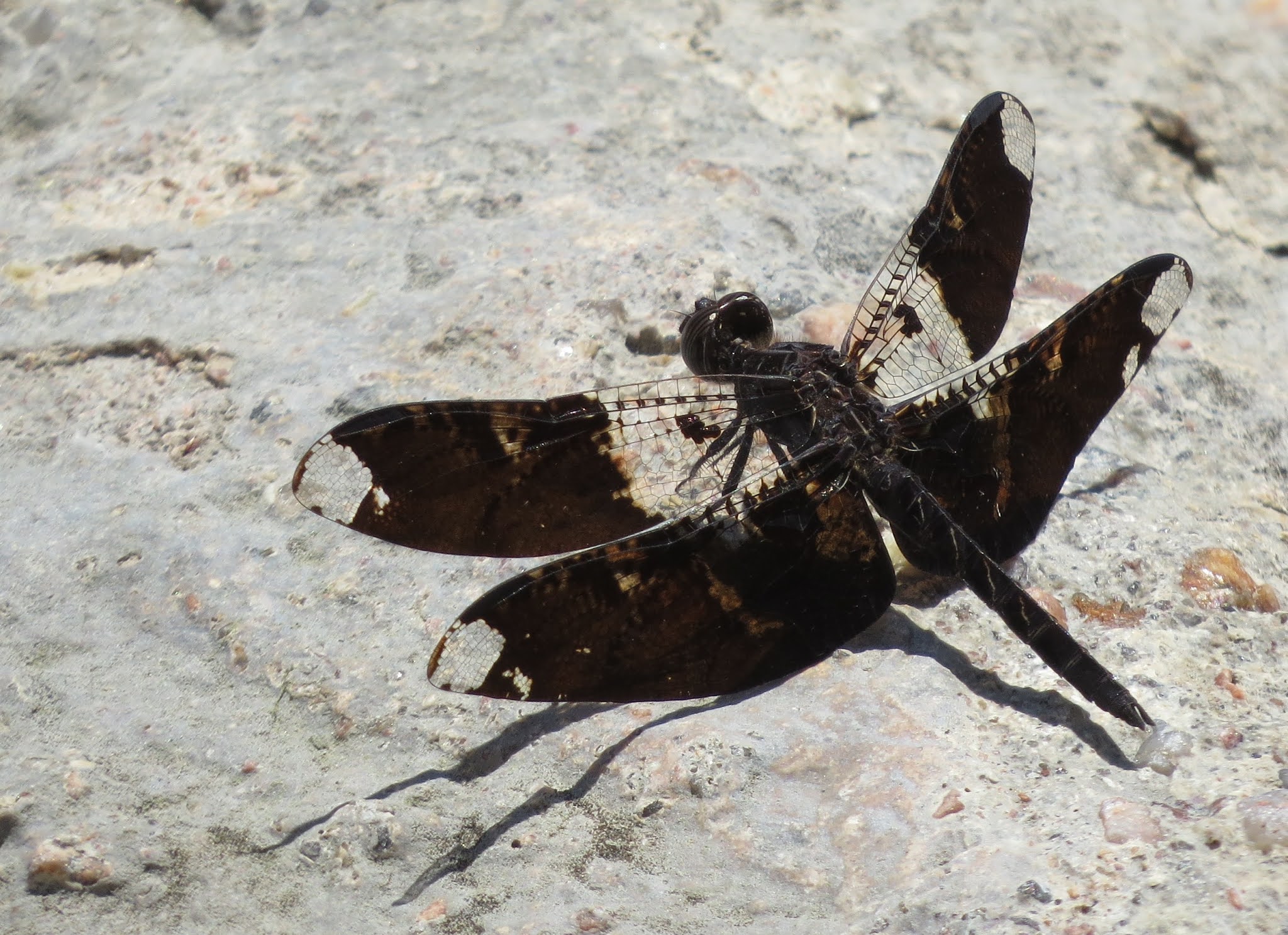
The experience that got me thinking about this was my discovery of the only known breeding population of the Filigree Skimmer dragonfly, Pseudoleon superbus, in Colorado. The documentation of the species just up the hill from my home in Colorado Springs represented a significant northern range extension for the species. I am using past tense because it is almost certain that the population will perish during or after a stormwater mitigation project slated for execution by Colorado Springs Utilities.

This situation was at the forefront of my mind in deciding whether to vote in favor of the reintroduction of the Gray Wolf to Colorado. The citizen-generated initiative made it onto the ballot in November, 2020, and passed by the narrowest of margins. It represents an attempt at restoration of historical ecosystems, and the historical range of Canis lupus in the Lower Forty-eight states. It could also be interpreted as contingency planning should wolves re-establish on their own, which seems to be the trend since the re-introduction of the species to the Greater Yellowstone Ecosystem.

In the absence of reliable predictive modeling for shifts in the geographic distribution of organisms, and therefore shifts in the composition of ecosystems, it is prudent to be as immediately responsive as possible when changes arise. The more preemptive actions that can be taken to facilitate those responses, the better. The wolf reintroduction bill at least forces the hand of Colorado Parks and Wildlife to manage wolves one way or the other, with the advantage going to the wolf and its human advocates. Similar legislation is needed at an ecosystem level to guard against both continued exploitation of natural resources by business interests, and to mitigate probable climate-driven catastrophes such as prolonged drought and wildfires.

A male Filigree Skimmer, Pseudoleon superbus

Back to the dragonfly for a moment. The Colorado Springs occurrence could be viewed as a disjunct population, far removed from the historical range of the species in canyons of the deep southwestern U.S. It could be that this is the “new normal” for the species. If the species is progressing northward, is something happening farther south that is driving it northward? Such outlier populations deserve consideration of protection, regardless of whether the species is currently listed as threatened or endangered in any part of its existing range.

I explored every recourse I could think of to get protection for the dragonfly population up the hill, but to no avail. It is tragically ironic that we demand a species to be already in peril before we give authority for its interests to be considered. Thus, the rights of a given species do not matter until the very last minute. What of the rights of humans to other species? What of our rights to experience other species in nature, in a passive fashion? Why do those rights not count at all? Many a human being would elevate the experience of immersion in wild ecosystems above mere recreation and into the realm of necessity for one’s mental health and physical well-being.

The time has come to raise the bar in proper stewardship of a constantly changing landscape, and give priority to preservation of not just species, but populations of each species. The maintenance of genetic diversity has never been so critical. There has never been such an urgent need to preserve as much remaining habitat as possible because climate change is diminishing viable ecosystems wholesale.

Conservation organizations and environmental law professionals, take note. The old standards and methods no longer apply. It is time to be creative, with innovative approaches to legislation, the forging of new partnerships with indigenous peoples to restore the “history” in “natural history,” and the assertion of urgency to preserve wildlands not for future generations, but to honor present and previous generations of ecological advocates. Get to work.

Friday, January 10, 2020

The U.S. Economy is a Dysfunctional Ecosystem

Economies might do well to emulate at least some aspects of biological ecosystems. Our American economy has somehow managed to magnify the undesirable characters of ecosystems while failing to adhere to the fundamentals that make such systems work. Meanwhile, our economy is undermining natural ecosystems that are the foundation for the economy.

Before I proceed farther, in accordance with a recently self-imposed personal law, I must disclose that I fall into the category of white privilege. It is important to remind myself that however I perceive my own circumstances and point of view, my status, for lack of a better term, is still greater than it should be when compared to other demographics that are not Caucasian nor male nor straight, and so forth. We need to hear those voices also.

How can one claim that economies are in any way like ecosystems? There are many similarities, but the most obvious is the idea of niche. Ecosystems are full of niches, each occupied by one or more species. Some, mostly plants and marine algae, are producers that take energy from the sun and convert it to biomass. Other organisms consume those plants, while still others feed on the first tier of consumers in what is properly known as the food web. Decomposing organisms help recycle deceased organisms back into the soil.

Economies are full of niches, too, but all of those niches are filled by one species: Homo sapiens. Niches in economies are called “jobs,” but it goes beyond that if only because, increasingly, one person may hold more than one job such that they can have the ability to consume more (or break even). Further, machines are filling more and more niches formerly occupied by persons as a result of automation. Society functions best when we do not limit the definition of an individual to their occupation. Human economies are more than simple transactions involving goods and services, they involve investments of intangibles like emotions and social capital.

The most profound similarity between ecosystems and economies is currency. The currency of ecosystems is energy, pure and simple. The currency of an economy is money. The only way an ecosystem functions properly is if energy flows freely, cycling ceaselessly for the benefit of all organisms. There is very little banking of energy, at least in the short term. Look at water and carbon in the natural world and they cycle endlessly.

Meanwhile, in the American economy at least, money is not viewed as energy. It is seen as power, and therefore hoarded, failing to flow as it should, despite the claims of those who subscribe to “trickle down” economics. The tap is perhaps dripping randomly. Worse yet, it is often only those in the white privilege category that receive any sustenance at all. This causes a cascade of negative effects that further erodes the economy. Entire segments of society are left without niches to fill, and therefore no way to participate in any part of the economic cycle, from production to consumption.

Among the negative side effects of an exclusionary economy is the rise of predators, parasites, thieves, and other criminal enterprises. While predators, for example, are one category of niches in natural ecosystems, there should be no place for them in an economy. When crime becomes a survival strategy, it is time to re-think the structure of our economy, question our aspirations to gratuitous material wealth, and tolerance for continued economic injustices.

One insistence of capitalist economies that is completely incompatible with natural ecosystems is the idea of infinite growth as the ideal. There can be no such thing, as human history has demonstrated repeatedly with the collapse of one civilization after another. Failure to accept the finite nature of natural resources, and/or partition them responsibly, has led to the fall of many empires, and it would appear that this is now a genuine threat to the entire globe.

Markets, like the biosphere, are also finite, despite efforts to expand them. Furthermore, while we claim allegiance to the idea of the “free market,” there is in reality no such thing. Were it true, then the U.S. auto industry, multinational banks, and other American corporations would have failed by now. Instead, we prop up those businesses artificially through government bailouts, tariffs, and other subsidies as corporate welfare that is deemed acceptable while social safety nets are allowed to unravel or are intentionally dismantled.

What does all this mean? It means that we need to look more critically at how we live our lives, what constitutes our premiums (Convenience? Value?), and perhaps seek to align our economy more with the functioning of the natural world. It is not a question of prosperity versus austerity, unless you are the ultra-privileged and your idea of austerity is one less yacht.

Thursday, June 20, 2019

In Praise of "Weeds"

You have been sold a bill of goods if you believe that all "weeds" are created equal. Weeds is in quotation marks because the majority of what we call weeds are simply native wildflowers and grasses that volunteer themselves in our carefully orchestrated urban and suburban landscapes. Allow me to explain.

A primrose sprouts defiantly from a sidewalk crack

We create villains to open opportunities for the invention and marketing of products and services to kill them. Meanwhile, the actual villains are exotic plants propagated by the nursery and landscaping industries, which then escape cultivation to wreak havoc on natural ecosystems. Everybody in the business sector wins, but you are out of pocket for a good deal of expense, and natural habitats are abused or at least compromised, in the process.

Lawn services and weed killers should be trending down by now

This is not a conspiracy as much as it is a marketing strategy that has gone so far as to encourage legislation of local municipal ordinances that may explicitly prohibit homeowners from allowing their property to revert to any semblance of a natural ecosystem. Ostensibly, these "nuisance laws" were created in an effort to ensure public health and safety, seeking to eliminate refuges of "vermin," pests, pathogens, and excessive pollen, and mitigate fire risks. The stereotypical weed ordinance is one which prohibits grasses or brushy vegetation to exceed a specified height. The junk vehicle discovered while mowing the lawn is a running joke.

Home Owners Associations (HOAs) have taken this to a whole new level, with their attention to minutiae rooted in preservation and enhancement of property values. In the case of the authority my spouse and I are under with our townhouse, this has resulted in removal of some trees, replacement of juniper hedges with rock substrates, and continued embracing of water-guzzling lawns. Keeping up appearances means more to these organizations than enhancing the health of local ecosystems.

Clover is a bee magnet and fixes nitrogen: Win-win!

What we should be doing is advocating what I call "weed tolerance." Even naturalized plants have their benefits. Dandelion is among the first plant to bloom in spring, offering a vital nectar and pollen resource to butterflies, bees, and other insects when nothing else is flowering. The clover in your lawn is a bee magnet, plus the plant is fixing nitrogen so you don't need to fertilize as often, if at all.

Ok, Chinese Clematis is a genuine noxious weed

In fairness, there truly are weeds that have no place in the landscape. You can find them as state-listed noxious weeds. The United States Department of Agriculture has conveniently compiled a database of these most-wanted (maybe most-despised is a better term) plants for you to use in determining which plants you need to eliminate from your yard and garden, or avoid when shopping for plants. This is an ever-changing list as more information is gathered about the impact of each commercially available plant. It was not until recently that Bradford Pear and Butterfly Bush (Buddleja davidii) became enemies instead of friends in the landscaping community. Keep tabs on the list for more additions.

Wild rose, with more open blossoms, is friendlier to bees than cultivars are

Increasingly, more attention is being paid to providing for native pollinating insects, and supplying breeding birds with the insects necessary to raise a brood of chicks. You can search endlessly online for resource after resource, but you may wish to start with books like Bringing Nature Home, by Douglas Tallamy. Dr. Tallamy and his colleagues and students have worked tirelessly to demonstrate conclusively the differences in ecological impact between native plants and exotic plants. Native plants, including many species we currently define as "weeds," sustain far more species of insects and other wildlife, as they are already adapted to soils, precipitation, and other variables where they thrive naturally. This makes the plants hardier, better able to withstand heavy impacts from herbivores, diseases, and other agents that affect plant health.

Yellow and white composites are favorites with bees and butterflies

Want help that is even more localized and informative? Join your state's Native Plant Society. Here is a list of them in the U.S. and Canada. Also avail yourself of the Cooperative Extension Service, typically associated with your state's land grant university. There is usually at least one office in each county, located in the county seat.

The tide does appear to be turning, even with those weed ordinances. While some cities have begun relaxing their codes, other municipalities have reversed course completely, actively encouraging citizens to "go native" with revised laws and financial incentives. Use these success stories to argue your case locally for similar innovative strategies.

Don't forget about evening- and night-blooming flowers like blazingstars when landscaping

Lately I have been enjoying the weeds that have been flourishing here in Colorado Springs thanks to an exceptionally wet, cool spring. There are flowers blooming that I have never seen before now. How do I translate my appreciation for vegetative rebellion into something meaningful to those who have bought into the neat and tidy vision of the marketplace?

Penstemon growing in a vacant lot in Colorado Springs

Thursday, March 21, 2019

Economies Are Warped Reflections of Ecosystems

If ecosystems are what the planet is made of, then economies are the funhouse mirrors that wildly distort the principles the two have in common. A diversity of species fill all the niches in a natural ecosystem. Humans fill most of those roles in urban ecosystems. Humans fill all of those roles in economies.

It is said that nature abhors a vacuum. The elimination of apex predators, parasites, and competing species do not leave voids. Those niches are filled by human equivalents. This becomes abundantly clear in urban ecosystems, but we do not think of it that way. We prefer to think we are civilized, that we can somehow rise above the laws of nature, that in fact we do not even need natural systems to flourish. Should we regress to the village living in fear of lions, to an era before medications rendered disease merely a chapter in history books? No, of course not, but the marvels of our modern age have conveniently allowed us to imagine we are now immune to ecology.

We have further complicated matters by overlaying economics on top of nature, failing to acknowledge that economies are themselves a type of ecosystem, in which all the niches are filled by people. The currency of nature is energy. That energy is parceled out into three basic categories: organismal growth (metabolic), movement (kinetic), and rest (potential). The currency of economies is money. It, too, has several functions, including growth (interest and investment), movement (the marketplace), and rest (savings, retirement). The ideal form of economics would operate much like a natural ecosystem in terms of energy flow, but this is not what is happening. The predatory lenders, the parasitic scam artists, the diseases of poverty and addiction, among many other villains, derail economies time and time again. Capitalism and socialism alike are prone to rampant corruption, resulting in the hoarding of wealth (financial currency) that starves the system.

The energy of nature is requisite, finite, and circulates freely. The currency of man is arbitrary in the value it assigns to objects and resources, and it does not flow as freely as it should. "Precious metals" and "precious stones" are only so because we say they are. Nature assigns equal value to all of its components. Our human economies now look at everything from land to certain categories of humans in terms of whether they can produce financial profit. This is in direct conflict with natural laws and so we see deforestation, desertification, poverty, climate change, endangered species, pollution, invasive species, mass incarceration, and racism and genocide. These are just the intolerable conditions that come immediately and randomly to mind. You can probably add to the list.

Our final failure lies in a stunning denial of the fact that no matter what we do, we answer to the whims of planet Earth. We started to see the effects of our economic practices on nature shortly after the Industrial Revolution, but now that we are in the digital age, we believe that technology can save us. Computers and cell phones still rely on the extraction of natural resources, which leads not only to pollution with the disposal of the outmoded generation of products, but to ruthless competition to harvest materials for the components, among other complications we conveniently turn our heads away from.

Ultimately, the future of nature comes down to the willingness of Homo sapiens to exercise restraint, in our sheer numbers, and in our economic impact. Every species dreams of being in our shoes, able to eliminate mortality factors, eliminate competitors, reproduce astronomically, and thoroughly dominate the landscape. It is an impossible "success" story, however, when you erode the foundation of your castle. We will adapt and truly evolve only if we recognize value beyond financial profit. The marketplace is artificial. The Earth is not.

Thursday, July 19, 2018

A Deep Desire to Live Somewhen Else

© MountainCrossingsAtNeelGap.wordpress.com

Many people are not happy with the place where they live. Maybe the neighborhood is bad. Maybe the climate does not agree with them. Maybe they are just restless. I have concluded that I would rather live in a different time. I have no desire to return to my childhood. This is not about a re-do on a personal level. We make the best of the cards we are dealt. This is about something bigger. This is about a longing for what was never allowed me because it was gone before I was born.

There is increasing evidence, if only anecdotal, of an "insect armageddon," which suggests the abundance and diversity of insects and related organisms are plummeting. We have already lost many once-populous species to the greed and ignorance of previous human generations. A planet devoid of even insects raises a specter that I am unwilling to contemplate, and a life I would not be able to endure, psychologically if not physically.

That is the thing about history. You will eventually learn about what you will never have the opportunity to experience.

You better believe I am angered that I have been deprived by my forefathers of the vast flocks of Passenger Pigeon, the antics of Carolina Parakeets, and the jaw-dropping icon that was the Ivory-billed Woodpecker. I can only see Bison on preserves and ranches, and on the ranches one suspects it is actually the hybrid "beefalo" that one is seeing. Meanwhile, I have a hard time looking at a salmon or trout without seeing a fish hatchery. There are still California Condors, but so few that each bird is fitted with huge, numbered tags, radio telemetry devices, and who knows what else. The bird's "recovery" is not a success story. Maybe it will be once they are no longer wearing the accessories of science, and are truly free to fly.

We have not just tamed the wild, we have diluted it beyond recognition in the name of risk assessment and public safety and public grazing, to name but a few agents of wilderness simplification. The national forests are national tree farms, and it should come as no surprise that the U.S. Forest Service is in the Department of Agriculture rather than the Department of the Interior where it ought to be.

Back to the past, the long ago that I long for. It would be wonderful to know the truth of the landscape that surrounds me today, to see what a riparian corridor looks like without Russian Olive everywhere. What is a foothills meadow without mullein? What is your eastern deciduous forest without an understory of Japanese Honeysuckle? Do I wish we could resurrect mastodons and mammoths? No. I draw the line at being a potential meal for a saber-toothed cat or a Dire Wolf. Furthermore, those were the days when our ancient ancestors were just surviving, without understanding of the ramifications of their actions.

Naturally, I would still want to bring my binoculars, digital camera, first aid kit, and waterproof jacket on the Lewis and Clark expedition.

Perhaps I am guilty of romanticizing the age of the old growth hardwood bottomland forests with their gargantuan oaks and hickories before we started logging and draining the good kind of swamp. Old photographs and artwork paint pictures that are hard not to idealize when you are passionate about the natural heritage of this country. That is the thing about history. You will eventually learn about what you will never have the opportunity to experience.

Ah, but what would I give up in exchange for that bygone era? I do believe I would sacrifice the internet, television, maybe even electricity, especially because I would never know those innovations were on the horizon. Naturally, I would still want to bring my binoculars, digital camera, first aid kit, and waterproof jacket on the Lewis and Clark expedition. Sure, I would likely have a shorter lifespan, but at least I would enjoy that life more fully. Today, instead of California Condors gracing the skies, I am subjected almost daily to extremely loud military aircraft overhead. I would gladly trade noise and neon and traffic and the illusion of choice in the marketplace for something a lot simpler, with fewer losses of species.

© DWParkinson.com

We can reverse some of this, turn back the clock if you will. The grand experiment of reintroducing the Gray Wolf to Yellowstone National Park proves decisively that Mother Nature has a memory, and that when you bring back a piece of the puzzle, the whole thing fits together tighter and smoother. We need a historical spectrum of nature, from the initial stages of succession to the "finished" product, because we know there is no such thing as a permanent climax ecosystem. Even natural communities are ephemeral, but until now there have been multiple, continuous habitats that feed each other. They are now so isolated that there is no transfer of species and so invasives take command. We need to link the wild spaces with corridors to facilitate healing of the landscape.

It remains to be seen if I can continue to be as resilient as that landscape, how many times I can come back healthy, vibrant, committed to making the world a better place, acting on my vision of wholeness in every sense of the word. For now I am misplaced, a pioneer naturalist and writer in a domain that I had no conscious hand in architecting.

Saturday, April 28, 2018

In Praise of Vacant Land

Growing up in Portland, Oregon in the 1960s and 1970s, I spent my lonely childhood exploring the forests, fields, and vacant lots around our neighborhood. Maybe it was the time period, maybe it was the culture, but I was allowed to roam freely for the most part. Not today. Our vacant parcels of land, whatever their size, have gone from implicit invitations to traverse them to extreme possessiveness and a clearly uninviting nature full of fences and other explicit boundaries and "no tresspassing" postings. I long for the good ol' days.

It would be an interesting exercise to plot a timeline of American land use over the centuries, from the frontier to current efforts to shrink public lands. Some things stand out from my own education, both formal and subsequently informed by "alternative media." We clearly usurped indigenous peoples in our effort to conquer the wild landscape and settle what were apparently chaotic ecosystems prior to our arrival as European colonists. Resource extraction went from individual mining claims during the Gold Rush to mountaintop removal for coal, to fracking done by faceless corporations. We tamed forests through logging and fire suppression.

If you believe that to have value, a given parcel of land must provide an economic return, then you are starting with the wrong premise.

Eventually, individuals with great foresight and appreciation of wilderness brought us the concept of parks, wildlife refuges, and roadless wilderness. Then came Aldo Leopold's land ethic, and Garrett Hardin's The Tragedy of the Commons. Our population boomed in post war celebration, and prosperity seemed boundless. The interstate highway system replaced the railroad as the way to move freely about the country, unfettered by fears of peak oil. Everyone could have everything, including their own piece of real estate. We could feed ourselves, recreate, work, and live, all in different locations. Sprawl was not the name for subdivisions back then.

Where once land was appreciated on several levels, today there is but one consideration: financial gain. If you believe that to have value, a given parcel of land must provide an economic return, then you are starting with the wrong premise. Land already has value as the ecosystem engine that keeps us breathing, keeps us grounded, keeps our minds resilient and stokes our creativity, awe, and curiosity. The idea that human activities enhance the value of land is a corruption of economics that ignores biology. I have personally never seen a natural landscape improved by the addition of a strip mall or suburban housing project. Indeed, such projects diminish the value of land at best.

Undeveloped acreage is protected the way ranchers protect their cattle before they take them to the slaughterhouse. The average lot is merely reserved for something "better" at some future date.

Today, the vacant lands of my youth are protected from children, and all other innocent and worthwhile interests. Undeveloped acreage is protected the way ranchers protect their cattle before they take them to the slaughterhouse. The average lot is merely reserved for something "better" at some future date. I ask what could be better than wildflowers, the hum of bees and songs of birds? What could be better than an unofficial playground for our wonderfully wild, exuberant children? I never got curious about illicit drugs because I was curious about insects and reptiles and other wildlife. I was able to satisfy my inquisitive nature precisely because I had places I could go, safe or not, where I could find and observe other organisms. This is saying something considering that I am an only child who was raised mostly by an overprotective single mother.

Vacant lots are only as much of a blight as we allow them to be, at least in urban settings. Why not take that weedy block and turn it into a butterfly and bird garden, or even a community garden that feeds people as well as wild things? Grow something other than another concrete and steel building. Density and infill are not dirty words. Apply them humanely and shrink your city's sprawl. Leave the larger pieces alone or manage them for all the biological services they provide us. Leave them for the kids.

Sunday, April 2, 2017

Book Review: Vulture

© ForeEdgeBooks.com

Even if you do not already admire the Turkey Vulture as a master of sustained and effortless flight, and its willingness to consume the deceased animal life that would fester and overwhelm us were it not for these efficient scavengers, you will find Vulture: the private life of an unloved bird University Press of New England, 2017), by author Katie Fallon, to be well worth your indulgence.

Experience informs the advocate, and Fallon does a superb job at weaving her personal life experiences into the narrative of this story. The natural arcs would be the life history of her subjects, from egg to adult; or the migratory journey of a vulture. Indeed, Fallon employs these natural rhythms as elements of continuity; but it turns out not all Turkey Vultures do migrate, a fascinating aspect of the diverse biology of the species.

Familiarity cannot breed contempt in the case of vultures because people, including avian scientists, are simply not familiar with these birds. Much of the content in Vulture represents new information, acquired within the last decade or so, resulting from tagging studies. Vultures cool themselves by urinating and defecating on their feet, which quickly corrodes the metal ankle-bands used by scientists on other birds, hence the need to apply the wing tag strategy instead.

An unexpected and welcome element to the book is the frequent addition of information that applies to other vulture species. The Turkey Vulture is the main character, but our avian hero is also employed here as a messenger for other vulture species all over the planet. Fallon shares her own globe-trekking adventures as they relate to other vultures, like the Egyptian Vulture in India, where the birds have vanished from a sacred Hindu temple they once visited like clockwork. Old World and New World vultures are not as closely related as one might imagine, but they suffer, unfortunately, from the same conflicts with humans.

It is easy for advocates of any orphaned or maligned species to be overly zealous in their efforts to educate; or be too sternly admonishing in addressing those people who lack an understanding and respect for other life forms. Fallon should be commended for reining in her emotions while still managing to be assertive in her opinions and policy recommendations when it comes to vulture "management" here in the U.S. She backs up her statements at every step, and also informs the reader when there is a need for more study to conclude whether a given assertion can be proven.

Fallon should not be compared to any other writer. She confesses to her admiration for Edward Abbey and other predecessors, but her writing stands on its own merits, with a unique and welcome new voice. This book enjoys the personal qualities of a memoir, but those insights and life events are used like spices in a favorite recipe: Not as a dependent "crutch" or overwhelming element, but instead adding just a touch of flavor and eloquence to the literary dish.

This book is about vultures in the human world, but nowhere in the story does the human aspect overly intrude. The great birds are front-and-center, consistently painted in a positive and empathetic light. It is to Fallon's credit that she is able to coax the reader into the same love affair with vultures that she herself enjoys, without romanticizing her subject to the point of putting off her audience. As a male reader, I find this a tricky path that Fallon negotiates with precision and consistency. Her research is far-reaching and impeccable.

Vulture ends with an afterword that leads readers to the next step: their own advocacy for vultures and related birds of prey. It may seem naive to believe that one book could generate enough momentum to result in a surge of sustained interest in promoting vulture conservation the world over, but I have high hopes. Fallon seamlessly integrates the plight of vultures into the landscape of wildlife conservation in general. What we do for vultures we do for the health of entire ecosystems....but don't take my word for it, read Vulture for yourself.

Turkey Vulture over western Massachusetts

Friday, July 6, 2012

Conserving Creation

One of my posts awhile back was lamenting the conspicuous absence of the “church” in advocating environmental conservation and protection of endangered species. It seems only fair that if I complain I also offer a potential solution. Perhaps a new, faith-based conservation organization is in order, or at least a non-profit that works to hold religious institutions accountable for their role in supporting or undermining The Creation.

To that end I propose the following mission and goals for churches when it comes to these issues:

Mission: Hold religious institutions accountable for their actions (or lack thereof) that impact the natural environment and the other creatures that inhabit the world.
Goals:
  • Recognize that as children of God, humans are endowed with the responsibility to protect, conserve, and manage the remainder of the animal kingdom (and plant kingdom) in a manner consistent with the desires of the Creator. Noah may have been the first wildlife conservationist, and he may be seen as a role model for the church’s approach to modern wildlife conservation.
  • Include in worship services prayers for the healing of the environment in the aftermath of human-initiated ecological disasters (oil spills, deforestation, slaughter of endangered species, etc). It would not hurt to make it routine to simply pray for the welfare of all non-human animals and their habitats.
  • Make ecological sustainability an overriding priority in all missions, both foreign and domestic. Aid to the poor should include lessons in sustainable practices, especially in regards to agriculture.
  • Church grounds shall reflect respect for nature and an enhancement of native habitats whenever possible. This means planting native trees, shrubs, and wildflowers, providing nest boxes for breeding birds, and limiting the amount of acreage devoted to lawns. Community gardens, when on church grounds, shall be managed with limited use of chemicals such as fertilizers and pesticides.
  • Community service projects shall include clean-up and maintenance of local parks, waterways, and other areas critical to native wildlife and plants.
  • Teaching of Creationism shall include modern stories of wildlife conservation to illustrate the ongoing need to be responsible stewards of the planet Earth.
  • Church congregations shall be encouraged to donate to conservation and environmental organizations.
  • Sermons based on the accomplishments and philosophies of Noah, St. Francis, and other notable religious conservationists should be incorporated into worship schedules whenever appropriate and possible.
  • Strive to reach out to scientists who may be schooled in the teachings of evolution, but who share a commitment to creating a healthier planet Earth through wildlife conservation and sustainable energy, agriculture, and environmental policies. Cooperation, not conflict, should be the order of the day. Science and religion have complementary roles here.

Scientists, for their part, should recognize the power of the Church to mobilize their congregations. Creationists could be, and should be, powerful allies in creating an ecologically-sustainable future for mankind. This will not happen as long as arguments rage over how Creation came to be. We can agree to disagree, but we must share responsibility in mitigating the continuing degradation of Eden.

One final thought: I would be all in favor of requiring a course in world religion for all high school students. It might go a long way toward correcting stereotypes, and fostering a better understanding and respect for the belief systems of others. Such a curriculum would also be the place for discussing Creation tenets.

I welcome your comments, opinions, ideas, and input about the above. I am only one mind, and I have surely overlooked something important here. I am also a novice when it comes to the Bible and all other things religious. Please forgive any inadvertently disrespectful rhetoric. I assure you that I hold everyone in equal contempt. I mean “esteem.”

Tuesday, June 26, 2012

Nature, red in tooth and claw

That phrase from Alfred Lord Tennyson’s poem In Memoriam A.H.H., published in 1850, certainly communicates the frequently savage nature of….nature. These days, however, we do not want to be confronted with the reality of predator and prey. I found that out last week while at the Cheyenne Mountain Zoo here in Colorado Springs. The shocking carnage took place outside of cages and enclosures, which was perhaps even more surprising to zoo guests.

I was on my way back to my wife’s building, Primate World, when I encountered what I thought were three screaming Golden-mantled Ground Squirrels racing down the hill right toward me. They veered off down another path. My initial thought was that I had no idea ground squirrels were that territorial. Then I saw the last one in line. It was not another ground squirrel. It was an adult Long-tailed Weasel, Mustela frenata. My jaw dropped. A zoo staffer grinned and said “That was a weasel. He wants him some chipmunk!” I told him I noticed that, but didn’t correct his identification of the prey.

One of the ground squirrels had the smarts to sit down right at the intersection of all three paved trails, literally plastering itself to the asphalt. I looked down the other path and noticed the chase was still in progress. I ran after them, hoping my camera had just enough battery life to eke out another picture.

By the time I caught up to the weasel, it had caught up with the ground squirrel, seizing it by the throat in front of several astonished members of the public. A mother and son encroached right on the predator and its victim. The son actually kicked the weasel, apparently hoping to save the doomed squirrel. I pushed him away, but must have looked like a crazed member of the paparazzi myself, frantically trying to focus my camera on the unfolding drama.

The weasel, unfazed by any of this, ran back uphill, maybe right between my legs, before aborting his trip and diving into a crevice in a rock retaining wall. All I got was a blurry image of weasel rear (see below).

I was forced to remember my initial purpose of borrowing batteries from my wife, and headed back again toward her building. Along the way I met with a horrific scene by any standards. Yet another ground squirrel was barely twitching in the middle of the path, with an enormous bloodstain behind it, quickly evaporating in the late morning heat. Parents were mortified and tried to find a zoo staff person to clean up the crime scene.

Once I got batteries, I headed back out, and optimistically surmised the weasel might come back for the ground squirrel it left for dead. I was right, but zoo guests had surrounded the now-deceased rodent to “protect” it from the weasel.

I found it mostly useless to pontificate on the fact that this is how nature works. At least one person agreed, but even he defended those who did not want their children to witness such brutality.

”Oh, no, Al-vin-n-n-n-n!” mocked one adult.

Well, there was one problem right there. Most people mistake Golden-mantled Ground Squirrels for chipmunks. I honestly can’t blame them in this case because these were young squirrels, not much, if any, larger than a chipmunk. Adult GMGSs are substantially larger than their similarly-striped cousins.

Before I continue, I must admit that there are animals I don’t like much, either, namely crocodilians, lions, and praying mantids. Watch any television nature program about those creatures, and the graphic scenes of predation are the only scenes. It amounts to unintentional propaganda against predators that makes us feel sorry for the prey. Still, I am well aware of the necessity of these apex predators to the health of an ecosystem. I don’t know that your average person is equally attuned.

Most people never get to see a weasel. Until now, I was under the impression they were extremely secretive animals you barely got a glimpse of….if you were lucky. Not one other person I encountered during and after the events I’ve described felt the same way. At least they did not communicate that emotion. My good luck wasn’t over, either. While the others stood guard over the “chipmunk,” I noticed the weasel had returned, threading its way through human legs and diving down a burrow on the other side of the split rail fence. I decided it was bound to come out again.

A crew of two came and unceremoniously disposed of the GMGS, and the party of bystanders broke up. I was about to give up on the prospect of the weasel ever surfacing again when….Voila! Up it popped with yet another ground squirrel in tow. It paused at the mouth of the tunnel allowing me to fire off a few shots with my camera as it licked the bloody throat of this latest victim. Eventually it grabbed the squirrel and dashed back across the path and bounded up the rocky slope above, eventually disappearing. By now I had understood that the weasel was either caching its kills or feeding its offspring, or both.

The weasel actually came back again, dragging out another carcass, but that was the last I saw of it.

So much for a “teachable moment.” Apparently parents, when given a choice, will shield their children from reality. I wonder if these same mothers and fathers will let their kids play videogames with explicit human-killing-human violence.

I won’t let the zoo off the hook on this one, either. The folks who picked up the ground squirrel were robbing the weasel of its prey. They were robbing zoo guests of a quick lesson in ecology. This is at least the second time such a drama between weasel and ground squirrel has played out at the zoo recently. No mention on the zoo’s blog. Lots of neat recipes, though. No interpretive signs explaining the Golden-mantled Ground Squirrel is not a chipmunk….and that guests should probably not be sharing their food with those rodents.

What opinions do you have? Should a zoo “sanitize” the visitor experience? How do we reach people in a way that does not insult their intelligence, but also doesn’t shy away from the hard truths of how nature works? I’m eager to have a discussion here and look forward to your comments and exchanges with one another.

Saturday, March 3, 2012

Leap Day 2012

February twenty-ninth comes around only once every four years, so we should probably make the most of the “extra” day. As luck would have it, the weather was just gorgeous here in Colorado Springs. The high for the day was 58° F, with occasional light breezes. I decided to explore one of the urban trails and was glad I did.

Murray Boulevard runs north and south in front of my apartment complex, and I can walk south for about a mile when it intersects the Homestead Trail paralleling the west fork of Sand Creek. Sand Creek is dry most of the year, and much of it is channelized, but wildlife seems to like it anyway. One of the first birds I saw when I set foot on the trail was a new one for me: a Townsend’s Solitaire. I thought it was some kind of flycatcher, but Jeffrey Gordon, President of the American Birding Association, was kind enough to correct me from the image (below) I e-mailed to him.

The Homestead Trail is short, and soon intersects the Rock Island Trail at Constitution Avenue. Here is the view you get looking west down the Rock Island Trail. Pretty nice, eh? Yes, that is Pike’s Peak in the background.

Most of the trails in the city are paved, in order to better accommodate bicycles, runners, and the handicapped. Many people also use the broad paths to walk their dogs. Where trails intersect streets, there are usually underpasses for pedestrians so that one does not have to cross traffic. The traffic signals also tend to be unusually long, so the underpasses help you maintain your pace and momentum.

The warm weather made for some surprising entomological encounters. I stopped to photograph a plant, and heard the unmistakable sound of a grasshopper making a crepitation flight. Certain adult grasshoppers can generate in-flight noise at will. The sound has a crackling quality and is easily audible, sometimes downright loud. It took me awhile, but I finally tracked down one of these insects. It turned out to be the Speckle-winged Rangeland Grasshopper, Arphia conspersa. Here are a pair of males:

Back in November I had seen nymphs of this species. I wasn’t expecting to see adults until April or so. Maybe this mild winter has accelerated their metamorphosis. I also was shocked to see adult Podalonia wasps out looking for cutworm caterpillars already. One was digging a burrow, which means she had already secured her prey and stashed it somewhere.

Spiders were also on the prowl. I spied a ground crab spider (Xysticus sp., family Thomisidae), and a running crab spider (Thanatus sp., family Philodromidae) scouring the surface of the soil for potential prey.

Beetles, too, were out and about. A Eusattus darkling beetle was scrounging for detritus, while nearby a tiny ground beetle (Carabidae family) was struggling to negotiate the shifting, sandy soil to get out of my footprint.

Going west, the Rock Island Trail eventually dead-ends at the Shooks Run Trail. As one approaches that point, the Rock Island Trail enters a heavily industrialized brownfield area frequented by the homeless (and a melanic squirrel, see below).

The Shooks Run Trail travels south, and meanders through the “Old North End” of Colorado Springs. This is an eclectic mix of old homes, new homes, and periodic commercial enterprises. Imagine my surprise at coming upon an antiquarian bookstore, right off the trail! I was delighted to find Doug Clausen, the proprietor of Clausen Books, to be friendly, informative, and, most importantly, negotiable. I left with a collection of small entomology books for a pittance. I’ll be back.

Farther down the trail I happened upon Dog Tooth Coffee. How sweet is that? A bookstore and a coffee house? Heaven. I left Dog Tooth with a mocha “Snow Dog,” one of those blended ice drinks with lots of calories.

Just behind the coffee house was a cohousing community called Casa Verde Commons. This unique, tiny neighborhood features a wonderful community garden, among other sustainable attributes. I am pleased to see that Colorado Springs has such innovative social enterprises.

Next week the weather is supposed to be even warmer, so I will have to find other trails to follow; or go back down these. Here’s to you finding your own paths of discovery in the coming weeks and months.