Showing posts with label birdwatching. Show all posts

Friday, January 23, 2026

Creepy Cooper's, Sinister Sharpie

Last month we had two predatory birds visit our yard in Leavenworth, Kansas, USA. While they were thrilling to observe, they gave me a bit of the shivers. Cooper's Hawk, and Sharp-shinned Hawk, are both accipiters, well-known for ambushing songbirds at feeders, much to the consternation of birders. These raptors don't give up easily, either, as I learned from the two I witnessed.

Profile of a regal killer.

My first look at the Cooper's Hawk.

On December 8, at about 12:15 PM, I got up abruptly from my chair in the living room, having remembered a household chore I needed to do. Glancing up, I saw, through the open blinds over our backdoor windows, the largest bird I had ever seen in our backyard. It was an adult Cooper's Hawk (COHA if you are a fan of banding codes), perched atop the shepherd's hook from which our feeders are suspended. Since I was startled myself, I fully expected it to fly off immediately, but went to get my camera anyway.

Oh, no, it's leaving?

The bird did indeed launch itself a short time later, but merely glided to the back section of our fence, where it came to rest once again. I was delighted to get more opportunities for photos from between the slats of the blind, through the entirely too-dirty windows.

Still here!

Three minutes later, the hawk flew to another section of the fence, closer still. A minute later, it returned to its previous spot on the rear section of fence. From there it moved to the fencepost that abuts our detached garage, and beneath a non-functional light fixture. We need to have that looked at, but I digress. The bird was staring intently at the brush pile I erected to offer cover to songbirds for situations just like this one.

At twelve-thirty, the Cooper's Hawk flew onto the brush pile itself, perching low, on one of the more exposed limbs. A minute later it was back atop the back section of fence. A moment later it was on the side fence again. What it did next was unexpected.

Prowling on the ground.

The hawk flew down to the ground into our backyard. It proceded to skulk around our forty gallon, prefabricated pond, and crawl through the dense, weedy thicket that is our vague attempt at a pollinator garden.

At this point, I became unsure whether I was watching a hawk, a Greater Roadrunner, or even a weasel. The alert, thorough searching of this predator was truly remarkable.

Searching in the weeds.

At twelve thirty-eight, the hawk returned to the brush pile. This time, it dove right in, scouring every inch of the labyrinth for potential prey. Creepy. Literally. Another minute or two later, the hawk flew away for good, headed in the direction of the federal penitentiary, an embarrassing block-and-a-half to the north, beyond the back section of our fence.

Exploring the brushpile.

The whole encounter seemed to last much longer than the twenty or so minutes between the time stamps on my first and last photo. I would have expected the hawk to conceal itself in the brush pile, and simply wait for the House Sparrows, House Finches, Dark-eyed Juncos, and maybe other birds, to return to the feeder, unaware of the potential danger. Not so. This was active hunting, and it took me completely by surprise.

On December 15, just before one o'clock PM, I stepped out the backdoor to top off the feeder. A bird about the size of a dove, maybe slightly larger, rocketed out of the brush pile, nearly giving me a heart attack. Miraculously, I could tell immediately that it was another accipiter, but definitely not the Cooper's Hawk from the previous week.

I was able to follow the flight of this smaller raptor and, amazingly, it came to alight atop a neighbor's fence about thirty yards away or so. I went back inside the house to retrieve my camera.

Even more surprisingly, the hawk was still there when I returned. I was too excited, and too vertically-challenged, to get a sharp (no pun intended) photo of what I suspected was a Sharp-shinned Hawk (SSHA banding code), over three layers of fences, at distance, but I tried anyway.

Sharp-shinned Hawk.

Separating Cooper's Hawks from Sharp-shinned Hawks is a challenging exercise even for seasoned birders. You caannot use size as a reliable difference because there is overlap between a small male Cooper's Hawk and a large female Sharpie. Both species are clad in nearly identical colors, though the back of the neck is colored the same as the top of the head and back of the bird in Sharp-shinned Hawk. The back of the neck is vaguely paler in Cooper's Hawk, giving it a black-capped appearance.

In my limited experience, I have noted that sharpies, when perched, look like they have no neck at all, the head tapering immediately into the rest of the body. Their beaks are very short and comparatively delicate compared to a Cooper's Hawk.

Profile of the Sharpie.

More experienced birders note that the eyes of a Sharp-shinned Hawk are larger in proportion to the head, such that they appear to be "bulging." The tip of the tail in a sharpie is straight-edged, whereas it is rounded in a Cooper's Hawk. This last trait can be unreliable, though, or at least difficult to properly perceive.

I wish I had not flushed the sharpie, and been able to observe whether it behaved similarly to the Cooper's Hawk. Maybe I can train my brain to recall these encounters before I abruptly and absent-mindedly throw open the back door again. It could be months, if not a year or more, before we get another visit, though. I suspect the hunting territory of these hawks encompasses a pretty large area.

You are invited to share your own stories of accipiter encounters in the comments here. I moderate input at least once per week. I will try and not be envious if you have seen a Northern Goshawk on your property.

Monday, December 4, 2023

What's in a (Bird) Name?

It has been one month since the American Ornithological Society released a statement of its intent to change the English common names of bird species named for people, starting with those birds found in the United States and Canada, then moving to Latin America. Reactions to this initiative have been predictably mixed, often polarized. It is demoralizing to me personally to see friends and respected colleagues opposed to it, an absence of nuanced perspectives, and lack of creativity in solutions.

Say goodbye to Bullock's Oriole

Here are some basics so we can all be on the same page. Common, English names of species that include the moniker of a historical figure are termed “eponymous” names. This practice of naming species after people dates to at least the 1800s, and has been revealed to be wildly inconsistent, if not random, in its application. A little excavation work by author Kenn Kaufman shows that some “honorees” in eponymous bird names had little if anything to do with ornithology, let alone advance the science.

More troubling still, eponymous names have come to be associated with racism, misogyny, other forms of bigotry, and colonialism. Rather than painstakingly evaluate the baggage of each eponymous bird name, the AOS has decided to do away with all of them. This has led to accusations of “wokeism” and political correctness by some birders, and many people who have no interest at all in our feathered friends. No one seems to be asking what is to be gained by retaining such names, aside from convenience and tradition.

Do we really want a tradition of exclusion? Birding is already viewed by many as an elitist recreational pursuit, with globetrotting retirees chasing rarities for their life lists. Birding will benefit greatly from expanded human diversity within its ranks. It follows that birds themselves will benefit from increased attention to their plight.

Some with less visceral reactions have questioned whether this effort at name-changing will draw valuable financial and human resources away from bird conservation and research. My intuition tells me that expenditures will be relatively minor, and the people doing the work will not be the same people already engaged in protection of species. This is an endeavor that complements conservation, if not enhances it by making the discipline of ornithology more attractive to Indigenous scientists, and others who have viewed the science as exclusionary.

There are those who do not believe that mere name changes go far enough towards the goal of decolonizing science, politics, economics, and improving other aspects of life. This may have merit if we do not address how we can take down barriers to birding such as the affordability of optics and other equipment, increase accommodations for disabled and neurodivergent birders, prioritize the safety and respect of women and children in the birding community, and take economic initiatives beyond bird-friendly coffee.

Should you question whether I have nothing to lose in siding with those endorsing a move away from eponymous names, allow me to mention that I am a direct descendent of the “OC” (Original Colonists). My forefathers were literally on the Mayflower. In no way do I feel threatened by extending rights, freedom, and prosperity to people who identify other than White, cis, male, straight, neurotypical, able-bodied, and otherwise advantaged.

Ironically, the one downside of eliminating eponymous names, as I see it, is that we cannot name birds after any people of color, who truly have furthered ornithology and birding. (J. Drew) Lanham’s Sparrow has a nice ring to it.

Thursday, December 8, 2022

The Comfort and Joy of Birds

In an otherwise winter-dead landscape, wild birds bring a reminder that animate life still exists. The sun still rises, the Earth still turns, the seasons march on. When the frenetic pace of humanity becomes too much, birds offer a sense of peace, a reset button that allows us to relax a moment. These basic sentiments and sensations are rarely cited as reason enough for conserving our feathered friends, nor used in arguing that we have a right to nature.

My partner and I live in Leavenworth, Kansas, USA, less than two blocks from the federal penitentiary. One could hardly imagine a more stark, vivid contrast between the freedom of flight and the permanence of incarceration. We can see the dome from our kitchen window, but in the foreground is our back yard, enclosed by a wooden fence and one wall of the detached garage. Heidi insisted we put up feeders, and that gesture has been a blessing.

We moved from a dense residential neighborhood in Colorado Springs, Colorado well over a year ago now, and I have found it nearly impossible to embrace this much smaller town, overwhelmingly conservative in the political sense. Prisons, churches, and Fort Leavenworth define the entire county. The human atmosphere has been utterly stifling, and I have found my creativity and productivity suffering. Everyone I see looks old, unhappy, often in poor health.

By contrast, the birds that visit our feeders are energetic, alert, colorful. They chatter and sing as they compete for seed and suet, or communicate with fledglings they are still feeding (I’m looking at you, White-breasted Nuthatches). The birds are at least a reminder of what can be, the vibrant, happy lives we could have if we only chose to. We subscribe to far too many unhealthy pursuits and addictions as we try to escape the prisons of capitalism, familial discord, and other stressors.

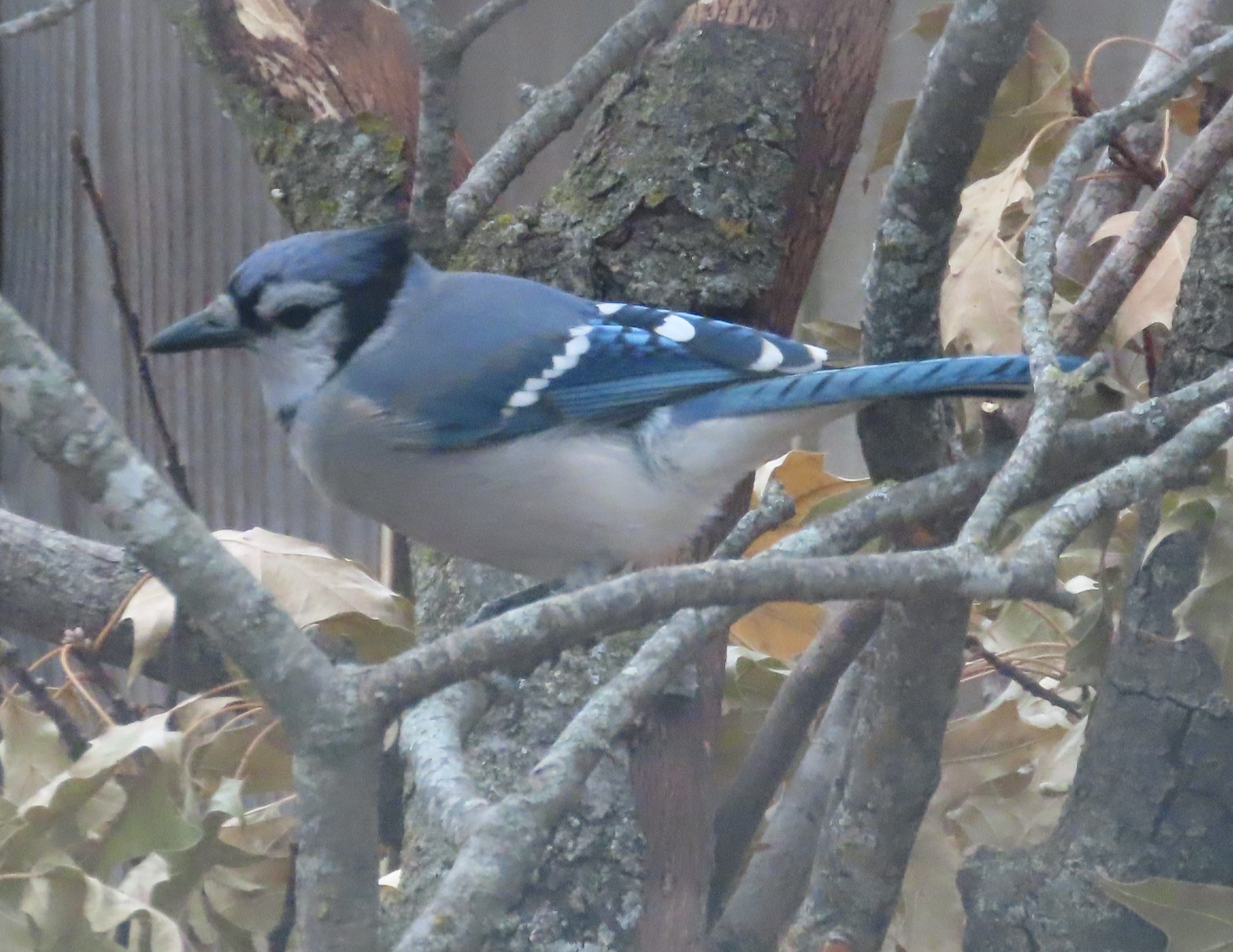
As I write this, the only sounds audible through the walls and windows are gunshots at the firing range on the prison property, light vehicle traffic, and an occasional dog bark. We wait for the birds to visit in waves of brief duration, usually mixed flocks of House Sparrow, juncos, chickadees, nuthatches, titmice, cardinals, Blue Jays, Mourning Dove, and woodpeckers. House Finches prefer to have the feeders to themselves and seldom appear with the other birds. What competition there is tends to be relatively peaceful, though until we can translate perfectly the calls of birds, who knows what is profanity.

Birds are not here for our entertainment, of course. Science tells us they fill niches unoccupied by other species, and provide ecosystem services such as membership in the food web, seed dispersal, and suppression of insects that would overwhelm entire ecosystems without checks and balances from avian predators. Still, such arguments are dry, impersonal, and relatively weak in convincing lawmakers and corporate executives of the need for conservation, preservation, and creation of bird-friendly habitat.

That is where comfort and joy come in. Birds, and other undomesticated organisms, are critical for the personal and social functioning of a great many people. The passion for birds is so great that it creates jobs itself: Seed growers and processors, feeder manufacturers, optical industries, travel and tourism, and parks and recreation agencies all depend on, and cater to, birders. Artists! Increasingly, landscape architects are specializing in planning and executing native plantings with birds in mind. Failing to acknowledge the comfort and joy that wild birds bring to citizens is an affront to human rights, and threatens to undermine our collective mental health, and even some livelihoods.

My partner and I have the luxury of White privilege, enough disposable income to feed the birds, and enough time to enjoy them. We can even travel to see birds elsewhere. We’re so far ambulatory and without most other physical challenges. It is incumbent upon us, however, to improve inclusiveness and promote diversity in birding whenever and wherever we can. We cannot allow anyone to be less than a proud birder, or birdwatcher, free of derision and shame perpetrated by those who have no appreciation for the living world in its natural state.

Share your bird-joy. Wrap others in philosophical, feathery comfort. Lend your binoculars and field guides. Donate to local, national, and international organizations promoting birding. Do not neglect those aimed at Indigenous, Black, LGBTQ, women, and other traditionally ignored demographics. There may be no greater gift you can give this holiday season, or at any other time of year.

Monday, August 3, 2020

Book Review: A Season on the Wind

Kenn Kaufman does something ingenious in A Season on the Wind: Inside the World of Spring Migration (Houghton Mifflin Harcourt, 2019). He compares and contrasts the way migratory birds harness the wind to propel them northward versus the bumbling attempts of our own species to capture the wind to meet our energy needs. He and his wife, Kimberly Kaufman, live in a unique location where these powerful phenomena clash head on, quite literally. To his credit, Kaufman exercises remarkable restraint in addressing the downside of renewable wind energy, while exhorting the miracle that is spring migration at Magee Marsh in northwest Ohio, U.S.A.

The book is a brilliant and colorful chronology of the history of tracking bird migration in the Americas, and northwest Ohio specifically. While many birders recoil at the notion that anything good can come from hunting, the author reminds us that the first major strides in bird conservation came about as a result of preservation of wetlands by waterfowl hunters. The organization of hunters into a cohesive unit of persuasion and legislation is something birders should take note of and emulate to achieve more widespread measures to preserve and protect our avian fauna.

From the almost primitive practice of bird banding, to next generation radar, citizen science initiatives, and birding festivals like the Biggest Week in American Birding right there at Magee Marsh, we are constantly improving our collective and individual understanding of spring migration. Kaufman deftly walks the line between what is often seemingly dispassionate formal scientific research and the nearly anthropomorphic appreciation of birds by non-scientists. The book, like the author himself, delivers fact, humor, emotion, and honesty in its appraisal of our constantly-changing, nearly schizophrenic relationship to the natural world, with birds at the center.

It would be easy to write effusively about the spectacle of bird migration as if it exists in a vacuum, a historical constant, a changeless exercise that goes on relentlessly regardless of our own existence. Most writers would simply paint a rosy picture that serves to recruit new birders and birdwatchers, and entertain readers without ever hinting at the negative impacts our species can have on migrant fauna.

Likewise, it would be easy to write a downer of a narrative that focuses solely on the perils birds face during their aerial journey north. There is certainly enough material for one to take a full manuscript in either direction. Balancing the joys with the sorrows, anger, and frustration is no easy task, but that is clearly what Kaufman set out to do, and he executes it flawlessly. When you think you cannot recover from the devastation of the previous chapter, the next one renews your enthusiasm and optimism.

One of the most significant points illustrated in A Season on the Wind is the growth of birding as a social activity. Thanks to advances in communication, formerly isolated naturalists and leisure birders can connect with each other to any degree they wish. Some still prefer “alone time” communing with the nature, but that no longer has to be the default setting. The speed of learning about birds has increased by several orders of magnitude, and the diversity of the birding community has the potential to explode as well.

Kaufman, his wife, and their contemporaries in the ornithological community are as relentless in their pursuit of justice for birds and birders as the birds are committed to their instinctive drive to move seasonally. The birds must navigate both the constant starlit sky above and the radically shifting landscape below. Climate change is a force we are attempting to mitigate for ourselves and other species, yet it is also the driving force behind wind turbine technologies that are cutting birds out of the sky.

This conundrum forces us to confront problems of scale. Bird migration is not a stream of birds like a river in the sky. The birds are widely dispersed and the grand scale of migration guarantees that migrants will confront lethal obstacles wherever they exist. The scale of wind farms, in both height and breadth, is the problem. Bird-safe technologies exist, but offer little profit for utility companies, so they remain neglected. By now we should have reciprocal power grids, mostly localized, where individual households and businesses can feed a centralized source with surplus energy in sunny, breezy times and draw from it on cooler, calmer days.

I am already anxious for a sequel to A Season on the Wind, as the emerging discipline of aeroecology recognizes the complex web of organisms that exists overhead, and seeks to unravel those aerial interactions. Meanwhile, you will find this current book a thoughtful, stimulating, and optimistic read.

Tuesday, April 3, 2018

The Eagle and the Flycatcher

Taking to the road in search of birds is usually a rewarding, relaxing experience, but sometimes it can be a roller-coaster of emotions. Such was the case on April first when my wife and I set out over the plains east of Colorado Springs in mid-afternoon to take advantage of a sunny, cool, day. We had no idea what was in store for us.

More on him later

We drove south down Interstate 25, and took the exit for Hanover Road, as we have done countless times. We quickly got one of our target birds, our first Turkey Vultures of the year for El Paso County. A whole kettle of them was circling over fields adjacent to Fountain Creek. The rolling shortgrass prairie here is studded with cholla cacti, which are sometimes so thick as to create a stubby forest of the spiny succulents.

Farther out on Hanover Road we saw a vehicle pulled over on the shoulder, and a woman looking at what first appeared to be a chunk of retread from a truck tire. We slowed, and I noticed that the rubber debris had feathers. "Oh, wow, that's and eagle" I said to Heidi, and we pulled over ourselves. Walking back, I greeted the woman and asked if she was a wildlife officer or someone assigned to pick up deceased raptors. She said no, she lived in the area and had seen the Golden Eagle flying in this vicinity earlier in the day. She had found it in the middle of the road, as indicated by residual downy feathers still adhered to the pavement by dried bird blood. She had placed the corpse where it now lay.

Maybe my coping mechanism for tragedies like this is to immediately begin thinking of how to make the best of a bad situation. It was an adult bird, as I could best determine by lifting a wing and finding no white patch like the juveniles have. We hoped it was not on a nest, but at this time of year that is a distinct possibility. This was a freshly-killed bird, no rigor, though it had clenched talons on one foot.

Note: Possession of a dead bird of prey, especially an eagle, or even its feathers, is a federal offense. Taking the bird ourselves, even with the best intentions for depositing it, was not an option. Ever the quick-thinker, Heidi suggested we call a friend who has experience with this kind of thing. Miraculously, out in the middle of nowhere, we had a cell phone signal. I dialed our friend and luckily she picked up. She promised to do her best to track down a state official to go and fetch the body. She would call back with a verdict one way or the other. My phone did not ring. Heidi found she did have a voicemail message, and we listened to that. Success! There was no Colorado Parks & Wildlife person on duty, but the state police would find someone and we would get a call from whomever it was.

A couple minutes later my phone rang and an off-duty officer was on the other end. We described our location, even with GPS coordinates thanks again to Heidi, and he told us it would take him at least twenty minutes to get there. Bear in mind this is Easter Sunday. I told him we would wait....

Surprisingly, traffic was not entirely absent from this rural stretch of two-lane road, and we wondered if each approaching vehicle was "the guy." Most cars and trucks barely slowed, some rushing past at speeds well in excess of the posted limit. That might explain the dead eagle, and I wondered to myself why no one bothered to ask if we were broken down. Check that, one older gentleman in a pick-up did pull up next to us to make sure we were all right.

About thirty minutes after my phone conversation with the wildlife officer, another truck, approaching from the opposite direction we expected our hero to come from, slowed down and pulled a u-turn behind us. I asked if he was here for the bird and he confirmed it, displaying his badge upon exiting his vehicle. He had brought his wife with him. She is even more experienced with birds than himself, he informed us. So began "CSI: Ornithology."

One thing that puzzled us all was that the entire tail of the eagle was missing. The wildlife officer suspected that someone had yanked the tail feathers, which are prized in Native American cultures for ceremonial dress and rituals. There was a blood trail. More feathers on the other side of the road, but the bird's wings appeared to be almost undamaged, so there was another head-scratcher. Examining the carcass revealed just how extensive the damage was. A broken leg. Massive injuries where one wing joined the body. The blood on the bird's hooked beak could well be its own.

Much to our surprise, another birder friend of ours pulled up, having recognized us and being curious as to what all the commotion was about. She greeted us warmly but quickly breathed a sigh of sorrow at the reason for our roadside gathering. As we wrapped up our crime scene investigation and climbed into our car, Heidi told me that our birder friend was returning from seeing another spectacular bird, this one still living, just down the road.

"They saw a Vermilion Flycatcher?" I asked incredulously. Yep, a male, too. This is a pretty common bird....in southeast Arizona, along the Rio Grande, and the Gulf Coast. This far north? Not so much. The bird was hanging out behind the fire station in Hanover. It had been there pretty much all day. We arrived to find one of Colorado's foremost birders on hand with a spotting scope, dutifully pointing out the bright red bird to the steady parade of "chasers" who flocked to the location for their own viewing pleasure. This gentleman is absurdly generous with his time. He has more patience than a saint.

Heidi and I could have had a supremely awful afternoon had our most memorable experience been coming across that eagle. We owe it to friends, and the bird gods, for providing us with an exhilarating "upper" to end our day. No one promises that pursuing your passion is always going to be a positive thing, but if you do the right thing in the face of the worst circumstances your favorite pastime can deliver, then you will still be rewarded. It may not always turn out the way our Easter excursion did, but you can at least sleep well in the aftermath.

Sunday, February 4, 2018

The Geometry of Luck

Birding and wildlife observation in the digital age means that our experiences in nature are defined more than ever by GPS (Global Positioning System) coordinates, maps, and other geography-based intelligence. The wildcard is always time. Your personal success or failure, if you frame it that way, will always come down to the matter of "when."

Immature Golden Eagle

The old philosophical question of whether a tree falling in the forest makes a sound if no one is around to hear it is an apt comparison. Had no one seen the Rufous-necked Wood-rail at Bosque del Apache National Wildlife Refuge back in July, 2013, had the bird really been there at all? Were it not for video evidence, and personal experience, professional ornithologists would no doubt still be skeptical.

These days, sightings of rare birds, stray migrants, and aberrant color forms seem to cross social media intersections monthly, if not weekly. Our historical perceptions have suffered from too few data points, it appears, and too few observers in too few places. Today, the likelihood of a birder intersecting something spectacular is greater than ever. Thanks to instant communication, that birder can also greatly increase the likelihood that other birders will have the same exciting encounter, provided they get there in time. However, the odds of the flight path of a Golden Eagle crossing my vehicle's path on my way to look for Mountain Plovers is still infinitesimal.

"Everyone" has been seeing that wayward Varied Thrush. Right here. How could I have missed it? Then again, I hadn't seen Bill and Ashley in about two years....and I got to meet Jeff in person for the first time. Maybe that is why I was supposed to be here, right now, without any birdy distractions. Sometimes, your interpretation of a situation makes all the difference.

Varied Thrush

The frequency with which you are out observing, or even attuned to possibilities of witnessing nature, the greater the chance of memorable encounters. Storm chasers know this better than anyone else, and they also accept defeat more readily than most of us even aspire to. Few of us commit to regular outings. We have jobs, family obligations, and fuel costs to consider, among other variables that directly or indirectly conflict with birding and wildlife watching.

Opportunities still abound. We recruit other members of the carpool to birding. We can bird ourselves during our commute, during lunch. When you least expect it, you may notice birds and other animals in the midst of major, unrelated events. I recall attending a Cincinnati Reds game when the team was still playing in Riverfront Stadium. Admittedly, I am not much of a base ball fan, but I enjoy the atmosphere and people-watching. I happened to glance up at the same time that a sleek bird swooped into the arena, alighting on the foul pole. It was a Peregrine Falcon. At the precise instant I was attempting to draw my seatmate's attention to the bird, Barry Larkin belted a home run. As the ball departed the outfield, fireworks were detonated, launching the falcon on its own departing trajectory.

Even people normally unmoved by birds can have unique and thrilling experiences. A video that went viral in April of 2017 was shared by a businessman who was joined on his Chicago commute by a Yellow-bellied Sapsucker that clung to his window as he drove to work. He dutifully pointed out the major attractions to his feathered friend along the way. Eventually, the bird ends up inside the car, on the man's collar or shoulder. "I think he's a woodpecker" the man utters matter-of-factly as the video concludes. There is little doubt the bird was injured and disoriented, and may or may not have survived, but in a matter of minutes it had left an indelible impression on thousands of humans.

Mountain Plover

Is it mere coincidence that the specifics of latitude and longitude are measured in minutes and seconds? That recognition of time is telling. Where you are is made important to you by when you are. The intersection of Kingbird Highway and Bluebird Lane is where crisscrossing vectors meet improbability on the axis of time. Birding is ultimately the geometry of luck. Take your chances, as many as you can.

Sunday, April 2, 2017

Book Review: Vulture

© ForeEdgeBooks.com

Even if you do not already admire the Turkey Vulture as a master of sustained and effortless flight, and its willingness to consume the deceased animal life that would fester and overwhelm us were it not for these efficient scavengers, you will find Vulture: the private life of an unloved bird University Press of New England, 2017), by author Katie Fallon, to be well worth your indulgence.

Experience informs the advocate, and Fallon does a superb job at weaving her personal life experiences into the narrative of this story. The natural arcs would be the life history of her subjects, from egg to adult; or the migratory journey of a vulture. Indeed, Fallon employs these natural rhythms as elements of continuity; but it turns out not all Turkey Vultures do migrate, a fascinating aspect of the diverse biology of the species.

Familiarity cannot breed contempt in the case of vultures because people, including avian scientists, are simply not familiar with these birds. Much of the content in Vulture represents new information, acquired within the last decade or so, resulting from tagging studies. Vultures cool themselves by urinating and defecating on their feet, which quickly corrodes the metal ankle-bands used by scientists on other birds, hence the need to apply the wing tag strategy instead.

An unexpected and welcome element to the book is the frequent addition of information that applies to other vulture species. The Turkey Vulture is the main character, but our avian hero is also employed here as a messenger for other vulture species all over the planet. Fallon shares her own globe-trekking adventures as they relate to other vultures, like the Egyptian Vulture in India, where the birds have vanished from a sacred Hindu temple they once visited like clockwork. Old World and New World vultures are not as closely related as one might imagine, but they suffer, unfortunately, from the same conflicts with humans.

It is easy for advocates of any orphaned or maligned species to be overly zealous in their efforts to educate; or be too sternly admonishing in addressing those people who lack an understanding and respect for other life forms. Fallon should be commended for reining in her emotions while still managing to be assertive in her opinions and policy recommendations when it comes to vulture "management" here in the U.S. She backs up her statements at every step, and also informs the reader when there is a need for more study to conclude whether a given assertion can be proven.

Fallon should not be compared to any other writer. She confesses to her admiration for Edward Abbey and other predecessors, but her writing stands on its own merits, with a unique and welcome new voice. This book enjoys the personal qualities of a memoir, but those insights and life events are used like spices in a favorite recipe: Not as a dependent "crutch" or overwhelming element, but instead adding just a touch of flavor and eloquence to the literary dish.

This book is about vultures in the human world, but nowhere in the story does the human aspect overly intrude. The great birds are front-and-center, consistently painted in a positive and empathetic light. It is to Fallon's credit that she is able to coax the reader into the same love affair with vultures that she herself enjoys, without romanticizing her subject to the point of putting off her audience. As a male reader, I find this a tricky path that Fallon negotiates with precision and consistency. Her research is far-reaching and impeccable.

Vulture ends with an afterword that leads readers to the next step: their own advocacy for vultures and related birds of prey. It may seem naive to believe that one book could generate enough momentum to result in a surge of sustained interest in promoting vulture conservation the world over, but I have high hopes. Fallon seamlessly integrates the plight of vultures into the landscape of wildlife conservation in general. What we do for vultures we do for the health of entire ecosystems....but don't take my word for it, read Vulture for yourself.

Turkey Vulture over western Massachusetts

Wednesday, January 15, 2014

Birding While Black

© m.inmagine.com, Cupid Alexander (model)

The other day I found myself inside a Barnes & Noble, and picked up the latest issue of Orion, the quarterly nature magazine. One of the first articles that caught my attention was a one-page piece by J. Drew Lanham entitled “9 Rules for the Black Birdwatcher.” At first I thought it might be a comedic or satirical treatment, but it became very clear very quickly it was a rage against the status quo when it comes to “minorities” in a traditionally White recreational and citizen science pursuit.

I hope I am forgiven for laughing quietly to myself over a couple of the rules: “Don’t bird in a hoodie. Ever.” And “Nocturnal birding is a no-no.” They would be hysterical suggestions were they not a reflection of our tragic and obscene stereotypes of African American culture. And of course we are all too familiar with the horrific outcomes those assumptions can lead to: Shooting teenagers who can’t possibly be up to any good if they are in the “wrong” attire in the “wrong” neighborhood at the wrong time.

Dr. Lanham, who is a professor at Clemson University, goes on to express rightful indignation over the reluctance of the birding community at large to embrace diversity, and how the “they all look alike” bias of Caucasians toward Blacks spills over into a hobby that likes to consider itself more refined and sophisticated than average street folk. The Focus on Diversity pre-conference at the Rio Grande Valley Birding Festival is a landmark start, and Lanham has been actively involved in the event for its three years of existence.

We also need diversity in leadership positions. This also applies to the female gender. A recent blog post by Brooke McDonald, entitled “The Field Glass Ceiling,” revealed a mostly unspoken uneasiness felt by many women in the birding community. I am being polite, actually. Unspoken disgust is more like it. The dismissive attitude of some male birders is appalling. There are many accomplished female birders and ornithologists who could be outstanding ambassadors for the birdwatching community.

I must admit that, for the longest time, I myself stereotyped birders as mostly overly-affluent snobs who looked down their noses at anybody else recreating in the great outdoors. My attitude has been adjusted in the last decade or so, and not forcibly so. Kenn Kaufman gently nudged me to look beyond “bugs” again; and Jeffrey Gordon brings a welcoming persona to his role as president of the American Birding Association. The “new” generation of birders has a sense of humor, a sense of responsibility to bird conservation, and increasingly reaches out to young people. They even look at insects every once in awhile!

Back to Birding While Black. I do think that there is genuine concern over the lack of minorities in one of the most popular of all outdoor activities; and that sympathy extends beyond mere "tolerance" and politeness. The challenge lies in how we communicate better, and not sound patronizing or stereotypical. That applies to all parties involved. We need to get out of our comfort zones to accomplish real integration, but the rewards will be well worth the effort.

Note: A Google image search for "African American bird watching" turned up few results. The above image came from a "African American binoculars" search.

Friday, May 3, 2013

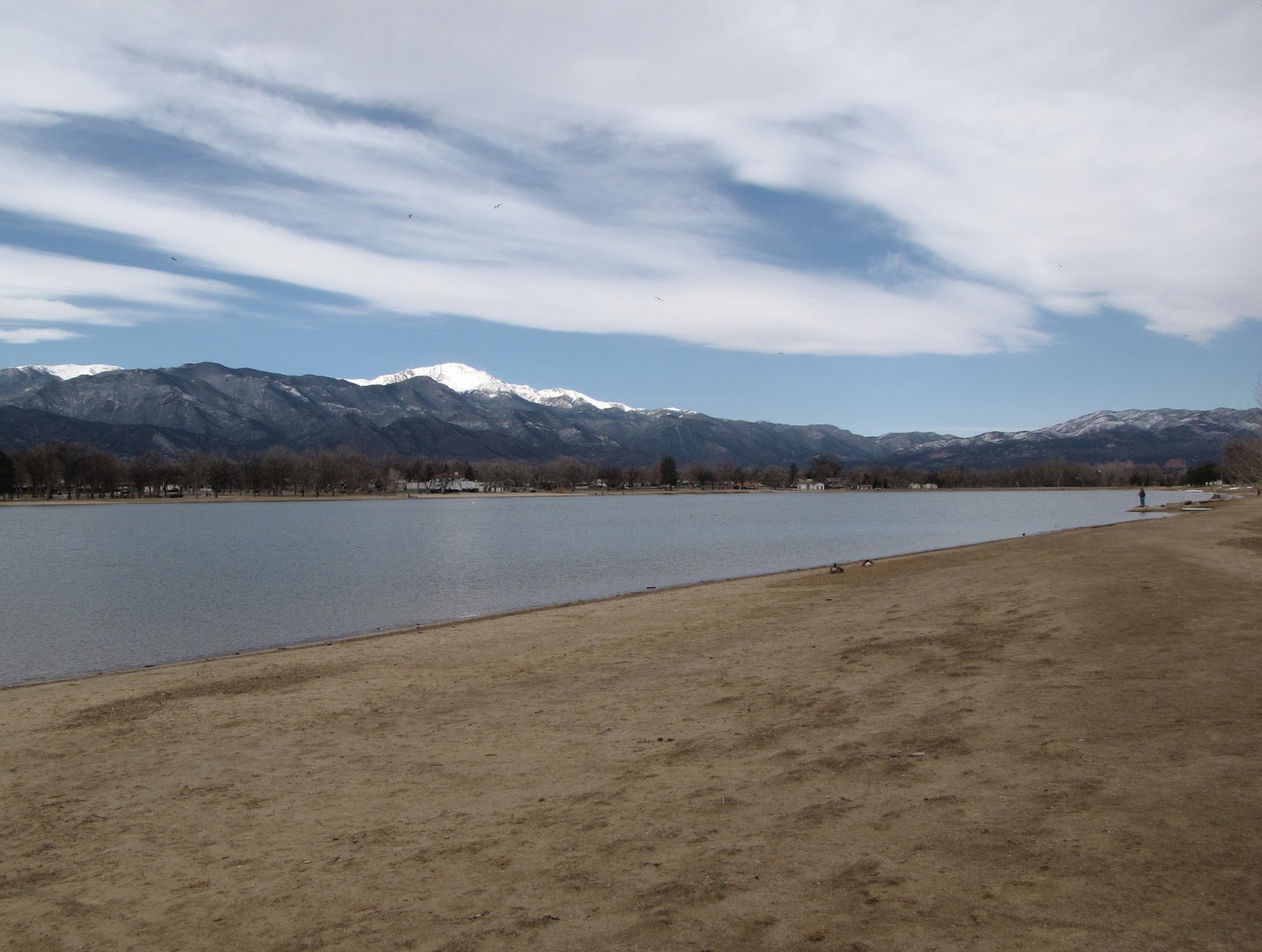
Prospect Lake

I had dismissed Prospect Lake in Memorial Park as just another fake lake in the urban landscape, not worth my time if I wanted to find any wildlife other than Rock Pigeons or European Starlings. Thanks to a Facebook group for the Colorado Field Ornithologists, I found out my assumptions had no validity whatsoever.

About the middle of last month, posts to the group included sightings of the most improbable birds you could imagine: American Avocet, Mountain Bluebird, even American White Pelican. Grebes of at least four species were common. There were pictures of several species to back up the claims.

It is embarrassing to admit that Memorial Park is only about three miles from my home, near downtown Colorado Springs. Yes, Prospect Lake is a large, artificial reservoir, dutifully stocked with trout for fishermen, and with boat ramps to facilitate water skiing, but the water level is low right now, and the boathouse is not yet open for business. I should have paid closer attention.


American White Pelicans

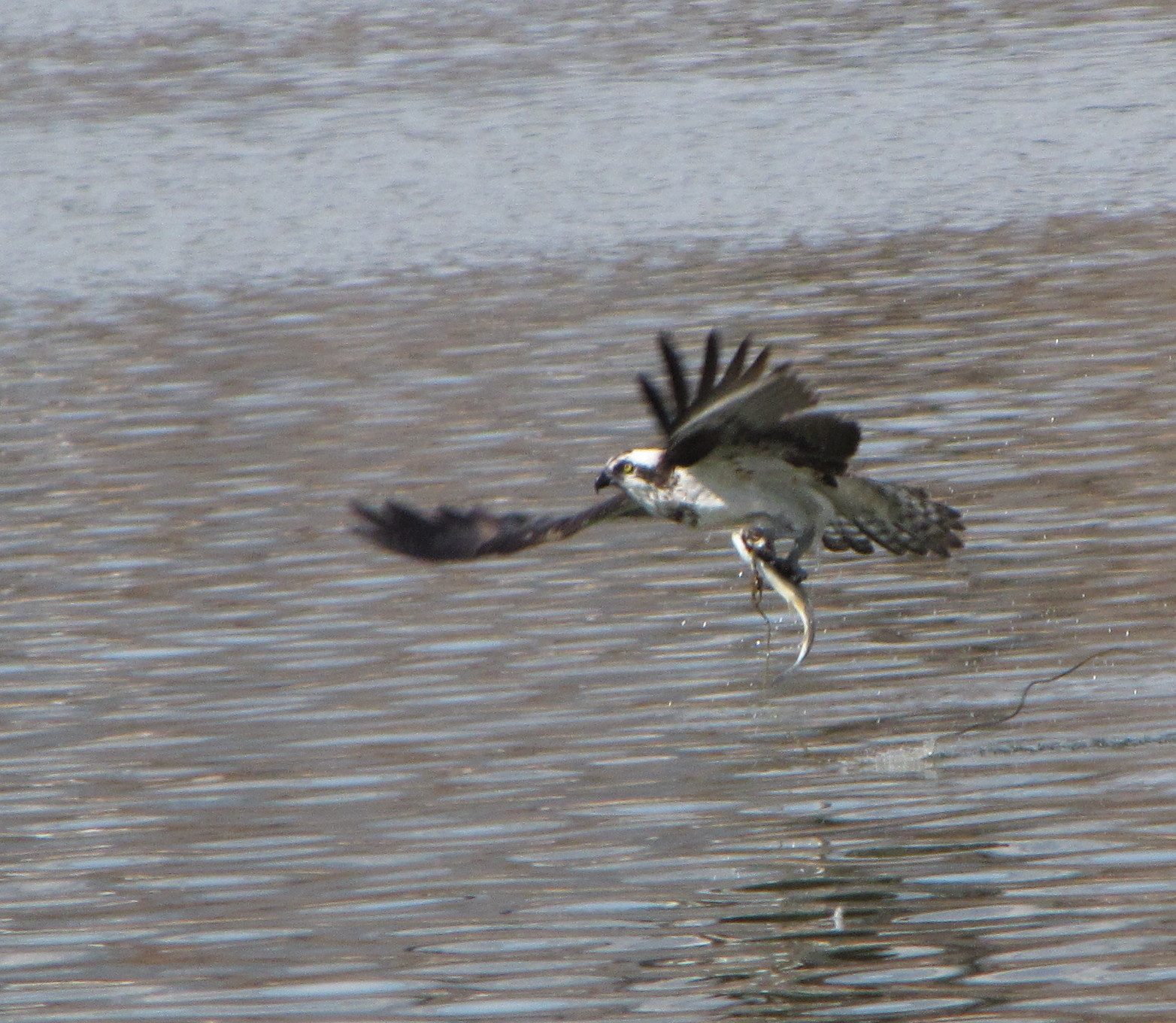
After reading the posts to the ornithology group with my jaw on the floor, I decided I needed to see for myself all the bird diversity. Apparently, on April 19, I was one day too late for the midge hatch that had attracted the large number of birds the previous day. I was still impressed even so. The pelican flock was still there, plus more waterfowl and gulls than I could count. At one point I counted six Ospreys in the air at once. It was like they were lining up and taking turns at the trout….at least until the Bald Eagle showed up and frightened everybody else away.

The land that is now Memorial Park was donated to the city by General William Jackson Palmer in 1890. Prospect Lake was excavated shortly thereafter. Initially, the reservoir was used to supply water to the Evergreen Cemetery, but that need expired in 1950. The water that fills the lake is extracted from the nearby Fountain Creek, a local watershed. A Naval Reserve station occupied the southwest corner of the lake from the late 1940s until the late 1980s. Plans to turn the entire lake over to naval training exercises in 1950 were thwarted by locals who enjoyed recreating on the rest of the lake. The Colorado Springs Fire Department used the armory for training after naval training facilities moved to Fort Carson, but after 2001 all the buildings were abandoned and demolished.

The lake began losing water at a high rate in 2002 when the pipeline supplying the lake was shut off, a severe drought was happening, and the liner for the lake became torn. A movement to add Prospect Lake to the National Register of Historical Places was successful, and spurred action to replace the liner. The lake was refilled and again stocked with fish in 2005, and it remains a vibrant center of recreation today.

The lake is surrounded today by playgrounds, including the state-of-the-art “Swing High” totally accessible playground, plus lawns, ornamental pine, cottonwood, and other trees, ballfields, residential neighborhoods, and commercial real estate. Despite all the hustle and bustle, birds seem to enjoy the area, at least in migration this year.

My own trips to the park on April 21, 26, 27, and 29 yielded a combined tally of the following species:

  1. Mallard
  2. American Wigeon
  3. Blue-winged Teal
  4. Northern Shoveler

    Northern Shovelers
  5. Lesser Scaup
  6. Redhead
  7. Bufflehead
  8. Ruddy Duck
  9. Canada Goose
  10. American Coot
  11. Pied-billed Grebe
  12. Horned Grebe
  13. Eared Grebe
  14. Western Grebe

    Western Grebe
  15. Clark’s Grebe
  16. Double-crested Cormorant
  17. American White Pelican
  18. Ring-billed Gull
  19. California Gull
  20. Franklin’s Gull
  21. Osprey
  22. Bald Eagle
  23. Cooper’s Hawk
  24. Great Blue Heron
  25. Great Egret
  26. Killdeer
  27. American Avocet

    American Avocets
  28. Spotted Sandpiper
  29. Lesser Yellowlegs
  30. Willet
  31. Wilson’s Phalarope
  32. Rock Pigeon
  33. Belted Kingfisher
  34. Downy Woodpecker
  35. Northern Flicker
  36. Tree Swallow
  37. Violet-green Swallow
  38. Say’s Phoebe
  39. American Robin
  40. American Pipit
  41. American Crow

    Osprey
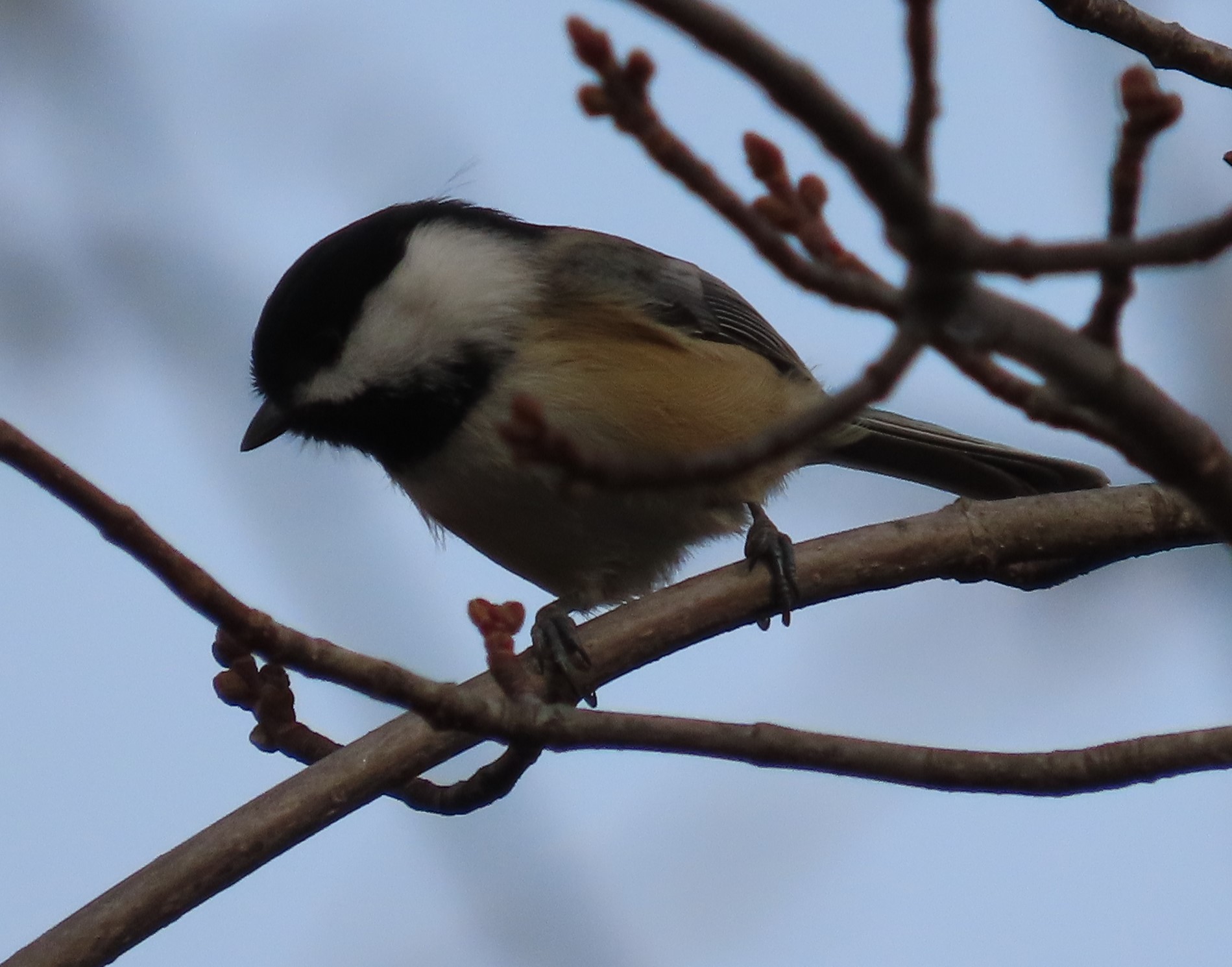
  42. Black-capped Chickadee
  43. White-breasted Nuthatch (heard)
  44. Yellow-rumped Warbler
  45. European Starling
  46. Common Grackle
  47. Brown-headed Cowbird
  48. House Sparrow
  49. Chipping Sparrow
  50. Lark Sparrow
  51. Savannah Sparrow
  52. Dark-eyed Junco
  53. House Finch

I am a novice birder, and I know other species were seen, and have been seen since. Warblers, for example, are only now starting to appear. It just goes to show that you can still be surprised by nature close to home. Really, really close to home.

Sources: Galas, Judith, and Cindy West. 1997. Walking Colorado Springs. Helena, Montana: Falcon Guides (Pequot Press). 233 pp.
Tankersley, Teila. 2010. “Some Interesting Pieces of Trivia on Prospect Lake in Colorado Springs,” Fresh Ink

Tuesday, February 19, 2013

Bluebird Trifecta

Sunday, February 17, my wife and myself and Debbie Barnes of the Aiken Audubon Society set out to find a flock of Bohemian Waxwings that had been seen the day before at the U.S. Army Turkey Creek Recreation Area south of Colorado Springs. We did not find them. The outing was, however, far from a total loss. What we lacked in waxwings we more than made up for in bluebirds.

Our first stop was at the intersection of Barrett Road and Highway 115, where the Bohemian Waxwings had been seen most recently. No sign of them despite a fair crop of juniper berries in the area. Upon exiting back onto 115, we did spot a pair of birds on a telephone wire. They were quickly identified as male Western Bluebirds, Sialia mexicana. One of the two birds obligingly glided to the ground, then popped back up to sit on a fence post about thirty feet from our vehicle, affording the view shown above.

We backtracked to the Turkey Creek Recreation Area, pulling into a playground area with a collection of buildings and the stables where horses for the mounted color guard reside. A Lewis’ Woodpecker is known to hang out there, too, and was sighted earlier in the day, but was a no-show when we were there. No waxwings, either, just more Western Bluebirds, a Common Raven or two, and a flock of Dark-eyed Juncos.

While taking in the austere scenery, Debbie connected with another birder friend, Jeannie Mitchell, via cell phone. Jeannie was kind enough to share that news that a group of birders who were in Turkey Creek that morning had seen a huge flock of Mountain Bluebirds, Sialia currocoides. I admit I was skeptical, but we followed the appropriate road and….

Sure enough, here were probably at least 200 Mountain Bluebirds, distributed on each side of the road. A handful of American Robins, Turdus migratorius, were in their ranks, but the sight of all that turquoise blue was jaw-dropping. One dead tree in particular was essentially festooned with living, feathered ornaments.

By now, around 4 PM in the afternoon, the wind had gotten gusty, the sun lower, and the temperature was dropping. Reluctant to leave, we took it slow and found still more Mountain Bluebirds in a vast open field studded with old yucca and mullein stalks, plus the obligatory barbed wire fences and metal fence posts. Various Mountain Bluebirds took turns alighting on all available perches in really great light.

We also saw what we initially thought was another Western Bluebird. Looking at her pictures once she got home, Debbie realized it was actually a male Eastern Bluebird, Sialia sialis. Note that the Eastern Bluebird lacks the blue throat of the Western Bluebird. The belly of the Eastern Bluebird is also bright white, in contrast to the dirty appearance of the Western Bluebird’s underparts.

Bluebird trifecta! Looking at the distribution maps for bluebirds in the various field guides, one would not guess that the Eastern Bluebird ranges this far west, but here is proof to the contrary. There are always strays, of course, but as habitat, climate, and other factors change, birds adapt and their geographic ranges change accordingly, even from week to week. The convergence of all three species here is now a regular occurrence, especially at this time of year.

Debbie mentioned that bluebirds are feeding on juniper berries when flying insects, grasshopper nymphs, and other prey is not readily available. Cold fronts may push the birds into protected valleys and other warmer situations, but they quickly return when the temperatures warm up again. Sounds like me.

Thursday, February 23, 2012

Weston Bend State Park

Thanks to my fiancée and her family, I am becoming acquainted with some wonderful parks and refuges in the vicinity of Leavenworth, Kansas and nearby areas across the river in Missouri. A recent visit at the end of January and beginning of February included an afternoon hike in Weston Bend State Park near Weston, Missouri.

Considering that our primary reason for this trip to Leavenworth was for the aftermath of a family tragedy, time spent in the quiet of a deciduous forest on bluffs overlooking the Missouri River was a perfect antidote to the stress surrounding funeral planning; and the cozy claustrophobia of too many well-meaning friends and family in one house.

The area has a rich history. Lewis and Clark’s Corps of Discovery reached the vicinity of Weston on July 4, 1804, reporting evidence of a Kansa settlement on the opposite bank of the river. The Kansa were one of several indigenous tribes that first occupied this region. The Lewis and Clark expedition returned two years later, finding fur traders navigating the Missouri.

Agriculture is the current industry here, with tobacco farming leading the way. The park itself even includes five old tobacco barns. One of these has been transformed into a covered shelter available for rent by park visitors.

Weston Bend is a relatively young state park, established in 1980 by the Missouri Department of Natural Resources. The amenities accommodate everyone from casual hikers to campers (traditional or RV) with hot showers, modern restrooms, and even laundry facilities available. The trails meander up and down ravines and along ridges. A lookout offers spectacular views of the Missouri River below, and five or six miles into Kansas on a clear day.

While human visitors are made to feel welcome, so are other creatures. The park is now recognized as an “Important Bird Area” (IBA) by the National Audubon Society, part of the Iatan/Weston River Corridor, a very popular stopover for avifauna during spring and fall migrations. The annual ”Wings Over Weston” birding event will be held at the 1,133 acre park on May 12, 2012.

Park trails are well-marked, with ample ample signage interpreting the local fauna, flora, and historical elements that make the park unique. There are enough warm, or at least tolerably cool, days for one to experience the park at any time of year.

Even in the “dead” of winter one can spot a variety of birds, insects (like the green lacewing below), lichens, and fungi. In the absence of the animals themselves one can find signs of life like the chiseled holes left by Pileated Woodpecker; or the abandoned galls of wasps on oak twigs. Beautyberry (Callicarpa dichotoma) lends a colorful accent to even the dreariest of landscapes here.

I am already looking forward to coming back to Weston Bend State Park, when the forests and bottomlands are greener and even fuller of wildlife. Be sure to add the park to your own itinerary whenever you find yourself in Kansas City, St. Joseph, or Leavenworth. You will not be disappointed.