Showing posts with label Colorado. Show all posts

Sunday, April 25, 2021

Misplaced Again

My wife and I are moving, from Colorado Springs, Colorado to Leavenworth, Kansas. I kid that we are moving to Leavenworth voluntarily, not as the result of incarceration, but the truth is that I am still not a willing participant. Her parents live there, and she wants to spend more time with them. I like my in-laws, so no problems there, but I also spent most of my adult life avoiding my own parents. Even now that both are deceased, I have zero interest in “going home” again.

Like most men, I don’t do well when I interpret a situation as one in which I have no choices. This is especially true when it comes to expenditures that are required for home and car repairs, insurance, medical costs, and other non-elective expenses. Having no choice can also apply to relocation when you either agree with your spouse’s decision or start looking for a divorce attorney. In no way do I “blame” my wife, but I see the window closing on a more optimal retirement scenario for us.

I would have preferred moving farther south, at least. The more I age the more intolerant I have become of extended periods of cold, or rollercoaster weeks like we have here in Colorado. At least we have plenty of sun. Meanwhile, Leavenworth is best known for prisons, the fort, and churches, three institutions that I largely abhor. Mostly, I want to live in a place that reflects my identity, my appreciation of, and dedication to, equality, justice, and inclusiveness.

Over the years we have accumulated far too many material goods, and purging them has been painful. Going through my own parents’ belongings, journals, and keepsakes, and discarding most of it, has left me feeling like I have betrayed them once again. At a visceral level I can’t help but think I am erasing their existence, rendering them invisible and irrelevant. I know that is not the case, but my entire childhood was one of denying that their tumultuous marriage, and eventual separation and divorce, had no impact on me. Then, as an adult, the PTSD asserted itself and I became a crusader for the rights of children of divorce.

The pictures, the household objects, they all symbolize the anger, the longing for stability and peace, and the resentment of the absence of anything resembling normalcy. In retrospect, neither my mother nor father were properly equipped to be parents. My mother did astoundingly well in spite of that, but she was overprotective. My father was just flat-out angry all the time, or on the verge of it. “Mamma’s boy” and “you’re just like your father” were not compliments, and I could not do right by one parent without insulting the other.

My wife put their cremated remains in the same suitcase. I thought they were already there, and was surprised they had not burst into flames all over again. Not funny, really, but they had no reverence for me, either. Yes, I am spiteful. I can be mean and hateful, though I am more aware of the triggers now.

What has been even more painful is what we cannot find in the course of cleaning and packing. The self-portrait in graphite that I did in college is nowhere to be seen. I am most devastated at losing my own creations. I already sacrificed my insect collection, an endeavor of forty-some years. It was the right thing to do, donating it to a museum where it will be properly cared for indefinitely and made available to scientists around the world. Still, I can’t point to it and say “I did that.” That is hugely demoralizing. Like most men, I don’t do well with intangibles, either. There is no observable value to them. My identity is closely tied to what I have produced, if only because that is what our society demands. We must demonstrate concretely our accomplishments. That can be a topic for another blog post.

What am I left with? Where, exactly, am I going, apart from a small town? Why is it not enough to be taking my person with me? Why do I assume I no longer have freedom, in any sense of the word? What do I have left to do, to be? Where would I rather be? When would I rather be? Who am I really, and how do I reconcile the past and the future?

Thursday, January 30, 2020

Thanks For "Listening"

Earlier this week I attended two local events billed as opportunities for civic engagement. I am still trying to decide if they were a waste of time. One was a “listening tour” of a state non-profit organization that serves as a liaison between Colorado government and a handful of other non-profits concerning disbursement of lottery funds to outdoor recreation and protection projects. Attendees did most of the listening, to presentations outlining updates to the goals of the organization. The other, larger event was a mostly one-sided panel-and-moderator discussion of the future of urban growth in Colorado Springs. The two forums did open my eyes to something I had been blind to, though. We collectively fail time and again to accommodate, let alone welcome, marginalized parties, at least in meaningful numbers.

© nbcpalmsprings.com

The attendance, and leadership, at both events overwhelmingly reflected white privilege, and mostly on the elder end of the age spectrum, too. That this has become what I expect is a tragedy in itself. I am modestly proud of myself for starting to notice, finally, and not being happy about the lack of involvement by people of color.

The urban growth event was so heavily weighted towards seniors that one of the speakers was the Colorado head of the American Association of Retired Persons (AARP). It became a running joke that each of the panel members, five of them, all white men, were either members already, or had recently received an invitation to join AARP.

What do I mean by white privilege in the context of the attendees in civic engagement events? Simple. We have the luxury of free time. We are not working a second or third job, or a second shift, in the late afternoon or evening when such events take place. We have the luxury of at least a modicum of disposable income for communication technology, and to fuel our vehicles to drive to meeting locations. We enjoy the advantage of not being hassled by law enforcement when we show up in locations where non-whites would be met with suspicion, if not hostility. We are able to understand everything being said at meetings because English is our first language. We know our opinions will be met with respect from our white peers, and that no one will question the authenticity of our experiences because they are shared by others. You can probably add additional points to this bullet list.

Oh, I already have another one. The “listening tour” did provide an opportunity to take a survey….by texting. I have a flip phone with less than instantaneous speed. Luckily, a paper-and-pencil option was available, but increasingly there are assumptions made as to the minimal level of technology utilized by citizens. This further marginalizes people who cannot afford those devices, wireless networks, and other supposedly universal products.

The responsible growth forum addressed Colorado Springs and El Paso County, an area that is expected to exceed Denver in population and geographical urban footprint in the not-too-distant future. The only thing worse than unbridled urban growth is growth for whites only….but that is the direction we are headed if we continue to prohibit equal participation in public conversations like this event. I will give civic leaders the benefit of the doubt and suggest that overwhelmingly white participation in public policy-making processes is not by design, but it still reflects a willful ignorance of the factors limiting participation by non-whites, and those who do not speak English.

The treadmill process that yields white privilege authority figures occurs when you have white privilege participation in all civic matters from voting to public hearings and meetings, resulting in the election of white privileged public officials, who then assume their constituents all enjoy the same circumstances as their white privileged benefactors and supporters….In instances where a person of color is elected or appointed, white privilege still colors their agenda, still enforces the boundaries of any meaningful reforms that could result in broader participation and increased leadership by people of color. Shameful.

Does it make me a “white savior” to be pointing out these systemic problems, these unquestioned attributes of institutional racism? I hope not, as that is not my intent. I am sharing my personal observations and interpretations, not putting words into the mouths of others, even fellow Caucasians. We have to start stepping back, take supporting roles, and even then, only when invited to do so. The irony is that all people will benefit and advance from diversity in leadership. I am supremely confident of that.

Tuesday, September 4, 2018

What Would a Truthful Campaign Advertisement Look Like?

© Marketoonist.com

Ready to throw a brick at your television yet over the latest wave of commercials in this election cycle? Me, too. They seem transparent enough, which may be why I find them so distasteful and deceiving. What would an honest ad look like, I wonder, and would it not be a refreshing alternative to the current disguising of agendas?

One of the more insidious advertising campaigns here in Colorado revolves around Initiative 97, where a grassroots public effort led to this measure making it onto the ballot. It would greatly restrict the places where oil and natural gas extraction could take place on non-federal lands. Most of the concern centers on potential health effects upon, and disaster risks borne by, those residential neighborhoods in rural and suburban districts. It would require a drilling location "setback" of 2,500 feet, or greater, from vulnerable parks, creeks, and homes. Scientific studies have suggested adverse public health consequences among populations close to drilling sites; and there have been documented explosions and fires associated with the industry that have resulted in worker deaths.

Naturally, the industry side is not in favor of further constraints, and of course they resort to fear-mongering to incentivize voters to reject Initiative 97. The recurring television ad features a stern-looking female spokesperson warning that the inevitable result of the passage of 97 will be greatly decreased revenue for public schools, fire and police, as well as lost jobs. Their argument is that the "setbacks" would "set back" the economy. This is the same rhetoric we have always heard, as if we believe the fossil fuel industry cares one whit about your safety, your education, or whether you are employed or not. The overwhelming number of these energy companies are not based in Colorado. Heck, some are not even based in this country, as Canadian corporations make ever-increasing inroads into natural resource extraction here in the U.S. and elsewhere. Most of the "jobs" they profess to be creating are open to applicants from all over, not reserved for Coloradans.

Well, maybe we are not as well educated as we would like to imagine, if anyone seriously believes the claims made in this advertisement. It must be a strategy that works, at least in part, or the advertising agencies would not adopt it, and the industry would not endorse it as their platform. That is perhaps the scariest part of it all: that anyone falls for it.

Ok, so what would a more honest approach be? Permit me a little artistic license if you will, but I think it would go something like this: An actual executive in the industry would present the following narrative.....

"We, as executive officers and shareholders, are addicted to the obscene profits we generate through fracking and other fossil fuel extraction methods. We greatly appreciate the generous federal, state, and local subsidies we receive in addition to those profits. We know we could make even more money were it not for those pesky environmental and public health regulations that we have to abide by. It is therefore necessary for us to make large expenditures on lobbyists and public advertising, even creating faux "green" organizations like Protect Colorado and Coloradans for Responsible Energy Development (CRED). Oh, we also have to constantly battle competition from renewable, vastly safer energy sources like solar and wind. That takes money, too. So, you see we need relaxed regulation, not increased regulation, if we are to make up the deficits we perceive in our bottom line. Your health, safety, employment status, and recreational opportunities are not our problem. You want heat, fuel, electricity, and telecommunications at low prices? That we can do for you, if you vote no on Initiative 97. Thank you, from here in the back of my limousine/inside my corner office suite/favorite golf course."

I am not holding my breath that any industry, candidate, or other interest group is going to stop lying and hiding their agenda any time soon, but I would find it more difficult to object to their posturing if it was put forth in an honest manner. Hey, what do they have to lose, right?

Sunday, August 5, 2018

Anger and Apathy

© Pinterest

A few days ago I posted this statement to my Facebook page: "I am angry because I fear the only other option is apathy." I was curious as to the responses, and I was not disappointed. The comments reflect a wide spectrum of viewpoints and coping strategies in our troubling times.

I find that my mind often perceives things as black or white, as limited to only a couple of points on the spectrum. I have been known to become impatient with people who do not express outrage at what I see as an injustice or other wrongdoing, usually inflicted by a government agency or policy, or a private corporation or religious institution. A lack of response in the face of egregious acts I see as either agreement with the action, or apathy.

Why don't you care?! How can you not be as angry as I am? Do not get me started with "life isn't fair." Our only responsibility while we are on this planet is to do our best to make life more equitable. We have instead allowed ourselves to be channeled into a way of thinking that elevates the attainment of vast personal material wealth as the highest degree of success....but I digress.

The responses to my statement were more concerned with personal psyche than with whatever triggers anger. "Anger is only good if you use it for organization towards a goal," wrote the person who replied first. "I go with rage, because horrific sadness sucks," said another. "True...stay with anger," wrote another in agreement.

The next response was perhaps the most revealing, and puzzled me: "Have you tried empathy? I helps me when i get where you are at." That somehow made me even more frustrated, and I answered "My empathy often incites my anger. I have an intense sense of justice and fairness, and of course the world is anything but." Farther down in the comments was a similar answer: "I know how you feel, Eric. And my only statement is this: Empathy expands you while anger only shrinks you. Small words, I know."

No, those are profound words which got me thinking, after I wrote " But I AM empathetic! That is where a lot of my anger comes from: injustices to people I empathize with." What next entered my mind, but which I did not communicate outright, was something to the effect of "do you expect me to have empathy for irresponsibly affluent people, for racists, for bigots, for those who put profits above environmental health? Am I to empathize with people who deny others the right to affordable housing, healthcare, food, and opportunity?" I cannot imagine that is what you mean, but if so then I need to reconsider some of my social media friends.

I am not sure why more people do not see the link between empathy and outrage. You cannot witness injustice after injustice and not be driven to madness....unless you benefit from the status quo. "I too am angry," wrote another friend. They continued "It doesn't help. Neither does the immense sadness I feel. Between the two I am stuck. We have politicians who deny climate change, and politicians who acknowledge it, but refuse to do anything on their watch. I am 74, and will live to see the devastation and great extinctions. They are already happening. I think I am doing what I can. It is not enough." I would argue that sometimes it is enough to simply express solidarity with other empathetic people.

Another sentiment: "Rage, grief, when it's too much, sometimes a numbing sets in. When it hurts too much to care... Everyone has their own way of dealing. Some become apathetic and some don't recognize how much they've changed until an event occurs in their life to wake them up again. Some never wake up. Some never feel alive again. Some fight all of it within and some are lucky enough to have a life that sustains their spirit. Many are not so lucky." Well said, friend.

"I believe ACTION is a third option," mentioned another person, and my response was that I am very much an "idea man." I am horrible at taking action on those ideas. I often don't know where to start. That is why I write. Another person chimed in "Writing is action. And, if compelling, it propels other people to take action. We cannot sit by paralyzed by depression, disappointment, inertia, whatever! The stakes are much, much, much too high...."

I was reminded by another that it might help channel my anger if I read more: "It occurs to me that I ought to read Viktor Frankl’s Man’s Search for Meaning. We’re all talking in affirmative messages that are pertinent for 'normal' times, and they’re still true but don’t feel proportionate to the current set of catastrophes. I want to see how a man got himself through a time when the world was completely falling apart.

What do you do in the face of injustice and misguided priorities by those in power and those who do not know better because of ignorance? Are you shopping differently in the marketplace? Writing and calling your public representatives? Practicing civil disobedience? Please share your ways of coping, and changing the world. Thank you.

Tuesday, April 3, 2018

The Eagle and the Flycatcher

Taking to the road in search of birds is usually a rewarding, relaxing experience, but sometimes it can be a roller-coaster of emotions. Such was the case on April first when my wife and I set out over the plains east of Colorado Springs in mid-afternoon to take advantage of a sunny, cool, day. We had no idea what was in store for us.

More on him later

We drove south down Interstate 25, and took the exit for Hanover Road, as we have done countless times. We quickly got one of our target birds, our first Turkey Vultures of the year for El Paso County. A whole kettle of them was circling over fields adjacent to Fountain Creek. The rolling shortgrass prairie here is studded with cholla cacti, which are sometimes so thick as to create a stubby forest of the spiny succulents.

Farther out on Hanover Road we saw a vehicle pulled over on the shoulder, and a woman looking at what first appeared to be a chunk of retread from a truck tire. We slowed, and I noticed that the rubber debris had feathers. "Oh, wow, that's and eagle" I said to Heidi, and we pulled over ourselves. Walking back, I greeted the woman and asked if she was a wildlife officer or someone assigned to pick up deceased raptors. She said no, she lived in the area and had seen the Golden Eagle flying in this vicinity earlier in the day. She had found it in the middle of the road, as indicated by residual downy feathers still adhered to the pavement by dried bird blood. She had placed the corpse where it now lay.

Maybe my coping mechanism for tragedies like this is to immediately begin thinking of how to make the best of a bad situation. It was an adult bird, as I could best determine by lifting a wing and finding no white patch like the juveniles have. We hoped it was not on a nest, but at this time of year that is a distinct possibility. This was a freshly-killed bird, no rigor, though it had clenched talons on one foot.

Note: Possession of a dead bird of prey, especially an eagle, or even its feathers, is a federal offense. Taking the bird ourselves, even with the best intentions for depositing it, was not an option. Ever the quick-thinker, Heidi suggested we call a friend who has experience with this kind of thing. Miraculously, out in the middle of nowhere, we had a cell phone signal. I dialed our friend and luckily she picked up. She promised to do her best to track down a state official to go and fetch the body. She would call back with a verdict one way or the other. My phone did not ring. Heidi found she did have a voicemail message, and we listened to that. Success! There was no Colorado Parks & Wildlife person on duty, but the state police would find someone and we would get a call from whomever it was.

A couple minutes later my phone rang and an off-duty officer was on the other end. We described our location, even with GPS coordinates thanks again to Heidi, and he told us it would take him at least twenty minutes to get there. Bear in mind this is Easter Sunday. I told him we would wait....

Surprisingly, traffic was not entirely absent from this rural stretch of two-lane road, and we wondered if each approaching vehicle was "the guy." Most cars and trucks barely slowed, some rushing past at speeds well in excess of the posted limit. That might explain the dead eagle, and I wondered to myself why no one bothered to ask if we were broken down. Check that, one older gentleman in a pick-up did pull up next to us to make sure we were all right.

About thirty minutes after my phone conversation with the wildlife officer, another truck, approaching from the opposite direction we expected our hero to come from, slowed down and pulled a u-turn behind us. I asked if he was here for the bird and he confirmed it, displaying his badge upon exiting his vehicle. He had brought his wife with him. She is even more experienced with birds than himself, he informed us. So began "CSI: Ornithology."

One thing that puzzled us all was that the entire tail of the eagle was missing. The wildlife officer suspected that someone had yanked the tail feathers, which are prized in Native American cultures for ceremonial dress and rituals. There was a blood trail. More feathers on the other side of the road, but the bird's wings appeared to be almost undamaged, so there was another head-scratcher. Examining the carcass revealed just how extensive the damage was. A broken leg. Massive injuries where one wing joined the body. The blood on the bird's hooked beak could well be its own.

Much to our surprise, another birder friend of ours pulled up, having recognized us and being curious as to what all the commotion was about. She greeted us warmly but quickly breathed a sigh of sorrow at the reason for our roadside gathering. As we wrapped up our crime scene investigation and climbed into our car, Heidi told me that our birder friend was returning from seeing another spectacular bird, this one still living, just down the road.

"They saw a Vermilion Flycatcher?" I asked incredulously. Yep, a male, too. This is a pretty common bird....in southeast Arizona, along the Rio Grande, and the Gulf Coast. This far north? Not so much. The bird was hanging out behind the fire station in Hanover. It had been there pretty much all day. We arrived to find one of Colorado's foremost birders on hand with a spotting scope, dutifully pointing out the bright red bird to the steady parade of "chasers" who flocked to the location for their own viewing pleasure. This gentleman is absurdly generous with his time. He has more patience than a saint.

Heidi and I could have had a supremely awful afternoon had our most memorable experience been coming across that eagle. We owe it to friends, and the bird gods, for providing us with an exhilarating "upper" to end our day. No one promises that pursuing your passion is always going to be a positive thing, but if you do the right thing in the face of the worst circumstances your favorite pastime can deliver, then you will still be rewarded. It may not always turn out the way our Easter excursion did, but you can at least sleep well in the aftermath.

Thursday, March 22, 2018

Unfriendly Fire

© KOAA.com

Having military bases as neighbors is not without its irritations, but last week civilians were forced to evacuate when the Carson Midway Fire swept through their neighborhoods after "going off the reservation" as it were. While I support our troops, the men and women on the ground at home and abroad, I do not always endorse the missions they are sent on, nor the leadership calling the shots. It is my opinion that the Army base of Fort Carson clearly compromised public safety by insisting on using live ammunition for training exercises during red flag warning days of high winds, exacerbated by severe drought. Surely, solutions exist.

The Carson Midway Fire actually represents the fusion of two separate fires. The merger resulted in the burning of 3,300 acres, reaching the El Paso-Pueblo County line, west of Interstate 25 near the Pikes Peak International Speedway. It was that portion of the fire that consumed several structures, including two homes, and resulted in at least 250 evacuations. It also ignited an enormous pile of discarded tires. Those tires are still burning as I write this, and evacuees from the immediate vicinity are not being permitted to return due to the dense smoke and toxic fumes emanating from the burning heap of rubber. According to one spokesperson, there are heavy metals in tires that, when there is "incomplete combustion," liberate toxic chemicals, especially cyanide. Terrific.

Fires in rural areas here also affect livestock, so accommodations have to be provided for evacuated horses, cattle, and other large animals, plus smaller pets. Colonel Fitch may have empathy for evacuees and those who lost their homes or other structures, and remorse or regret for how things went south, but if so it was not on display at the press conference on March 16. Instead, he asserted matter-of-factly that imminent deployments of personnel to Afghanistan and elsewhere necessitated employing live rounds during training. Meanwhile, the El Paso County Sheriff's office is the agency left holding the bag.

This is a fast-moving story, and now the Environmental Protection Agency (EPA) has taken over the extinguishing the tire fire and subsequent clean-up of the underlying soil contaminants resulting from the fire. Evacuees might be allowed to return today (Thursday, March 22), but no final call has been made.

It remains unclear among the myriad of agencies involved as to which ones will be deemed responsible for compensating for damages, or providing relief in other ways. The Red Cross did set up an evacuation center in Fountain, Colorado, and as usual the state fairgrounds in Pueblo offered shelter for livestock. Two other centers were established to receive smaller animals. What happens next?

An online petition is now circulating calling for the prohibition of live fire rounds on the Fort Carson base during red flag days of high or extreme fire danger. The petition has already secured over 2,000 signatures. The purpose of this petition should not be read as a desire to hamstring our military operations, but instead to insure the safety of both military and civilian personnel, and to limit the impact on precious fire-fighting resources that can be stretched thin given the outbreak of fires off the base.

No matter the jurisdiction, when it comes to fire prevention, everyone should be playing by the same rules. This is simply common sense, and would unite our diverse community instead of dividing it. The Front Range is a unique and complicated amalgamation of urban, rural, military, and wilderness landscapes. Establishing guidelines that respect those diverse interests, public or private, is not without its challenges, as we are learning from this unfortunate event. We need to come to the table and make some tough decisions before the fire next time.

Sunday, February 11, 2018

Sprawl vs. Nature at Banning Lewis Ranch

What we have here is a failure to appreciate. The prairie presents an illusion of emptiness, giving license to unwitting abuse. It looks like a waste of space, Mother Nature's vacancy sign beckoning development. Indeed, how could it have any other value besides potential for human housing, shopping, and business?

A herd of Pronghorn near Jimmy Camp Creek Park, a parcel of the annexed Banning Lewis Ranch at the eastern edge of Colorado Springs

Vastness defines the landscape and the ecosystem. It quite literally cannot exist at a smaller scale. Sprawl, and industrialized agriculture, are killing it. Subdivisions and strip malls are poor replacements for prairie dog towns. Those rodent settlements foster far more diversity than any human equivalent. A prairie cannot even be properly grazed when it has been fragmented into disconnected patches. The deer and the Pronghorn can no longer play; and the bison? Long gone, unable to roam once highways divided the range. Heck, even the railroads spelled their doom.

Some summer day take a walk through the grass. Tall, short, or non-existent, it hides the truth of abundance. You will realize the very ground is alive, a blanket of grasshoppers, crickets, leafhoppers, beetles, ants, solitary bees and wasps, and flies. Horned Larks burst from beneath your feet to alight on barbed wire fences. Meadowlarks sing from the posts. Above them kingbirds perch on power lines and bare tree branches. Higher still soar Red-tailed and Swainson's Hawks and Golden Eagles. Mountain Plovers contradict their name, nesting in the middle of the nowhere plains.

What we have here is the failure of assumptions. We assume that the definition of progress is the erection of man-made structures, opportunities for acquisition of material goods, services, and personal financial wealth. The other side of that balance sheet is environmental health, ecological integrity, and the well-being of those people who value such things. Even if you do not count yourself among those who bird, or otherwise enjoy other living organisms, you are obligated to respect the rights of those who do.

Our collective civil liberties include the pursuit of intangibles, emotions, and fulfillment that cannot be quantified or even fully explained. How does one articulate the exhilaration of seeing a Prairie Falcon blazing across the sky? How do you measure the importance of personal or scientific discovery, such as spotting a Mexican Silverspot butterfly, never before seen in Colorado, or this far north of the Mexican border? That happened in Jimmy Camp Creek Park.

Mexican Silverspot butterfly

We have choices. We can choose to have a city of muscle, bone, and heart at its core, or a city fat with haphazard housing developments and shopping centers flung into the outskirts. It may seem the logical thing to do, adhere to the annexation-and-build model that every city seems to follow. It may even feel like a necessary action. Ah, but that is how an addict thinks.

Our city and county leaders may need rehab. Perhaps they need to be sent to Portland, Oregon, or some other municipality that has learned proper land use planning, worked diligently for public and private consensus, and actually allowed annexation to pay for itself, something that rarely happens. A flexible "urban growth boundary" may be in order to accommodate not just new residential neighborhoods, but local agriculture and wildlife corridors.

There is nothing that has yet been done with the Banning Lewis Ranch property that cannot be undone, but once you build there is no turning back. No recapturing the scenic views. No tearing up the roads, no calling back the birds, the bees, the Pronghorn. We must have all stakeholders at the table before we do anything more. We have to consider all potential solutions, all values. Maybe that means adding more land to Jimmy Camp Creek Park and Corral Bluffs Open Space. Perhaps the state could take over the property as a wildlife management area. Should cattle continue to graze there? What should be the role of local farmers? How do we manage the water? We need honest, open dialogue that includes more than elected officials and real estate developers. It will go a long way toward transparency and true democracy, toward a healthy human ecosystem.

Friday, February 9, 2018

Peace Officers

We have already had three law enforcement officers slain in Colorado this year. The latest casualty resulted from an incident roughly half a mile up the road from my home. A total of four officers were shot, one of them fatally, plus the suspect (also a fatality) and an innocent bystander. What I learned is that we cannot properly grieve for these tragedies any more.

© KKTV News 11

What does it say about our current culture that one of my first thoughts was that I hoped the deceased suspect wasn't Black? That was not a likely scenario, if only because we do not have a high population of African Americans here in Colorado Springs. I think our community suffers from that, a lack of visible diversity and the cultural richness and vibrancy that comes with it. I digress. The line between the good guys and the bad guys is not as readily defined in this day and age as it once was. We trust no one, like we are living in an episode of The X-files or something. Authority has lost our respect, and too often there is a corpse unable to prove its innocence.

Maybe it never really was clear cut. Back in the nineteen sixties and seventies, when I was just a kid, activists used epithets to refer to policemen: Pig. The Fuzz. Copper. Cop. The consensus seemed to be that the police force worked for "The Man," not for average, ordinary citizens. Moreover they were agents of oppression of both ethnic minorities and minority viewpoints that disagreed with "the establishment." Sound familiar? Today, Whites are more likely to consider abuses of lethal force against minority suspects as isolated instances instead of rampant racism and oppression, but Black Lives Matter and other movements would beg to differ.

Alas, the shootout up the street appears to have no such controversy. El Paso County Sheriff's Department and Colorado Springs Police Department were conducting an investigation of an auto theft when things turned violent. A stolen car. That was worth killing for? The shooter was a 19-year old male. He had his whole life ahead of him, even if he had been arrested. The slain officer who died, to the day, on the eleventh anniversary of his hiring, had his two twin children's lives to look forward to.

We are appalled, disgusted, and struggling to come to terms with this as a neighborhood and city and county. We need to have a short memory, yet are told to never forget. I have walked that stretch of street countless times, and now it will never be the same. It has never crossed my mind that but for the grace of God I could take an errant bullet. No one should be living with that fear. Anywhere.

The public trust in law enforcement at street level here seems relatively healthy, for now, but one gets the uneasy feeling that it could all come apart with one incident of questionable use of force, someone's phone video, or a peaceful demonstration met with officers in riot gear. I think the bottom line in any given scenario is that the one who is the aggressor will always be the bad guy. Most of the time that will be a criminal, but once in a while it will be someone in uniform.

There are no easy answers, but maybe we can start with language. We can choose to continue throwing around derogatory slang terms for the police, or we can look at a thesaurus, as I did just now, and see that the first synonym listed for police officer is peace officer. Say it with me. Say it out loud. It has a calming quality, does it not? When was the last time you heard the word peace at all? Have we given up on the notion, even in our daily lives, let alone in regards to world conflicts? Maybe we need hope officers, too.

It takes a special breed of human being to comprehend the potential confrontation of their own mortality on a daily basis, and still want to serve the public good in the name of peace and justice, with the goal of saving lives and preventing violence and crime. You and I may not be that kind of person, but we can lead by example, be peace officers of a different caliber. We can go beyond mere racial "tolerance" and accept everyone as equal. We can walk the streets confidently, unarmed, unafraid, and eager to help others in need. Be not the aggressor. Be like Micah Flick.

Wednesday, January 11, 2017

Letters to....Colorado Parks & Wildlife Re: Predator Control

Our Colorado Parks and Wildlife have recently made public a plan to hunt bear and mountain lion in select areas of the state in an effort to increase populations of deer for hunters. The period for public comment is apparently still open and I took it upon myself to draft the following letter to the commission at dnr_cpwcommission@state.co.us. I encourage others to make their voices heard as well.

Dear Commissioners:

I hope this comment in opposition to the proposed predator control strategy for bear and cougar does not come too late in the process.

While I support the hunting of game animals, and understand the occasional need to put down a "nuisance bear" or other individual predator, I am vehemently opposed to hunting non-game wildlife otherwise. It is my opinion that we do not have adequate knowledge of predator populations to ensure that hunting would not cause undo harm, not simply in decreasing populations beyond a viable threshold, but also by weakening the gene pool. This may already be happening with game animals because human hunters tend to target the healthiest, most robust specimens while natural predators go after weak, diseased, elderly, and young prey.

Secondly, for better or for worse, the cat is out of the bag, so to speak, in terms of our current understanding of the biology of predators. Research by state and federal agencies, universities, and private organizations and individuals has revealed these animals to be far more complex and admirable than previously recognized. Documentary filmmakers have turned public sentiment in favor of fostering populations of predators. Whether or not you decry anthropomorphism, you have to recognize that the public is now going to oppose hunting predators in most instances. In fact, there is widespread support for increasing predator populations to balance what is seen as a surplus of deer, elk, and other prey species.

The idea that predator control is necessary for deer and other game animals to prosper has been disproven time and again since the days of Aldo Leopold and his land ethic. I know that I am not saying anything you do not know already, I respect your individual and collective intelligence, knowledge, and experience. However, we have reached a point in history where politics no longer has a place at the table.

Hunters may have a strong lobby, but that does not mean those who pursue wildlife in a non-consumptive fashion to watch, photograph, paint, and otherwise take away experiences that do not involve killing an animal, do not have rights as well. They are simply not as organized, in many cases not as wealthy, and are certainly a lot less quantifiable. This does not mean their numbers are small, or their voices should be ignored. I am quite confident I speak for hundreds if not thousands.

The one case you could make is that aside from state park fees, and tax check-offs, wildlife "watchers" pay little towards conservation and management. I am certainly open to help crafting ways to change that so that we are helping instead of complaining and otherwise responding without participating in a material fashion.

Thank you for your attention and consideration of the points made above.

Sincerely,
Eric R. Eaton

This is a $4.5 million plan that will be executed in the Piceance Basin and along the Upper Arkansas River, involving trapping as well as shooting puma and Black Bear. There is no question there is a disconnect between rural residents (and hunters) and urban populations in how each view predators. Those who make their livelihood "in the woods" and on ranches deal with real, live predators on a regular basis, with real, live consequences. City-dwellers are mostly exposed to carnivores in television documentaries and at the zoo. Predators tend to be an abstract concept from the safety of your living room or from the safe side of a fence or moat.

We need to start a dialogue between all public and private stakeholders before situations like this arise that needlessly pit one group against another.

Friday, September 9, 2016

Frack Off

© Propublica.org (Canada)

I was already aggravated by the incessant television commercials here in Colorado that are promoting fracking, a method of natural gas and oil extraction that uses pressurized chemicals to fracture bedrock in order to "free" the desired natural resource. This week, we get Gale Norton (yes, that Gale Norton) stumping for Protect Colorado, the greenwashed front for the oil and natural gas industry. This raises my degree of ire even higher.

Gale Norton is the former Secretary of the Interior. You heard me correctly, this woman once oversaw the National Park Service, BLM, and other public land management bodies. Even when she was appointed by George W. Bush to serve as the 48th Secretary of the Interior (2001-2006), her ties to the energy lobby elicited vocal criticism.

She also served as Colorado's State Attorney General, 1991-1999, and has returned here where she is apparently her own corporation, Norton Regulatory Strategies. She also served as general counsel to "Royal Dutch Shell Unconventional Oil, 2007-2010. She was a member of Shell’s global legal leadership team, and handled legal, regulatory and governmental issues for Shell’s oil shale and in-situ oil sands projects, primarily in Colorado and Alberta." That according to her Norton Regs website.

Norton has managed, successfully, to greenwash herself, masquerading as someone who truly cares about the environment and sustainable energy, thanks in large part to her former employment overseeing public lands. No wonder Protect Colorado finds her to be such a perfect spokesperson.

Understand that we are treated to at least one pro-fracking television commercial in prime time every single night. It is the industry's right, of course, to exercise their free speech. They are paying handsomely for the chance to broadcast their message, but that is exactly my point. They can afford to make their case publicly, night after night. Not so for any group opposing them. Just because you are the loudest voice, doesn't mean you should be the only voice.

It is common courtesy to allow both sides to have their voice in debate of an issue. In my opinion, it should be the law. On issues as contentious as this one, both views should be granted equal time to make their case. This is also why the Supreme Court case of Citizens United needs to be overturned. The essential outcome of that decision was the "money equals free speech" doctrine that now dominates public discourse, certainly skewing the course of said discourse.

Advocacy groups involved in issues of free speech need to brainstorm another way to circumvent Citizens United until we get a constitutional amendment stripping corporations from the overwhelming advantage they have in the court of public opinion on issues like fracking that threaten public and environmental health.

Can you imagine where we would be today if oil and natural gas corporations were not so greedy in pursuit of profit, seeking from day one the elimination of competing, renewable, energy industries like solar and wind? It isn't just energy, either. The automobile industry has steadfastly opposed funding for public transit, while garnering huge government subsidies and outright bailouts. The cotton, pulp and paper, and plastics industries have all convinced us that hemp is a drug threat needing regulation if not prohibition, when in reality hemp is nothing but a more durable and preferred alternative in the manufacture of products from clothing to acid-free paper.

Back to Norton and her spokesperson role. We have apparently not yet graduated as a culture from the era of snake oil salesmen and other con artists. In fact, we are now appointing them to office and allowing them to swindle our faith in those who govern. It is up to us not only as consumers, but as citizens, to do a background check on those who purport to have our best collective interests at heart.

Tuesday, March 15, 2016

Strawberry Fields (and Hills) Forever?

Heidi and I had the privilege today of touring the parcel of land in western Colorado Springs, Colorado known legally as Strawberry Hills, and affectionately as "Strawberry Fields." This is the 189 acres destined to be transferred to the Broadmoor Hotel if a proposed land swap occurs between the City of Colorado Springs and that private corporation.

© Heidi Eaton

The tour was led by Rick Skorman, better known perhaps as the owner and founder of Poor Richard's, a series of adjacent downtown storefronts with a bookstore, coffee house, restaurant, and toy store.

© Heidi Eaton

Last week I wrote my opinion about the land exchange, and if anything my sentiments are stronger after traversing the meadow myself. I can only imagine what it would look like in spring and summer when wildflowers are in bloom, and the landscape greener. Here is a video of another tour, including some stunning overhead footage shot by a drone, and a bit of history.

There is precious little time for the public to make their case against this land swap. There have been many public "meetings," but citizens have had little time allotted to express their opinions at these gatherings. At least one more meeting will be held at Goldcamp Elementary School on Wednesday, March 30, at 6:00 PM.

© Heidi Eaton

Meanwhile, the best thing you can do is write, call, or e-mail the Mayor and City Council directly. Here is information for doing so:

  • Andy Pico, District 6, (719) 385-5491, ApicoATspringsgov.com
  • Bill Murray, At-Large, (719) 385-5485, bmurrayATspringsgov.com
  • Don Knight, District 1, (719) 385-5487, DknightATspringsgov.com
  • Helen Collins, District 4, (719) 385-5492, hcollinsATspringsgov.com
  • Jill Gaebler, President Pro Tem, (719) 385-5483, JgaeblerATspringsgov.com
  • Keith King, District 3, (719) 385-5470, KckingATspringsgov.com
  • Larry Bagley, District 2, (719) 385-5493, lbagleyATspringsgov.com
  • Merv Bennett, President, (719) 385-5469, MBennettATspringsgov.com
  • Tom Strand, At-Large, (719) 385-5486, tstrandATspringsgov.com
  • Mayor John Suthers, (719) 385-5900, jsuthersATspringsgov.com
  • Entire City Council(?), (719) 385-5986, allCouncilATspringsgov.com

Remember to replace "AT" with the "@" symbol when e-mailing. It is especially critical that Mayor and Council hear from those residents who do not live near Strawberry Hills. There is a strong perception that no one else cares about this parcel of public land and we need to correct that assumption. Lastly, it might help to lobby the Parks and Recreation Advisory Board, which will ultimately vote on the proposal: (719) 385-5940, jkriskoATspringsgov.com.

© Heidi Eaton

Oh, I almost forgot. Your most up-to-date source of information about this ongoing saga is Save Cheyenne on Facebook.

This "deal," a product of premature action, in the absence of biological inventories, without channeling through the Planning Commission, and largely without public input or avenues for recourse, would set a terrible precedent if allowed to pass. Today it is Strawberry Hills. What will it be tomorrow?

Saturday, February 27, 2016

Land Swapping in the Springs

A proposed land swap is in the works between the City of Colorado Springs and the Broadmoor Hotel. The following is my personal assessment of the deal based on my own experiences with the parties involved.

Full disclosure: I have been interacting with the City Parks department and Trails and Open Spaces Working Group to try and get a large parcel of land in my own neighborhood designated as an Open Space. I have found department personnel and committee members to be very receptive to citizen initiatives; and I have nothing but good things to say about them.

Unfortunately, I have no nice things to say about the Broadmoor, which is owned by the Anschutz Corporation, a large conglomerate headquartered in Denver. Since I have lived here, the Broadmoor has demonstrated nothing but arrogance, bullying, and whining when it doesn't get its way.

The company put its name on the World Arena, a venue for many entertainment acts and sports events. "World Arena" was a fine name all by itself, if you ask me, and everyone knew the Broadmoor before that publicity anyway.

The Broadmoor later exerted leverage to essentially turn the public Bear Creek Regional Park into its own private trail-riding club. The kicker here is that the Broadmoor already owns riding stables up on Cheyenne Mountain. Neighborhoods around Bear Creek fought back, and the idea has been tabled.

When the Broadmoor does not get what it wants, it often throws editorial temper-tantrums in the Colorado Springs Gazette, which....surprise, surprise, is also owned by the Anshutz Corporation. Gee, I wonder how critical that newspaper is going to be concerning the proposed land swap.

City and county officials paint a glowing picture of this land exchange proposal, consistently repeating how the City is getting more acreage than the Broadmoor wants in exchange, and at how the property being acquired is worth more than what is being sacrificed. We are assured that this will make all the trail connections seamless now, with any future extensions much easier to carry out with the new rights-of-way.

Were it not for the Friends of North Cheyenne Cañon, and the recently-created Save Cheyenne, we would not know what we stand to lose in this transaction. Locals know the 189-acre parcel slated to be turned over to the Broadmoor as "Strawberry Fields." I'd never heard of it, but many people who are long-time residents haven't, either. It may be the most scenic piece of real estate in the Front Range foothills, and perhaps the closest thing to true wilderness this close to the city.

Aside from my contempt for the Broadmoor, I have two additional concerns. The City puts an overwhelming emphasis on "active" recreation, which I prefer to call "speed recreation" since it mostly means trail runners and mountain bikers. One "perk" of the land swap being touted by the City is that the trade will still preserve access to Hully Gully, an ice-climbing route. The City would also get to finally claim the "Incline," a nearly mile-long, almost vertical (2,000 ft. elevation gain) staircase of railroad ties that is immensely popular with the athletic crowd.

What about those of us who like to hike leisurely, without being run over by runners or mountain bikers? In fairness, the majority of mountain bikers I have encountered are conscientious, and observant, and will stop if they see me taking pictures of a bird or something. Some are even genuinely interested in what caught my eye. Still, there are those blind curves where cyclist and pedestrian risk colliding. And then there is the erosion issue.

Lastly, I am unaware of any natural heritage inventory to inform us as to what may be compromised in terms of natural resources should this deal go through. The Broadmoor has thusfar not declared what developments will happen on the Strawberry Fields property, or where they would happen. There is the promise of a picnic shelter where the Parks Department can conduct fundraising events free of rental charges. The Broadmoor may or may not want stables and a riding arena. They will certainly build equestrian trails for their use only.

My bottom line is that I would really, really hate to see Strawberry Fields become yet another playground for the wealthy, forever closed to those who cannot afford to visit. Further, enacting this plan would continue the practice of the Mayor and City Council putting the interests of corporations and wealthy individuals ahead of the public good. You have a chance to make your own voice heard via an online response form at Speak Up! COS, but there is not a lot of latitude for "freestyle" comments, and you have to create an account to participate. Still, I recommend it.

Sources:Hazlehurst, John. 2016. "Broadmoor land swap proposal divides southwest neighborhood," The Colorado Springs Business Journal

Monday, September 9, 2013

but Syriaously....

I have had it with politics. Were it not for politics I might consider running for office, but alas it is a cruel game now and our government leaders, or what passes for them, do not command the respect they once did. Today I find myself confronted by two political dramas that illustrate how damaging and wasteful the political process has become.

Here in Colorado we are holding a recall election for two state representatives. The recall was initiated by a group that disagreed with the legislature’s support of strong initiatives for firearms regulations in the wake of the Aurora, Colorado theatre massacre. From what I understand, national groups then jumped on the bandwagon and funneled money to solicitors for gathering the signatures necessary to warrant a recall election.

Farther down the road, the proponents of the recall whined that they needed more time to generate alternative candidates to add to the ballot. The court(?) granted them an extension, but that meant that there was no way to qualify this as a mail-in ballot election. Not only that, but normal polling places were not going to be used, either. It was highly confusing unless you paid careful attention to the news and to your mailbox.

Meanwhile, the propaganda generated by both sides was obscene, both in content and sheer quantity. What a waste of trees to print this vitriol. We also had two door-to-door visits from young people reminding us to vote and who to vote for.

Recall elections should be reserved for extreme cases of abuse of power; and not because you don’t agree with one decision by your elected representative. I would like to think that I would vote against this particular recall regardless of which political party affiliation the incumbent had.

But seriously, there is another issue of national and international significance capturing our collective attention right now: should we launch strategic strikes against Syria for their use of chemical weapons on civilians? Public sentiment seems to be very much against this idea, but the opposition comes from two very different perspectives.

I think it can be argued that the United States has, since Vietnam at the least, engaged in war only when there was something at stake for itself. The Middle East has always held two things coveted by America: oil, and strategic locations from which other military actions could be carried out. We failed to intervene fully in Bosnia, and in Rwanda, mostly because there were no resources at stake. While we claim to be proponents of civil rights and freedom from oppression, we don’t back up our words with action. Ending genocide is apparently not enough of a principle to warrant military intervention.

So what about Syria? There doesn’t seem to be enough natural resources there to provide incentive to use military force, so Republicans and right-wingers are not supportive of action. Those left-leaning liberals who at least claim to value human life regardless of its religious affiliation and level of wealth, and who do not support war under any circumstances, certainly don’t endorse any action, either. What an odd couple, both sides opposed to military action in Syria for such divergent reasons!

Clearly, there should be global intolerance for the use of biological weapons, and some kind of collective action needs to be taken against the Syrian government. Acting unilaterally is not the way to go. We have lots of work to do at home, though, to educate ourselves about other nations, and brainstorm ways to help prevent the circumstances that lead to such catastrophic attacks in the first place.

I will happily endorse my tax dollars being spent on global disarmament, building ecologically sustainable communities, and creating renewable energy platforms. You ask me to pay for another boondoggle of a recall election, or support corporate welfare for agribusiness and petroleum companies, then you won’t be getting my vote in the next election.

Friday, May 3, 2013

Prospect Lake

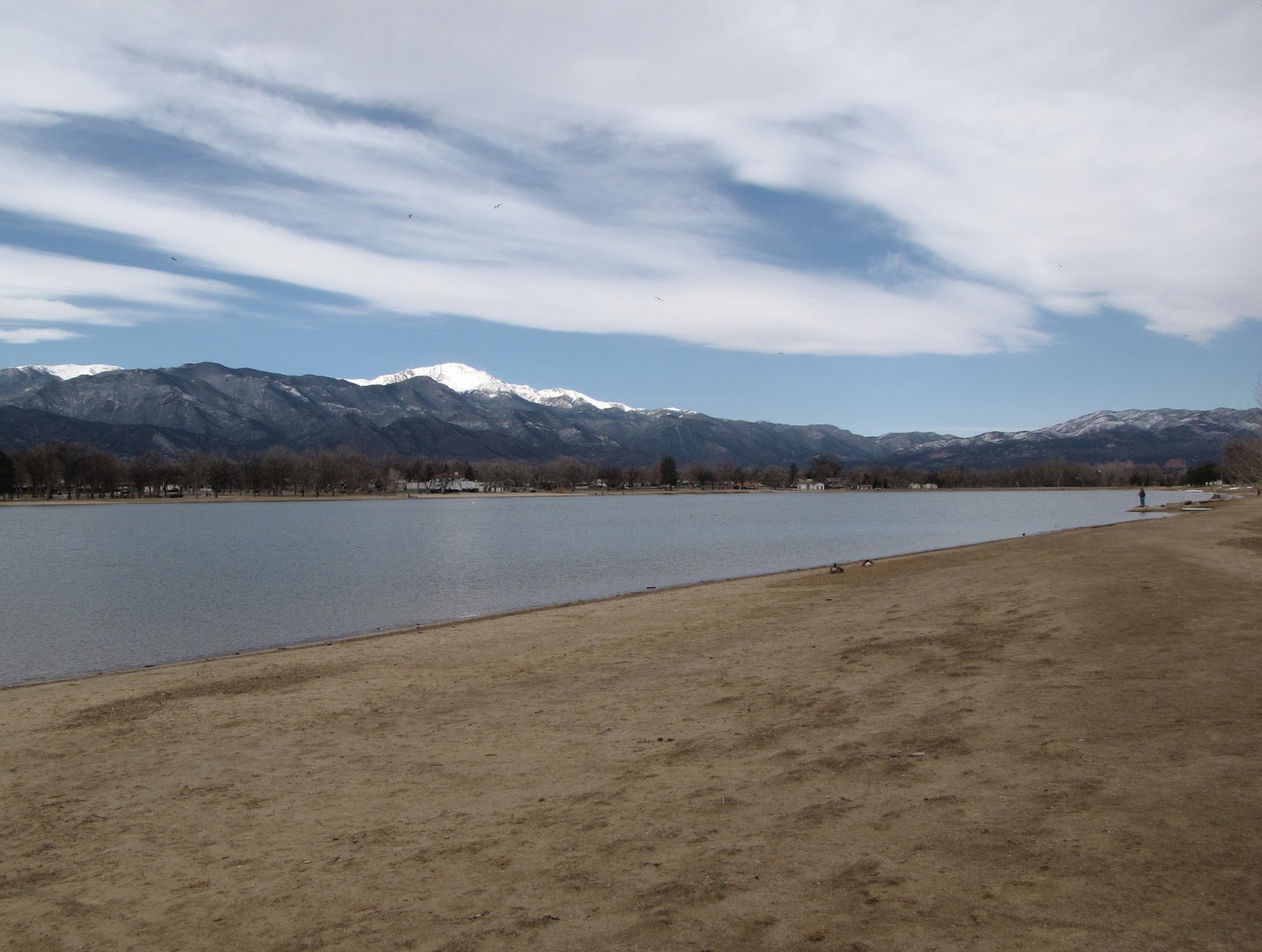
I had dismissed Prospect Lake in Memorial Park as just another fake lake in the urban landscape, not worth my time if I wanted to find any wildlife other than Rock Pigeons or European Starlings. Thanks to a Facebook group for the Colorado Field Ornithologists, I found out my assumptions had no validity whatsoever.

About the middle of last month, posts to the group included sightings of the most improbable birds you could imagine: American Avocet, Mountain Bluebird, even American White Pelican. Grebes of at least four species were common. There were pictures of several species to back up the claims.

It is embarrassing to admit that Memorial Park is only about three miles from my home, near downtown Colorado Springs. Yes, Prospect Lake is a large, artificial reservoir, dutifully stocked with trout for fishermen, and with boat ramps to facilitate water skiing, but the water level is low right now, and the boathouse is not yet open for business. I should have paid closer attention.


American White Pelicans

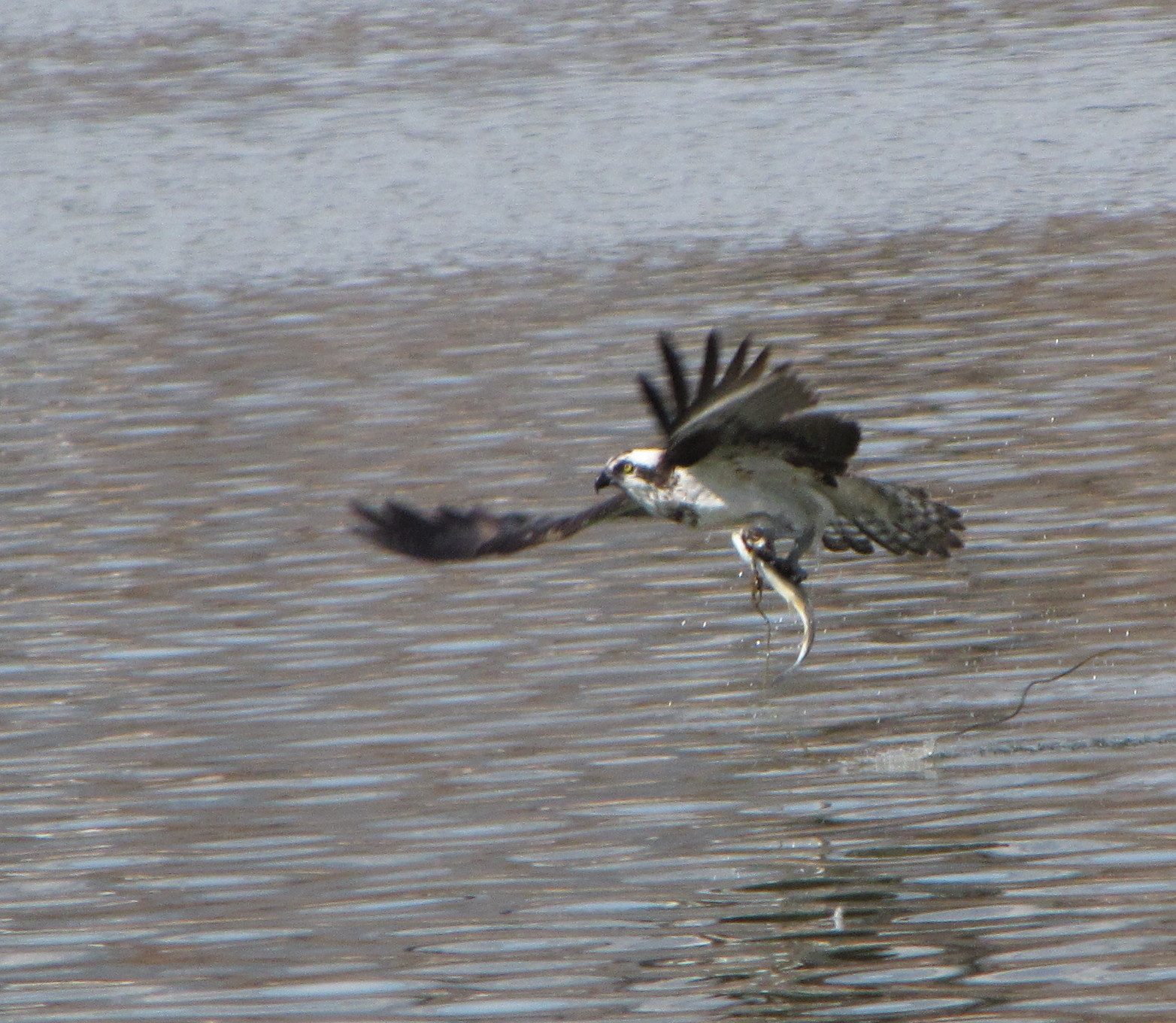
After reading the posts to the ornithology group with my jaw on the floor, I decided I needed to see for myself all the bird diversity. Apparently, on April 19, I was one day too late for the midge hatch that had attracted the large number of birds the previous day. I was still impressed even so. The pelican flock was still there, plus more waterfowl and gulls than I could count. At one point I counted six Ospreys in the air at once. It was like they were lining up and taking turns at the trout….at least until the Bald Eagle showed up and frightened everybody else away.

The land that is now Memorial Park was donated to the city by General William Jackson Palmer in 1890. Prospect Lake was excavated shortly thereafter. Initially, the reservoir was used to supply water to the Evergreen Cemetery, but that need expired in 1950. The water that fills the lake is extracted from the nearby Fountain Creek, a local watershed. A Naval Reserve station occupied the southwest corner of the lake from the late 1940s until the late 1980s. Plans to turn the entire lake over to naval training exercises in 1950 were thwarted by locals who enjoyed recreating on the rest of the lake. The Colorado Springs Fire Department used the armory for training after naval training facilities moved to Fort Carson, but after 2001 all the buildings were abandoned and demolished.

The lake began losing water at a high rate in 2002 when the pipeline supplying the lake was shut off, a severe drought was happening, and the liner for the lake became torn. A movement to add Prospect Lake to the National Register of Historical Places was successful, and spurred action to replace the liner. The lake was refilled and again stocked with fish in 2005, and it remains a vibrant center of recreation today.

The lake is surrounded today by playgrounds, including the state-of-the-art “Swing High” totally accessible playground, plus lawns, ornamental pine, cottonwood, and other trees, ballfields, residential neighborhoods, and commercial real estate. Despite all the hustle and bustle, birds seem to enjoy the area, at least in migration this year.

My own trips to the park on April 21, 26, 27, and 29 yielded a combined tally of the following species:

  1. Mallard
  2. American Wigeon
  3. Blue-winged Teal
  4. Northern Shoveler

    Northern Shovelers
  5. Lesser Scaup
  6. Redhead
  7. Bufflehead
  8. Ruddy Duck
  9. Canada Goose
  10. American Coot
  11. Pied-billed Grebe
  12. Horned Grebe
  13. Eared Grebe
  14. Western Grebe

    Western Grebe
  15. Clark’s Grebe
  16. Double-crested Cormorant
  17. American White Pelican
  18. Ring-billed Gull
  19. California Gull
  20. Franklin’s Gull
  21. Osprey
  22. Bald Eagle
  23. Cooper’s Hawk
  24. Great Blue Heron
  25. Great Egret
  26. Killdeer
  27. American Avocet

    American Avocets
  28. Spotted Sandpiper
  29. Lesser Yellowlegs
  30. Willet
  31. Wilson’s Phalarope
  32. Rock Pigeon
  33. Belted Kingfisher
  34. Downy Woodpecker
  35. Northern Flicker
  36. Tree Swallow
  37. Violet-green Swallow
  38. Say’s Phoebe
  39. American Robin
  40. American Pipit
  41. American Crow

    Osprey
  42. Black-capped Chickadee
  43. White-breasted Nuthatch (heard)
  44. Yellow-rumped Warbler
  45. European Starling
  46. Common Grackle
  47. Brown-headed Cowbird
  48. House Sparrow
  49. Chipping Sparrow
  50. Lark Sparrow
  51. Savannah Sparrow
  52. Dark-eyed Junco
  53. House Finch

I am a novice birder, and I know other species were seen, and have been seen since. Warblers, for example, are only now starting to appear. It just goes to show that you can still be surprised by nature close to home. Really, really close to home.

Sources: Galas, Judith, and Cindy West. 1997. Walking Colorado Springs. Helena, Montana: Falcon Guides (Pequot Press). 233 pp.
Tankersley, Teila. 2010. “Some Interesting Pieces of Trivia on Prospect Lake in Colorado Springs,” Fresh Ink

Wednesday, April 17, 2013

Stormy Weather

I was not prepared for what this spring has brought in terms of weather. Last year we were spoiled by essentially having no winter. This year is the winter that will not leave. Compounding the unseasonably cold temperatures and blustery winds is the fact that we are still getting precious little precipitation here in Colorado Springs. While the drought continues, it is the impact on my psyche that has been hardest to deal with.

You would think that I, having spent the first twenty-seven years of my life in Portland, Oregon, where seeing the sun is a near miraculous event, that I would be hardened to overcast, dreary days. Apparently not. Indeed, I have most recently spent a decade in climates of “extreme sun” counting Tucson, Arizona and here on the Front Range in Colorado. I think I have been trying to make up for those 27 years of drizzle.

It occurred to me while riding the bus on a particularly ugly day in Cincinnati what I find intolerable about “gray” days: The sky has no contour. You look up and it is like you are under a great silver dome. It feels like you are still indoors. This, to me, is the overriding feature that must be at the root of SAD (“Seasonal Affective Disorder”).

At least here in Colorado you can’t usually say the clouds themselves are depressing. Eerie, yes, and sometimes menacing, but not depressing. This is the only place I’ve been where the clouds remind me of being in a coffee mug and God is stirring cream into it. Short of a tornado, this is the closest one can come to the feeling that the sky really is falling.

Lately, however, the days have been far too reminiscent of Oregon. The worst is when the mountains disappear. The foothills and Pikes Peak are near constants in the landscape here, and when you cannot see them it becomes both disorienting and claustrophobic. The world literally seems to be closing in around you.

Lastly, the duration of cold, and periodic light snow, has taken its toll on me mentally. I guess you would call it “cabin fever,” but whatever the name it robs your mood of the highs that normally come at this time of year with blooming flowers, singing birds, the hum of bees. I find myself disturbingly unmotivated, disinterested, and even angry when I have no reason to be.

Weather cannot alone be blamed for our own personal miseries (excepting tornados, hurricanes, and floods I suppose), but no longer will I readily dismiss anyone who says that rainy days and gray skies get them down. We all have a hard time with things we cannot control. Rising above the austerity of climate at this time of year is challenging to be sure.

Wednesday, February 27, 2013

Indelible

A funny thing happened the other day on my way to taking winter snow images in Garden of the Gods park here in Colorado Springs. Just as I settled into position for a great scenic shot of Pikes Peak between two rock formations, a commercial jet arced over the mountain, dead center, leaving a bright contrail in its wake.

Timing really is everything in a case like this. Had I gotten my butt on the road even a few minutes earlier, the morning light would have been even better, and there would have been no ugly airline graffiti. I am sure the navigator aboard the aircraft would argue the plane was not at all “misplaced,” but I would beg to differ, from my vantage point on terra firma.

I pride myself on not retouching any of my images with digital software like Photoshop or GIMP, and I am still debating on whether to bother in this case. People viewing a manipulated image would never know the contrail was there, but no matter what I do to obscure or erase the “defect,” I would still know. I literally “can’t un-see that!” It will always be an indelible vapor trail in the landscape of my mind.

That is what really bothers me, I think. Any time afield, no matter what the results, is time well spent, but a true wilderness experience is getting harder and harder to come by. It is nearly impossible to avoid litter of some kind, and then there are those planes. I have to wonder how many flights I have been on that spoiled someone else’s photographic souvenirs 30,000 feet below me.

Yesterday I walked the dog around our complex of townhouses, just after another snowfall. Ours were the first footprints, even on the sidewalk. I have to admit it was both exciting to be a momentary pioneer, and disappointing to spoil the pristine cover of white.

Tuesday, February 19, 2013

Bluebird Trifecta

Sunday, February 17, my wife and myself and Debbie Barnes of the Aiken Audubon Society set out to find a flock of Bohemian Waxwings that had been seen the day before at the U.S. Army Turkey Creek Recreation Area south of Colorado Springs. We did not find them. The outing was, however, far from a total loss. What we lacked in waxwings we more than made up for in bluebirds.

Our first stop was at the intersection of Barrett Road and Highway 115, where the Bohemian Waxwings had been seen most recently. No sign of them despite a fair crop of juniper berries in the area. Upon exiting back onto 115, we did spot a pair of birds on a telephone wire. They were quickly identified as male Western Bluebirds, Sialia mexicana. One of the two birds obligingly glided to the ground, then popped back up to sit on a fence post about thirty feet from our vehicle, affording the view shown above.

We backtracked to the Turkey Creek Recreation Area, pulling into a playground area with a collection of buildings and the stables where horses for the mounted color guard reside. A Lewis’ Woodpecker is known to hang out there, too, and was sighted earlier in the day, but was a no-show when we were there. No waxwings, either, just more Western Bluebirds, a Common Raven or two, and a flock of Dark-eyed Juncos.

While taking in the austere scenery, Debbie connected with another birder friend, Jeannie Mitchell, via cell phone. Jeannie was kind enough to share that news that a group of birders who were in Turkey Creek that morning had seen a huge flock of Mountain Bluebirds, Sialia currocoides. I admit I was skeptical, but we followed the appropriate road and….

Sure enough, here were probably at least 200 Mountain Bluebirds, distributed on each side of the road. A handful of American Robins, Turdus migratorius, were in their ranks, but the sight of all that turquoise blue was jaw-dropping. One dead tree in particular was essentially festooned with living, feathered ornaments.

By now, around 4 PM in the afternoon, the wind had gotten gusty, the sun lower, and the temperature was dropping. Reluctant to leave, we took it slow and found still more Mountain Bluebirds in a vast open field studded with old yucca and mullein stalks, plus the obligatory barbed wire fences and metal fence posts. Various Mountain Bluebirds took turns alighting on all available perches in really great light.

We also saw what we initially thought was another Western Bluebird. Looking at her pictures once she got home, Debbie realized it was actually a male Eastern Bluebird, Sialia sialis. Note that the Eastern Bluebird lacks the blue throat of the Western Bluebird. The belly of the Eastern Bluebird is also bright white, in contrast to the dirty appearance of the Western Bluebird’s underparts.

Bluebird trifecta! Looking at the distribution maps for bluebirds in the various field guides, one would not guess that the Eastern Bluebird ranges this far west, but here is proof to the contrary. There are always strays, of course, but as habitat, climate, and other factors change, birds adapt and their geographic ranges change accordingly, even from week to week. The convergence of all three species here is now a regular occurrence, especially at this time of year.

Debbie mentioned that bluebirds are feeding on juniper berries when flying insects, grasshopper nymphs, and other prey is not readily available. Cold fronts may push the birds into protected valleys and other warmer situations, but they quickly return when the temperatures warm up again. Sounds like me.

Saturday, July 21, 2012

Sinton Pond Open Space

Wetlands here in El Paso County, Colorado are few and far between. Consequently, a handful of artificial lakes have been created for recreation and wildlife. One of the more interesting of these is Sinton Pond Open Space in Colorado Springs

At only thirteen acres, the property actually consists of two ponds. The larger, an impoundment of a natural spring, is full of small freshwater sunfish, and possibly other species as well. Above the big pond is a smaller one, likewise with a few fish, but with more emergent vegetation and better shaded by large cottonwood trees. Here’s a view of that smaller pond. The property abuts Sinton Dairy, which is what you see in the background.

Sinton Pond is pretty much surrounded by industrial enterprises and at least one office park , yet it is a magnet for birds, insects, reptiles, amphibians, and mammals. You also get a nice view of Pikes Peak during the winter months when foliage on the cottonwoods doesn’t hide the mountain.

Since I could find next to nothing on the history of Sinton Pond, I’ll concentrate on the diversity of animal life you can find there. Birdwatchers won’t be disappointed as there are many birds that utilize the pond and the surrounding landscape for feeding and nesting. We found this family of Mallard ducks on one trip there.

With the help of a crow or raven I managed to spy a Great Horned Owl on my most recent visit. One of my scenic shots has a falcon in the distance, too….

Reptiles and amphibians are pretty prolific, too. I nearly stepped on this Western Terrestrial Garter Snake as it sunned beside the trail near Monument Creek, which flows right by the pond.

Both the native Painted Turtle and the non-native Red-eared Slider can be seen basking on logs or other debris in the big pond, especially in the morning.

I was thrilled to find a Northern Leopard Frog on my latest trip, seeking refuge from the hot sun beneath a tangle of brush along the margin of the big pond. Leopard frogs have not fared very well because of drought and the increasing populations of the Bullfrog.

Naturally, I am looking mostly for insects, and there is no shortage. Many butterflies find abundant flower nectar and larval foodplants in the area. I was surprised to find a Questionmark butterfly on June 8, and even more surprised to find it was still there as of July 20! I was downright shocked to glimpse a Giant Swallowtail, also on June 8, though I don’t have a picture to prove it.

The Monarch finds plenty of milkweed here, and a variety of skippers can be seen on almost any visit. There are open areas of varying quality in terms of vegetation, and shady groves of spruce and other trees, and different butterflies prefer different degrees of sun and cover.

Any wetland is likely to attract dragonflies and damselflies, and there is indeed a good variety of odonates here. Big darners (family Aeschnidae) are constantly on the wing, while skimmers (family Libellulidae) of all sorts perch and patrol the shore and adjacent fields. Vivid Dancers, bluets, and forktail damselflies can be found by the score.

I recommend Sinton Pond Open Space to both residents of Colorado Springs and visitors as a place to enjoy hiking, walking, biking, fishing, or just plain relaxing. The site gets a fair amount of traffic (no pun intended, despite the fact that Interstate 25 is about one block to the west and a major rail line about a block to the south), but it is still a relatively quiet place for contemplation and peaceful enjoyment.