Showing posts with label Rocky Mountains. Show all posts

Friday, May 3, 2013

Prospect Lake

I had dismissed Prospect Lake in Memorial Park as just another fake lake in the urban landscape, not worth my time if I wanted to find any wildlife other than Rock Pigeons or European Starlings. Thanks to a Facebook group for the Colorado Field Ornithologists, I found out my assumptions had no validity whatsoever.
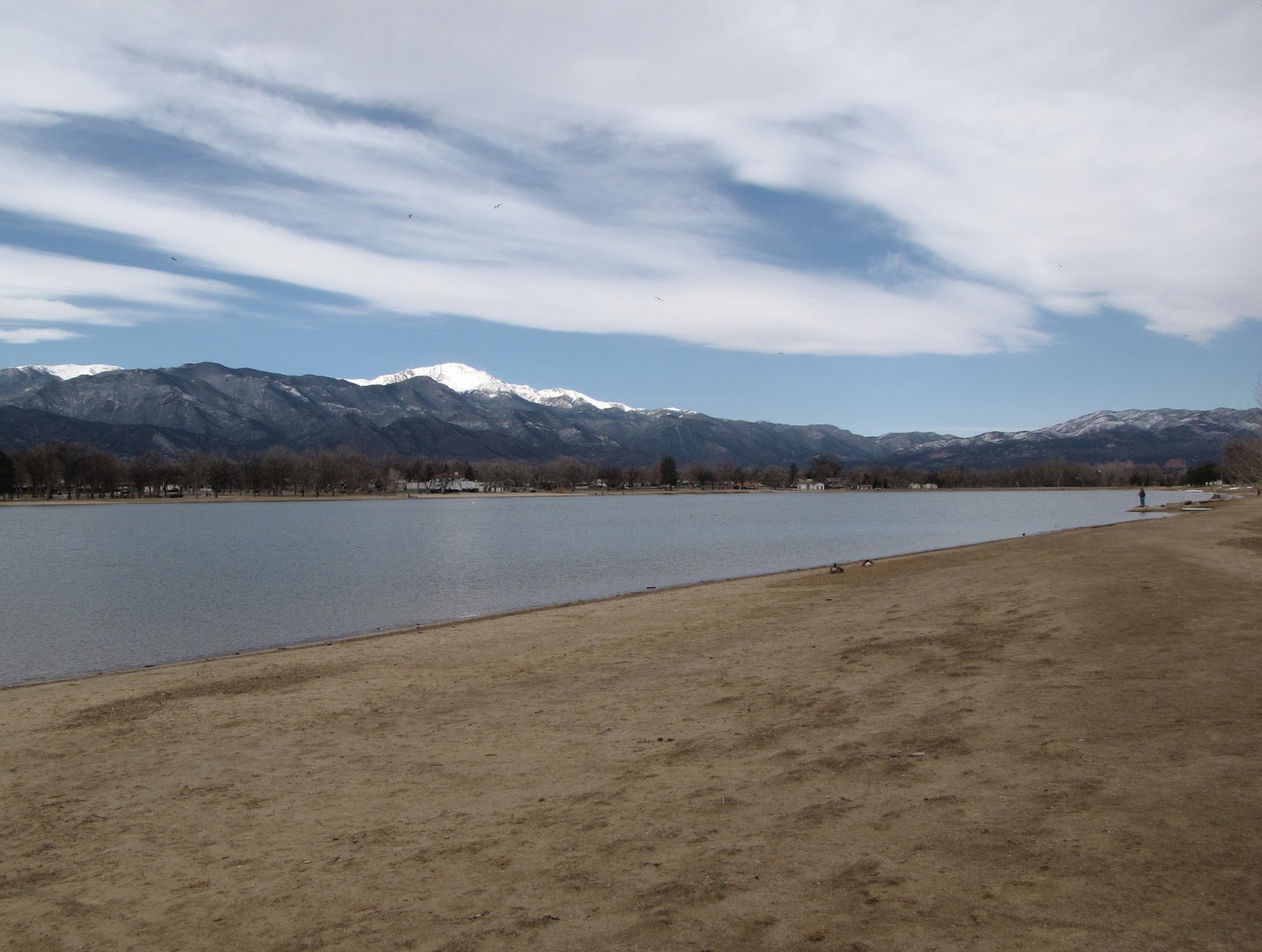
About the middle of last month, posts to the group included sightings of the most improbable birds you could imagine: American Avocet, Mountain Bluebird, even American White Pelican. Grebes of at least four species were common. There were pictures of several species to back up the claims.

It is embarrassing to admit that Memorial Park is only about three miles from my home, near downtown Colorado Springs. Yes, Prospect Lake is a large, artificial reservoir, dutifully stocked with trout for fishermen, and with boat ramps to facilitate water skiing, but the water level is low right now, and the boathouse is not yet open for business. I should have paid closer attention.


American White Pelicans

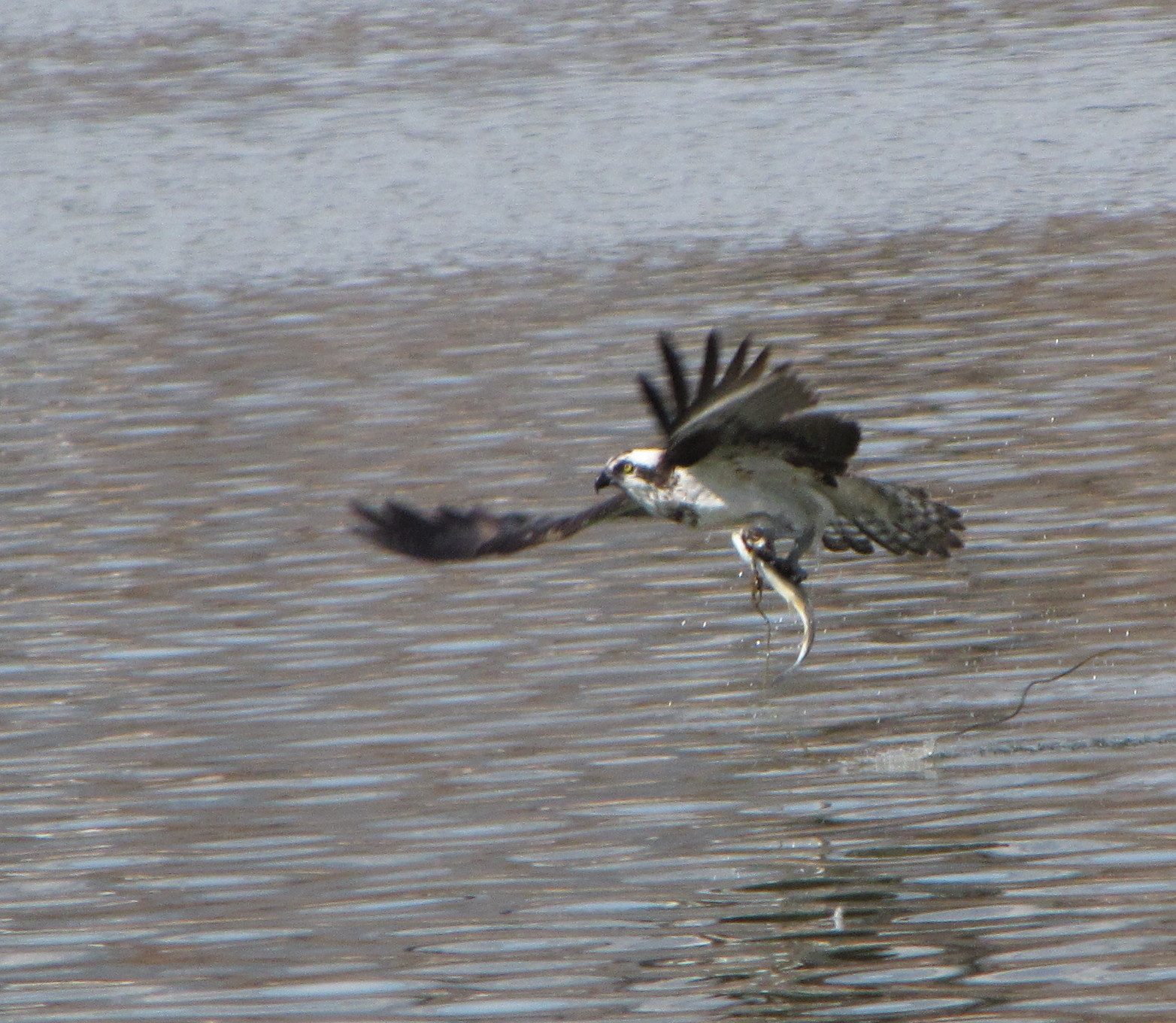
After reading the posts to the ornithology group with my jaw on the floor, I decided I needed to see for myself all the bird diversity. Apparently, on April 19, I was one day too late for the midge hatch that had attracted the large number of birds the previous day. I was still impressed even so. The pelican flock was still there, plus more waterfowl and gulls than I could count. At one point I counted six Ospreys in the air at once. It was like they were lining up and taking turns at the trout….at least until the Bald Eagle showed up and frightened everybody else away.

The land that is now Memorial Park was donated to the city by General William Jackson Palmer in 1890. Prospect Lake was excavated shortly thereafter. Initially, the reservoir was used to supply water to the Evergreen Cemetery, but that need expired in 1950. The water that fills the lake is extracted from the nearby Fountain Creek, a local watershed. A Naval Reserve station occupied the southwest corner of the lake from the late 1940s until the late 1980s. Plans to turn the entire lake over to naval training exercises in 1950 were thwarted by locals who enjoyed recreating on the rest of the lake. The Colorado Springs Fire Department used the armory for training after naval training facilities moved to Fort Carson, but after 2001 all the buildings were abandoned and demolished.

The lake began losing water at a high rate in 2002 when the pipeline supplying the lake was shut off, a severe drought was happening, and the liner for the lake became torn. A movement to add Prospect Lake to the National Register of Historical Places was successful, and spurred action to replace the liner. The lake was refilled and again stocked with fish in 2005, and it remains a vibrant center of recreation today.

The lake is surrounded today by playgrounds, including the state-of-the-art “Swing High” totally accessible playground, plus lawns, ornamental pine, cottonwood, and other trees, ballfields, residential neighborhoods, and commercial real estate. Despite all the hustle and bustle, birds seem to enjoy the area, at least in migration this year.

My own trips to the park on April 21, 26, 27, and 29 yielded a combined tally of the following species:

  1. Mallard
  2. American Wigeon
  3. Blue-winged Teal
  4. Northern Shoveler

    Northern Shovelers
  5. Lesser Scaup
  6. Redhead
  7. Bufflehead
  8. Ruddy Duck
  9. Canada Goose
  10. American Coot
  11. Pied-billed Grebe
  12. Horned Grebe
  13. Eared Grebe
  14. Western Grebe

    Western Grebe
  15. Clark’s Grebe
  16. Double-crested Cormorant
  17. American White Pelican
  18. Ring-billed Gull
  19. California Gull
  20. Franklin’s Gull
  21. Osprey
  22. Bald Eagle
  23. Cooper’s Hawk
  24. Great Blue Heron
  25. Great Egret
  26. Killdeer
  27. American Avocet

    American Avocets
  28. Spotted Sandpiper
  29. Lesser Yellowlegs
  30. Willet
  31. Wilson’s Phalarope
  32. Rock Pigeon
  33. Belted Kingfisher
  34. Downy Woodpecker
  35. Northern Flicker
  36. Tree Swallow
  37. Violet-green Swallow
  38. Say’s Phoebe
  39. American Robin
  40. American Pipit
  41. American Crow

    Osprey
  42. Black-capped Chickadee
  43. White-breasted Nuthatch (heard)
  44. Yellow-rumped Warbler
  45. European Starling
  46. Common Grackle
  47. Brown-headed Cowbird
  48. House Sparrow
  49. Chipping Sparrow
  50. Lark Sparrow
  51. Savannah Sparrow
  52. Dark-eyed Junco
  53. House Finch

I am a novice birder, and I know other species were seen, and have been seen since. Warblers, for example, are only now starting to appear. It just goes to show that you can still be surprised by nature close to home. Really, really close to home.

Sources: Galas, Judith, and Cindy West. 1997. Walking Colorado Springs. Helena, Montana: Falcon Guides (Pequot Press). 233 pp.
Tankersley, Teila. 2010. “Some Interesting Pieces of Trivia on Prospect Lake in Colorado Springs,” Fresh Ink

Tuesday, February 19, 2013

Bluebird Trifecta

Sunday, February 17, my wife and myself and Debbie Barnes of the Aiken Audubon Society set out to find a flock of Bohemian Waxwings that had been seen the day before at the U.S. Army Turkey Creek Recreation Area south of Colorado Springs. We did not find them. The outing was, however, far from a total loss. What we lacked in waxwings we more than made up for in bluebirds.

Our first stop was at the intersection of Barrett Road and Highway 115, where the Bohemian Waxwings had been seen most recently. No sign of them despite a fair crop of juniper berries in the area. Upon exiting back onto 115, we did spot a pair of birds on a telephone wire. They were quickly identified as male Western Bluebirds, Sialia mexicana. One of the two birds obligingly glided to the ground, then popped back up to sit on a fence post about thirty feet from our vehicle, affording the view shown above.

We backtracked to the Turkey Creek Recreation Area, pulling into a playground area with a collection of buildings and the stables where horses for the mounted color guard reside. A Lewis’ Woodpecker is known to hang out there, too, and was sighted earlier in the day, but was a no-show when we were there. No waxwings, either, just more Western Bluebirds, a Common Raven or two, and a flock of Dark-eyed Juncos.

While taking in the austere scenery, Debbie connected with another birder friend, Jeannie Mitchell, via cell phone. Jeannie was kind enough to share that news that a group of birders who were in Turkey Creek that morning had seen a huge flock of Mountain Bluebirds, Sialia currocoides. I admit I was skeptical, but we followed the appropriate road and….

Sure enough, here were probably at least 200 Mountain Bluebirds, distributed on each side of the road. A handful of American Robins, Turdus migratorius, were in their ranks, but the sight of all that turquoise blue was jaw-dropping. One dead tree in particular was essentially festooned with living, feathered ornaments.

By now, around 4 PM in the afternoon, the wind had gotten gusty, the sun lower, and the temperature was dropping. Reluctant to leave, we took it slow and found still more Mountain Bluebirds in a vast open field studded with old yucca and mullein stalks, plus the obligatory barbed wire fences and metal fence posts. Various Mountain Bluebirds took turns alighting on all available perches in really great light.

We also saw what we initially thought was another Western Bluebird. Looking at her pictures once she got home, Debbie realized it was actually a male Eastern Bluebird, Sialia sialis. Note that the Eastern Bluebird lacks the blue throat of the Western Bluebird. The belly of the Eastern Bluebird is also bright white, in contrast to the dirty appearance of the Western Bluebird’s underparts.

Bluebird trifecta! Looking at the distribution maps for bluebirds in the various field guides, one would not guess that the Eastern Bluebird ranges this far west, but here is proof to the contrary. There are always strays, of course, but as habitat, climate, and other factors change, birds adapt and their geographic ranges change accordingly, even from week to week. The convergence of all three species here is now a regular occurrence, especially at this time of year.

Debbie mentioned that bluebirds are feeding on juniper berries when flying insects, grasshopper nymphs, and other prey is not readily available. Cold fronts may push the birds into protected valleys and other warmer situations, but they quickly return when the temperatures warm up again. Sounds like me.

Saturday, July 21, 2012

Sinton Pond Open Space

Wetlands here in El Paso County, Colorado are few and far between. Consequently, a handful of artificial lakes have been created for recreation and wildlife. One of the more interesting of these is Sinton Pond Open Space in Colorado Springs

At only thirteen acres, the property actually consists of two ponds. The larger, an impoundment of a natural spring, is full of small freshwater sunfish, and possibly other species as well. Above the big pond is a smaller one, likewise with a few fish, but with more emergent vegetation and better shaded by large cottonwood trees. Here’s a view of that smaller pond. The property abuts Sinton Dairy, which is what you see in the background.

Sinton Pond is pretty much surrounded by industrial enterprises and at least one office park , yet it is a magnet for birds, insects, reptiles, amphibians, and mammals. You also get a nice view of Pikes Peak during the winter months when foliage on the cottonwoods doesn’t hide the mountain.

Since I could find next to nothing on the history of Sinton Pond, I’ll concentrate on the diversity of animal life you can find there. Birdwatchers won’t be disappointed as there are many birds that utilize the pond and the surrounding landscape for feeding and nesting. We found this family of Mallard ducks on one trip there.

With the help of a crow or raven I managed to spy a Great Horned Owl on my most recent visit. One of my scenic shots has a falcon in the distance, too….

Reptiles and amphibians are pretty prolific, too. I nearly stepped on this Western Terrestrial Garter Snake as it sunned beside the trail near Monument Creek, which flows right by the pond.

Both the native Painted Turtle and the non-native Red-eared Slider can be seen basking on logs or other debris in the big pond, especially in the morning.

I was thrilled to find a Northern Leopard Frog on my latest trip, seeking refuge from the hot sun beneath a tangle of brush along the margin of the big pond. Leopard frogs have not fared very well because of drought and the increasing populations of the Bullfrog.

Naturally, I am looking mostly for insects, and there is no shortage. Many butterflies find abundant flower nectar and larval foodplants in the area. I was surprised to find a Questionmark butterfly on June 8, and even more surprised to find it was still there as of July 20! I was downright shocked to glimpse a Giant Swallowtail, also on June 8, though I don’t have a picture to prove it.

The Monarch finds plenty of milkweed here, and a variety of skippers can be seen on almost any visit. There are open areas of varying quality in terms of vegetation, and shady groves of spruce and other trees, and different butterflies prefer different degrees of sun and cover.

Any wetland is likely to attract dragonflies and damselflies, and there is indeed a good variety of odonates here. Big darners (family Aeschnidae) are constantly on the wing, while skimmers (family Libellulidae) of all sorts perch and patrol the shore and adjacent fields. Vivid Dancers, bluets, and forktail damselflies can be found by the score.

I recommend Sinton Pond Open Space to both residents of Colorado Springs and visitors as a place to enjoy hiking, walking, biking, fishing, or just plain relaxing. The site gets a fair amount of traffic (no pun intended, despite the fact that Interstate 25 is about one block to the west and a major rail line about a block to the south), but it is still a relatively quiet place for contemplation and peaceful enjoyment.

Wednesday, June 27, 2012

The Waldo Canyon Fire

I am still in relative shock and denial over what is going on just across town here in Colorado Springs. We are facing a wildfire that threatens the entire northwest quadrant of the city, plus the Air Force Academy, Monument, Palmer Lake, Manitou Springs (where Heidi and I were wed), Woodland Park, and several other small communities. All of those locations have either been evacuated or face imminent evacuation as I write this. A total of more than 32,000 citizens have been displaced so far.

The images here are from late Sunday morning, June 24, when the fire was just a tiny, reasonably tame thing. It has since ballooned into a monster, especially as of Tuesday afternoon, June 26. That is when a thunderstorm to the northeast of the fire produced an “outflow” of air that changed the wind direction and intensity. A sixty-five mile per hour gust drove the flames into Queens Canyon, funneling the fire right into the subdivision of Mountain Shadows. The aftermath has revealed many homes and other structures destroyed.

I feel strangely detached, having moved here only last October. Still, I do know some people who have been evacuated. Heidi, my wife, knows far more and is devastated emotionally. Physically we are fine, though we have simultaneously experienced a record-setting heat wave here that finally broke today. The air quality ranges from tolerable to heinous, depending on the wind direction. I itch all over and haven’t worn my contact lenses for two straight days. It is useless, if not downright idiotic, to go outside if you don’t have to.

Many places I have been visiting in search of wildlife and wildflowers are either closed, threatened by the fire, or already burned. City bus service was suspended today. The television is, understandably, non-stop news reports on the fire, those fighting it, and those affected by it. This is my reality right now, with no end in sight. The fire remains only five percent contained. Officials predict it will be at least the middle of July before it is fully contained. We are hoping the annual monsoon storms are on time, if not a little early.

Colorado Springs is one of the top ten cities in the nation for “urban-wildland interface,” making us extremely vulnerable to disasters like this. Now, if rain does come, there is nothing to absorb it. We will face flash floods as a result. Meanwhile, thunderstorms devoid of rain threaten to fan the flames with more wind gusts, and/or spark more fires with dry lightning.

Those inquiring about our safety (Heidi and myself), and the condition of the Cheyenne Mountain Zoo will be relieved to know that our residence is on the east side of town, south of the fire; and that the zoo is also far south of the blaze. Firefighters are unyielding in shielding the south side of highway 24 from the fire. Should it jump that roadway (which is currently closed to all traffic but emergency vehicles between here and Woodland Park), all bets are off.

Interstate 25 marks the eastern boundary of the fire so far, and indeed it has not reached that freeway. Assuming the grasslands of the high plains are as equally flame-prone as the drought-stressed forests, then we need to keep the fire at bay along that boundary as well.

We, as a city, county, and state, appreciate the empathy and sentiments expressed from around the rest of the country. We return those thoughts to those facing catastrophic excesses of rain from tropical storms and thundershowers (Florida and Minnesota). I’ll keep you appraised as best I can on the situation here as it unfolds.

Tuesday, June 26, 2012

Nature, red in tooth and claw

That phrase from Alfred Lord Tennyson’s poem In Memoriam A.H.H., published in 1850, certainly communicates the frequently savage nature of….nature. These days, however, we do not want to be confronted with the reality of predator and prey. I found that out last week while at the Cheyenne Mountain Zoo here in Colorado Springs. The shocking carnage took place outside of cages and enclosures, which was perhaps even more surprising to zoo guests.

I was on my way back to my wife’s building, Primate World, when I encountered what I thought were three screaming Golden-mantled Ground Squirrels racing down the hill right toward me. They veered off down another path. My initial thought was that I had no idea ground squirrels were that territorial. Then I saw the last one in line. It was not another ground squirrel. It was an adult Long-tailed Weasel, Mustela frenata. My jaw dropped. A zoo staffer grinned and said “That was a weasel. He wants him some chipmunk!” I told him I noticed that, but didn’t correct his identification of the prey.

One of the ground squirrels had the smarts to sit down right at the intersection of all three paved trails, literally plastering itself to the asphalt. I looked down the other path and noticed the chase was still in progress. I ran after them, hoping my camera had just enough battery life to eke out another picture.

By the time I caught up to the weasel, it had caught up with the ground squirrel, seizing it by the throat in front of several astonished members of the public. A mother and son encroached right on the predator and its victim. The son actually kicked the weasel, apparently hoping to save the doomed squirrel. I pushed him away, but must have looked like a crazed member of the paparazzi myself, frantically trying to focus my camera on the unfolding drama.

The weasel, unfazed by any of this, ran back uphill, maybe right between my legs, before aborting his trip and diving into a crevice in a rock retaining wall. All I got was a blurry image of weasel rear (see below).

I was forced to remember my initial purpose of borrowing batteries from my wife, and headed back again toward her building. Along the way I met with a horrific scene by any standards. Yet another ground squirrel was barely twitching in the middle of the path, with an enormous bloodstain behind it, quickly evaporating in the late morning heat. Parents were mortified and tried to find a zoo staff person to clean up the crime scene.

Once I got batteries, I headed back out, and optimistically surmised the weasel might come back for the ground squirrel it left for dead. I was right, but zoo guests had surrounded the now-deceased rodent to “protect” it from the weasel.

I found it mostly useless to pontificate on the fact that this is how nature works. At least one person agreed, but even he defended those who did not want their children to witness such brutality.

”Oh, no, Al-vin-n-n-n-n!” mocked one adult.

Well, there was one problem right there. Most people mistake Golden-mantled Ground Squirrels for chipmunks. I honestly can’t blame them in this case because these were young squirrels, not much, if any, larger than a chipmunk. Adult GMGSs are substantially larger than their similarly-striped cousins.

Before I continue, I must admit that there are animals I don’t like much, either, namely crocodilians, lions, and praying mantids. Watch any television nature program about those creatures, and the graphic scenes of predation are the only scenes. It amounts to unintentional propaganda against predators that makes us feel sorry for the prey. Still, I am well aware of the necessity of these apex predators to the health of an ecosystem. I don’t know that your average person is equally attuned.

Most people never get to see a weasel. Until now, I was under the impression they were extremely secretive animals you barely got a glimpse of….if you were lucky. Not one other person I encountered during and after the events I’ve described felt the same way. At least they did not communicate that emotion. My good luck wasn’t over, either. While the others stood guard over the “chipmunk,” I noticed the weasel had returned, threading its way through human legs and diving down a burrow on the other side of the split rail fence. I decided it was bound to come out again.

A crew of two came and unceremoniously disposed of the GMGS, and the party of bystanders broke up. I was about to give up on the prospect of the weasel ever surfacing again when….Voila! Up it popped with yet another ground squirrel in tow. It paused at the mouth of the tunnel allowing me to fire off a few shots with my camera as it licked the bloody throat of this latest victim. Eventually it grabbed the squirrel and dashed back across the path and bounded up the rocky slope above, eventually disappearing. By now I had understood that the weasel was either caching its kills or feeding its offspring, or both.

The weasel actually came back again, dragging out another carcass, but that was the last I saw of it.

So much for a “teachable moment.” Apparently parents, when given a choice, will shield their children from reality. I wonder if these same mothers and fathers will let their kids play videogames with explicit human-killing-human violence.

I won’t let the zoo off the hook on this one, either. The folks who picked up the ground squirrel were robbing the weasel of its prey. They were robbing zoo guests of a quick lesson in ecology. This is at least the second time such a drama between weasel and ground squirrel has played out at the zoo recently. No mention on the zoo’s blog. Lots of neat recipes, though. No interpretive signs explaining the Golden-mantled Ground Squirrel is not a chipmunk….and that guests should probably not be sharing their food with those rodents.

What opinions do you have? Should a zoo “sanitize” the visitor experience? How do we reach people in a way that does not insult their intelligence, but also doesn’t shy away from the hard truths of how nature works? I’m eager to have a discussion here and look forward to your comments and exchanges with one another.

Saturday, March 3, 2012

Leap Day 2012

February twenty-ninth comes around only once every four years, so we should probably make the most of the “extra” day. As luck would have it, the weather was just gorgeous here in Colorado Springs. The high for the day was 58° F, with occasional light breezes. I decided to explore one of the urban trails and was glad I did.

Murray Boulevard runs north and south in front of my apartment complex, and I can walk south for about a mile when it intersects the Homestead Trail paralleling the west fork of Sand Creek. Sand Creek is dry most of the year, and much of it is channelized, but wildlife seems to like it anyway. One of the first birds I saw when I set foot on the trail was a new one for me: a Townsend’s Solitaire. I thought it was some kind of flycatcher, but Jeffrey Gordon, President of the American Birding Association, was kind enough to correct me from the image (below) I e-mailed to him.

The Homestead Trail is short, and soon intersects the Rock Island Trail at Constitution Avenue. Here is the view you get looking west down the Rock Island Trail. Pretty nice, eh? Yes, that is Pike’s Peak in the background.

Most of the trails in the city are paved, in order to better accommodate bicycles, runners, and the handicapped. Many people also use the broad paths to walk their dogs. Where trails intersect streets, there are usually underpasses for pedestrians so that one does not have to cross traffic. The traffic signals also tend to be unusually long, so the underpasses help you maintain your pace and momentum.

The warm weather made for some surprising entomological encounters. I stopped to photograph a plant, and heard the unmistakable sound of a grasshopper making a crepitation flight. Certain adult grasshoppers can generate in-flight noise at will. The sound has a crackling quality and is easily audible, sometimes downright loud. It took me awhile, but I finally tracked down one of these insects. It turned out to be the Speckle-winged Rangeland Grasshopper, Arphia conspersa. Here are a pair of males:

Back in November I had seen nymphs of this species. I wasn’t expecting to see adults until April or so. Maybe this mild winter has accelerated their metamorphosis. I also was shocked to see adult Podalonia wasps out looking for cutworm caterpillars already. One was digging a burrow, which means she had already secured her prey and stashed it somewhere.

Spiders were also on the prowl. I spied a ground crab spider (Xysticus sp., family Thomisidae), and a running crab spider (Thanatus sp., family Philodromidae) scouring the surface of the soil for potential prey.

Beetles, too, were out and about. A Eusattus darkling beetle was scrounging for detritus, while nearby a tiny ground beetle (Carabidae family) was struggling to negotiate the shifting, sandy soil to get out of my footprint.

Going west, the Rock Island Trail eventually dead-ends at the Shooks Run Trail. As one approaches that point, the Rock Island Trail enters a heavily industrialized brownfield area frequented by the homeless (and a melanic squirrel, see below).

The Shooks Run Trail travels south, and meanders through the “Old North End” of Colorado Springs. This is an eclectic mix of old homes, new homes, and periodic commercial enterprises. Imagine my surprise at coming upon an antiquarian bookstore, right off the trail! I was delighted to find Doug Clausen, the proprietor of Clausen Books, to be friendly, informative, and, most importantly, negotiable. I left with a collection of small entomology books for a pittance. I’ll be back.

Farther down the trail I happened upon Dog Tooth Coffee. How sweet is that? A bookstore and a coffee house? Heaven. I left Dog Tooth with a mocha “Snow Dog,” one of those blended ice drinks with lots of calories.

Just behind the coffee house was a cohousing community called Casa Verde Commons. This unique, tiny neighborhood features a wonderful community garden, among other sustainable attributes. I am pleased to see that Colorado Springs has such innovative social enterprises.

Next week the weather is supposed to be even warmer, so I will have to find other trails to follow; or go back down these. Here’s to you finding your own paths of discovery in the coming weeks and months.

Thursday, January 19, 2012

Bear Creek Park

The El Paso County Parks in Colorado are a real treasure. Among the most used is Bear Creek Park on the western edge of Colorado Springs, abutting the Front Range of the Rocky Mountains. The park is laced with trails, which actually makes it somewhat difficult to navigate, but the views alone are worth the trouble.

Signs with maps are present at each major intersection of trails, but it took me a minute to decide that the bright yellow circular highlight stood for “you are here.” A large parcel of private land also divides the park, forcing hikers into a frustratingly long detour to get from one side to the other. The landowner needs to at least grant an easement to permit a more direct trail to the nature center located in the northwest corner of the park.

The nature center is spacious, and besides the permanent displays there is a room that can host traveling exhibits. When I visited on January 5, a traveling exhibit entitled “The Hidden World of Bears” was in its final days there. Oh, and they don’t call the place Bear Creek for nothing. There really are Black Bears living in the area.

Many of the exhibits in the nature center are interactive rather than static, but there are the obligatory taxidermy mounts. The original building was destroyed in a suspected arson fire in the year 2000. That it was rebuilt quckly is a testament to the commitment of the Colorado Springs community to continue the park’s commitment to excellence in environmental education and natural history interpretation.

While the front desk is usually manned by a volunteer, I was lucky enough to meet Ken Pals, a semi-retired naturalist with El Paso County Parks. He shared his ideas on how I might be able to help the park by presenting programs there. Indeed, they have a wide variety of activities going on all the time, aimed at children, families, and adults.

There is a paved nature trail in the immediate vicinity of the nature center, with one loop designated as the “Songbird Trail.” It includes several illustrated interpretive signs and a boardwalk close to Bear Creek. There are also feeders that attract a wide variety of birds at any time of the year. I got good views of Dark-eyed Junco, Blue Jay, Western Scrub Jay, White-breasted Nuthatch, Black-capped Chickadee, House Finch, American Goldfinch, and even a Downy Woodpecker in under an hour of watching on the afternoon of January 5. I can only imagine what an early morning visit would be like for bird diversity.

I’m already looking forward to spending some spring days at Bear Creek Park. I hope you will put it on your own list of places to go when you visit Colorado Springs.

Thursday, December 22, 2011

Misplaced Waterfowl

Have you ever wondered what constitutes a “duck pond?” Is it the mere presence of waterfowl? Is it over a certain number of acres, or under a certain number? Perhaps it is always an artificial pond, constructed as a decorative landscape feature. The “lake” at the intersection of Interstate 25 and Circle Drive/Lake Avenue in Colorado Springs certainly fits the bill on all counts.

Heidi had been watching the “rare bird alert” for Colorado and discovered that a Long-tailed Duck, Clangula hyemalis, had been spotted in this most improbable of locales. You just can’t get any more urban than this: a pond situated right off a major freeway, with a Doubletree Hotel and Tinsel Town cinemas being the most prominent nearby features. Yet, there it was, this wayward migrant. The duck formerly known as the “Oldsquaw” normally spends the winter along the extreme north Pacific coast, from BC to Alaska, and the Atlantic coast as far south as North Carolina (though scarce). It breeds in the Arctic, spending the summers there.

This specimen was without the trademark long tail, but there was no mistaking that pink-and-black bill. We were pleasantly surprised that the lake was small enough to allow us to get really good views of all the species of waterfowl there. Here on the Front Range, there are not that many wetlands to begin with, and most are large reservoirs that do not allow anything but long-distance views of birds requiring spotting scopes and high-powered binoculars.

A large flock of the Canada Goose, Branta Canadensis, dominated the lake, and you have to watch where you step lest you return home with goose poop on your shoes. Beyond the geese were good numbers of the Common Goldeneye, Bucephala clangula, Ring-necked Ducks, Aythya collaris, and a small number of Canvasback, A. valisineria. A few Mallards were there, too, of course, and a handful of Hooded Mergansers, Lophodytes cucullatus. Oh, and at least three Northern Shovelers, Anas clypeata.


Common Goldeneye drake

Hooded Merganser pair

Heidi has sharper eyes than I do, and she spotted something equally out-of-place. She managed to get a picture, but we are getting conflicting opinions as to whether the bird depicted below is a Greater or Lesser Scaup. Lessers are not uncommon summer residents here in central Colorado, but should be wintering farther south. Greaters are again coastal birds that should have no business this far inland.

The western edges of the pond were already covered in ice, but with days now getting longer, we hope to return regularly to look for more ducks and geese on the remaining open water. It sure beats longer road trips to Chatfield Reservoir and even Fountain Creek Regional Park where we have seen far lower numbers and diversity of our fine feathered friends.