Monday, September 9, 2013

but Syriaously....

I have had it with politics. Were it not for politics I might consider running for office, but alas it is a cruel game now and our government leaders, or what passes for them, do not command the respect they once did. Today I find myself confronted by two political dramas that illustrate how damaging and wasteful the political process has become.

Here in Colorado we are holding a recall election for two state representatives. The recall was initiated by a group that disagreed with the legislature’s support of strong initiatives for firearms regulations in the wake of the Aurora, Colorado theatre massacre. From what I understand, national groups then jumped on the bandwagon and funneled money to solicitors for gathering the signatures necessary to warrant a recall election.

Farther down the road, the proponents of the recall whined that they needed more time to generate alternative candidates to add to the ballot. The court(?) granted them an extension, but that meant that there was no way to qualify this as a mail-in ballot election. Not only that, but normal polling places were not going to be used, either. It was highly confusing unless you paid careful attention to the news and to your mailbox.

Meanwhile, the propaganda generated by both sides was obscene, both in content and sheer quantity. What a waste of trees to print this vitriol. We also had two door-to-door visits from young people reminding us to vote and who to vote for.

Recall elections should be reserved for extreme cases of abuse of power; and not because you don’t agree with one decision by your elected representative. I would like to think that I would vote against this particular recall regardless of which political party affiliation the incumbent had.

But seriously, there is another issue of national and international significance capturing our collective attention right now: should we launch strategic strikes against Syria for their use of chemical weapons on civilians? Public sentiment seems to be very much against this idea, but the opposition comes from two very different perspectives.

I think it can be argued that the United States has, since Vietnam at the least, engaged in war only when there was something at stake for itself. The Middle East has always held two things coveted by America: oil, and strategic locations from which other military actions could be carried out. We failed to intervene fully in Bosnia, and in Rwanda, mostly because there were no resources at stake. While we claim to be proponents of civil rights and freedom from oppression, we don’t back up our words with action. Ending genocide is apparently not enough of a principle to warrant military intervention.

So what about Syria? There doesn’t seem to be enough natural resources there to provide incentive to use military force, so Republicans and right-wingers are not supportive of action. Those left-leaning liberals who at least claim to value human life regardless of its religious affiliation and level of wealth, and who do not support war under any circumstances, certainly don’t endorse any action, either. What an odd couple, both sides opposed to military action in Syria for such divergent reasons!

Clearly, there should be global intolerance for the use of biological weapons, and some kind of collective action needs to be taken against the Syrian government. Acting unilaterally is not the way to go. We have lots of work to do at home, though, to educate ourselves about other nations, and brainstorm ways to help prevent the circumstances that lead to such catastrophic attacks in the first place.

I will happily endorse my tax dollars being spent on global disarmament, building ecologically sustainable communities, and creating renewable energy platforms. You ask me to pay for another boondoggle of a recall election, or support corporate welfare for agribusiness and petroleum companies, then you won’t be getting my vote in the next election.

Thursday, July 4, 2013

Freedom


Here it is, July 4, Independence Day in the U.S.A. Last Sunday, the pastor at our Lutheran Church gave a sermon entitled “Freedom,” and it got me thinking. We are indeed “free” in many ways, but I also believe we have a long way to go to be free as individuals and as a society.

Pastor Dave (Hall) was astute in recognizing that most of us are still enslaved by our jobs, our debts, our addictions, and other self-imposed limitations. We have freedom of choice, but too often our choices are not in our best interest, at least not in the long term. We are still too concerned with keeping up appearances, and often go into debt to create the impression that we are doing just fine economically. Privately, we worry about the credit monster we have created, and perhaps take up an addiction to help us cope.

Are we not also slaves of politics, our employers, the marketplace, even religion? Do we cling tightly to pre-conceived notions, stereotypes, and outdated beliefs because we fear change or feel threatened by the different beliefs of others? Do we keep working at a job we cannot stand because we must have the paycheck and health insurance coverage? Newsflash: Your employer is not going to be loyal to you if the shareholders or board of directors demand cost-cutting changes.

I think being free means taking risks, thinking outside the box (or cubicle or condo), keeping an open mind, and nurturing empathy. It means sacrifice, deciding what material things you can do without. Freedom in essence, then, is what our society claims to value, but which culture also does everything in its power to stifle.

Freedom is what this very blog is all about: Celebrating alternative landscapes, alternative energy, public transportation, continuing education, public discourse on meaningful subjects. Do I always practice what I preach? Of course not. No one is perfect, but that is not the point. Finding out what works for you is what freedom should be about, even if it flies in the face of convention. Especially if it flies in the face of convention.

Go out this evening and enjoy yourself. Indulge in a baseball game and eat food that is bad for you. My wife and I are going to do so ourselves. We have collectively earned the right to celebrate. Tomorrow, give yourself, your family, friends, and the country a reason to be optimistic about the future. Change what doesn’t work for you and encourage others to be fearless in pursuing their own destiny.

The only thing we should be a slave to is God’s (however you define that) purpose for our lives. You’ll know it because you won’t be able to turn away from it, even if it isn’t the most popular road to success. Especially if it isn’t a popular road. Take care, but take up your cause.

Friday, May 3, 2013

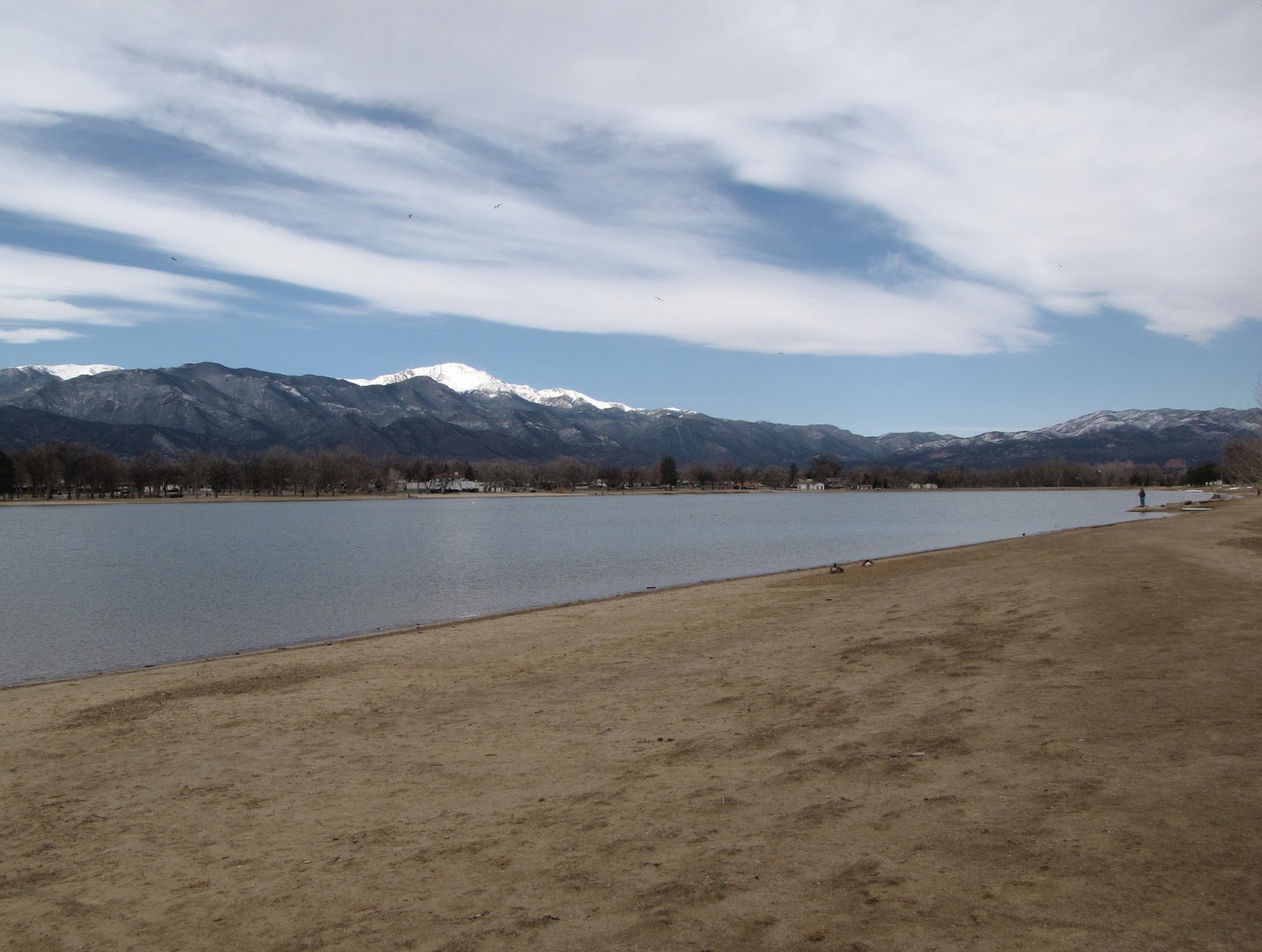
Prospect Lake

I had dismissed Prospect Lake in Memorial Park as just another fake lake in the urban landscape, not worth my time if I wanted to find any wildlife other than Rock Pigeons or European Starlings. Thanks to a Facebook group for the Colorado Field Ornithologists, I found out my assumptions had no validity whatsoever.

About the middle of last month, posts to the group included sightings of the most improbable birds you could imagine: American Avocet, Mountain Bluebird, even American White Pelican. Grebes of at least four species were common. There were pictures of several species to back up the claims.

It is embarrassing to admit that Memorial Park is only about three miles from my home, near downtown Colorado Springs. Yes, Prospect Lake is a large, artificial reservoir, dutifully stocked with trout for fishermen, and with boat ramps to facilitate water skiing, but the water level is low right now, and the boathouse is not yet open for business. I should have paid closer attention.


American White Pelicans

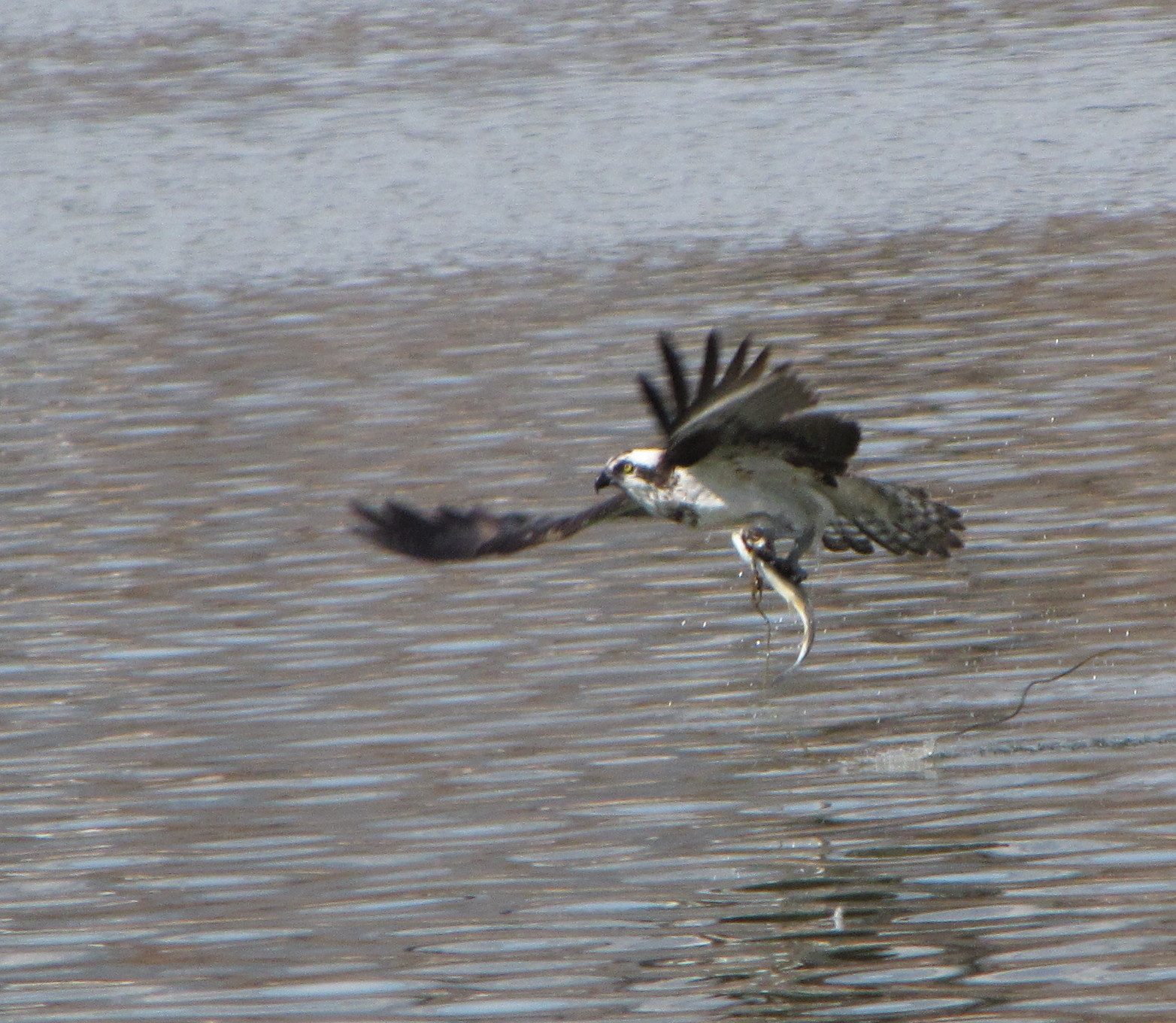
After reading the posts to the ornithology group with my jaw on the floor, I decided I needed to see for myself all the bird diversity. Apparently, on April 19, I was one day too late for the midge hatch that had attracted the large number of birds the previous day. I was still impressed even so. The pelican flock was still there, plus more waterfowl and gulls than I could count. At one point I counted six Ospreys in the air at once. It was like they were lining up and taking turns at the trout….at least until the Bald Eagle showed up and frightened everybody else away.

The land that is now Memorial Park was donated to the city by General William Jackson Palmer in 1890. Prospect Lake was excavated shortly thereafter. Initially, the reservoir was used to supply water to the Evergreen Cemetery, but that need expired in 1950. The water that fills the lake is extracted from the nearby Fountain Creek, a local watershed. A Naval Reserve station occupied the southwest corner of the lake from the late 1940s until the late 1980s. Plans to turn the entire lake over to naval training exercises in 1950 were thwarted by locals who enjoyed recreating on the rest of the lake. The Colorado Springs Fire Department used the armory for training after naval training facilities moved to Fort Carson, but after 2001 all the buildings were abandoned and demolished.

The lake began losing water at a high rate in 2002 when the pipeline supplying the lake was shut off, a severe drought was happening, and the liner for the lake became torn. A movement to add Prospect Lake to the National Register of Historical Places was successful, and spurred action to replace the liner. The lake was refilled and again stocked with fish in 2005, and it remains a vibrant center of recreation today.

The lake is surrounded today by playgrounds, including the state-of-the-art “Swing High” totally accessible playground, plus lawns, ornamental pine, cottonwood, and other trees, ballfields, residential neighborhoods, and commercial real estate. Despite all the hustle and bustle, birds seem to enjoy the area, at least in migration this year.

My own trips to the park on April 21, 26, 27, and 29 yielded a combined tally of the following species:

  1. Mallard
  2. American Wigeon
  3. Blue-winged Teal
  4. Northern Shoveler

    Northern Shovelers
  5. Lesser Scaup
  6. Redhead
  7. Bufflehead
  8. Ruddy Duck
  9. Canada Goose
  10. American Coot
  11. Pied-billed Grebe
  12. Horned Grebe
  13. Eared Grebe
  14. Western Grebe

    Western Grebe
  15. Clark’s Grebe
  16. Double-crested Cormorant
  17. American White Pelican
  18. Ring-billed Gull
  19. California Gull
  20. Franklin’s Gull
  21. Osprey
  22. Bald Eagle
  23. Cooper’s Hawk
  24. Great Blue Heron
  25. Great Egret
  26. Killdeer
  27. American Avocet

    American Avocets
  28. Spotted Sandpiper
  29. Lesser Yellowlegs
  30. Willet
  31. Wilson’s Phalarope
  32. Rock Pigeon
  33. Belted Kingfisher
  34. Downy Woodpecker
  35. Northern Flicker
  36. Tree Swallow
  37. Violet-green Swallow
  38. Say’s Phoebe
  39. American Robin
  40. American Pipit
  41. American Crow

    Osprey
  42. Black-capped Chickadee
  43. White-breasted Nuthatch (heard)
  44. Yellow-rumped Warbler
  45. European Starling
  46. Common Grackle
  47. Brown-headed Cowbird
  48. House Sparrow
  49. Chipping Sparrow
  50. Lark Sparrow
  51. Savannah Sparrow
  52. Dark-eyed Junco
  53. House Finch

I am a novice birder, and I know other species were seen, and have been seen since. Warblers, for example, are only now starting to appear. It just goes to show that you can still be surprised by nature close to home. Really, really close to home.

Sources: Galas, Judith, and Cindy West. 1997. Walking Colorado Springs. Helena, Montana: Falcon Guides (Pequot Press). 233 pp.
Tankersley, Teila. 2010. “Some Interesting Pieces of Trivia on Prospect Lake in Colorado Springs,” Fresh Ink

Wednesday, April 17, 2013

Stormy Weather

I was not prepared for what this spring has brought in terms of weather. Last year we were spoiled by essentially having no winter. This year is the winter that will not leave. Compounding the unseasonably cold temperatures and blustery winds is the fact that we are still getting precious little precipitation here in Colorado Springs. While the drought continues, it is the impact on my psyche that has been hardest to deal with.

You would think that I, having spent the first twenty-seven years of my life in Portland, Oregon, where seeing the sun is a near miraculous event, that I would be hardened to overcast, dreary days. Apparently not. Indeed, I have most recently spent a decade in climates of “extreme sun” counting Tucson, Arizona and here on the Front Range in Colorado. I think I have been trying to make up for those 27 years of drizzle.

It occurred to me while riding the bus on a particularly ugly day in Cincinnati what I find intolerable about “gray” days: The sky has no contour. You look up and it is like you are under a great silver dome. It feels like you are still indoors. This, to me, is the overriding feature that must be at the root of SAD (“Seasonal Affective Disorder”).

At least here in Colorado you can’t usually say the clouds themselves are depressing. Eerie, yes, and sometimes menacing, but not depressing. This is the only place I’ve been where the clouds remind me of being in a coffee mug and God is stirring cream into it. Short of a tornado, this is the closest one can come to the feeling that the sky really is falling.

Lately, however, the days have been far too reminiscent of Oregon. The worst is when the mountains disappear. The foothills and Pikes Peak are near constants in the landscape here, and when you cannot see them it becomes both disorienting and claustrophobic. The world literally seems to be closing in around you.

Lastly, the duration of cold, and periodic light snow, has taken its toll on me mentally. I guess you would call it “cabin fever,” but whatever the name it robs your mood of the highs that normally come at this time of year with blooming flowers, singing birds, the hum of bees. I find myself disturbingly unmotivated, disinterested, and even angry when I have no reason to be.

Weather cannot alone be blamed for our own personal miseries (excepting tornados, hurricanes, and floods I suppose), but no longer will I readily dismiss anyone who says that rainy days and gray skies get them down. We all have a hard time with things we cannot control. Rising above the austerity of climate at this time of year is challenging to be sure.

Wednesday, February 27, 2013

Indelible

A funny thing happened the other day on my way to taking winter snow images in Garden of the Gods park here in Colorado Springs. Just as I settled into position for a great scenic shot of Pikes Peak between two rock formations, a commercial jet arced over the mountain, dead center, leaving a bright contrail in its wake.

Timing really is everything in a case like this. Had I gotten my butt on the road even a few minutes earlier, the morning light would have been even better, and there would have been no ugly airline graffiti. I am sure the navigator aboard the aircraft would argue the plane was not at all “misplaced,” but I would beg to differ, from my vantage point on terra firma.

I pride myself on not retouching any of my images with digital software like Photoshop or GIMP, and I am still debating on whether to bother in this case. People viewing a manipulated image would never know the contrail was there, but no matter what I do to obscure or erase the “defect,” I would still know. I literally “can’t un-see that!” It will always be an indelible vapor trail in the landscape of my mind.

That is what really bothers me, I think. Any time afield, no matter what the results, is time well spent, but a true wilderness experience is getting harder and harder to come by. It is nearly impossible to avoid litter of some kind, and then there are those planes. I have to wonder how many flights I have been on that spoiled someone else’s photographic souvenirs 30,000 feet below me.

Yesterday I walked the dog around our complex of townhouses, just after another snowfall. Ours were the first footprints, even on the sidewalk. I have to admit it was both exciting to be a momentary pioneer, and disappointing to spoil the pristine cover of white.

Tuesday, February 19, 2013

Bluebird Trifecta

Sunday, February 17, my wife and myself and Debbie Barnes of the Aiken Audubon Society set out to find a flock of Bohemian Waxwings that had been seen the day before at the U.S. Army Turkey Creek Recreation Area south of Colorado Springs. We did not find them. The outing was, however, far from a total loss. What we lacked in waxwings we more than made up for in bluebirds.

Our first stop was at the intersection of Barrett Road and Highway 115, where the Bohemian Waxwings had been seen most recently. No sign of them despite a fair crop of juniper berries in the area. Upon exiting back onto 115, we did spot a pair of birds on a telephone wire. They were quickly identified as male Western Bluebirds, Sialia mexicana. One of the two birds obligingly glided to the ground, then popped back up to sit on a fence post about thirty feet from our vehicle, affording the view shown above.

We backtracked to the Turkey Creek Recreation Area, pulling into a playground area with a collection of buildings and the stables where horses for the mounted color guard reside. A Lewis’ Woodpecker is known to hang out there, too, and was sighted earlier in the day, but was a no-show when we were there. No waxwings, either, just more Western Bluebirds, a Common Raven or two, and a flock of Dark-eyed Juncos.

While taking in the austere scenery, Debbie connected with another birder friend, Jeannie Mitchell, via cell phone. Jeannie was kind enough to share that news that a group of birders who were in Turkey Creek that morning had seen a huge flock of Mountain Bluebirds, Sialia currocoides. I admit I was skeptical, but we followed the appropriate road and….

Sure enough, here were probably at least 200 Mountain Bluebirds, distributed on each side of the road. A handful of American Robins, Turdus migratorius, were in their ranks, but the sight of all that turquoise blue was jaw-dropping. One dead tree in particular was essentially festooned with living, feathered ornaments.

By now, around 4 PM in the afternoon, the wind had gotten gusty, the sun lower, and the temperature was dropping. Reluctant to leave, we took it slow and found still more Mountain Bluebirds in a vast open field studded with old yucca and mullein stalks, plus the obligatory barbed wire fences and metal fence posts. Various Mountain Bluebirds took turns alighting on all available perches in really great light.

We also saw what we initially thought was another Western Bluebird. Looking at her pictures once she got home, Debbie realized it was actually a male Eastern Bluebird, Sialia sialis. Note that the Eastern Bluebird lacks the blue throat of the Western Bluebird. The belly of the Eastern Bluebird is also bright white, in contrast to the dirty appearance of the Western Bluebird’s underparts.

Bluebird trifecta! Looking at the distribution maps for bluebirds in the various field guides, one would not guess that the Eastern Bluebird ranges this far west, but here is proof to the contrary. There are always strays, of course, but as habitat, climate, and other factors change, birds adapt and their geographic ranges change accordingly, even from week to week. The convergence of all three species here is now a regular occurrence, especially at this time of year.

Debbie mentioned that bluebirds are feeding on juniper berries when flying insects, grasshopper nymphs, and other prey is not readily available. Cold fronts may push the birds into protected valleys and other warmer situations, but they quickly return when the temperatures warm up again. Sounds like me.

Friday, February 1, 2013

Of Birds and Blades

I like birds, I really do. I am also a strong proponent of renewable energy like solar and wind power. Imagine my dismay at finding many of my birding friends denouncing the huge wind farms popping up all over the place these days. Ok, the objections are mostly concerning the location of the big turbines, but the arguments are not going to end well if taken out of context as the press is prone to do.

There are two problems that occur to me immediately. One, if “environmentalists” first object to traditional energy sources like coal, gas, and oil, but then start whining about commercial pursuit of alternative energy, they lose credibility and are dismissed as “NIMBYs” (Not in my Backyard). Secondly, if we invest too heavily or too quickly in a technology that demonstrates itself to have severe detrimental side effects, then we are back to square one on all fronts.

No question, oil, coal, and gas involve truly horrific extraction procedures and equally risky transportation methods. Time and again we have seen the outcome in the form of petroleum-soaked pelicans, black beaches, mountain-top removals, and other disasters. Virtually anything is better than that. A recent online article and chart from Mother Jones purports to show that wind turbines kill just a few birds compared to the mortality inflicted by…..cats.

Naturally, any bird fatalities attributable to humans, or their pets, is intolerable to many in the birding community. Here is another article, in PDF file format, that offers statistics on bird fatalities associated with cell phone towers. There seems to be no end to the number of ways we are killing our fauna, including automobiles, airplanes, and wanton executions at the end of (insert random weapon here).

I am not saying I am in favor of preventable slaughter. There are alternative designs for wind-driven devices that harness power. Raymond Green has created one that looks promising. The roadblocks to its manufacture at any scale will undoubtedly come from the companies making money with the status quo. That is what must change: Our corporate addiction to whatever is making money at the cost of everything else. We need industries to be flexible to accommodate new findings and better ideas that benefit humanity as a whole, and are sustainable.

I will continue supporting wind energy, and promote safer designs. I will also always love cats, but agree that they should be kept indoors, and/or walked on a leash. I will also continue opposing the stock market as the driving force of our society. It is driving alright, driving down wages, driving through consumer rights, and driving our natural environment to hell. I’m all ears when it comes to an alternative to that.