Showing posts with label natural history. Show all posts

Tuesday, August 31, 2021

Book Review: In One Yard: Close to Nature Book 2

I was introduced to Warren A. Hatch several years ago by a mutual friend. He sent me a copy of the original In One Yard: Close to Nature, which I regretfully never got around to reviewing. I will not make the same mistake with Hatch’s sequel. This book has much to recommend it, no matter where you live.

Mr. Hatch resides in Portland, Oregon, USA, and every organism shown in the book was discovered on his property, the yard of which is only one-sixth of an acre. Clearly, exploring even this small an area can result in constant discovery and astonishment. A reader is going to be inspired to put the book down frequently so as to go looking for mosses, lichens, insects, arachnids, algae, and other living things right outside their door.

This “ignition switch” alone is what makes this book unique and critically important. One could consider it an exercise in vanity (the first book was self-published), but by documenting various species in depth, and showing the reader how he captured the detail and drama of each creature, it becomes a blueprint for how you can do the same. Why you should go to the trouble is self-evident in the countless, captivating images.

The text both explains the natural histories of the organism, and challenges the reader to make their own observations. The stories are an interesting and effective mix of the author’s personal experience, additional knowledge gleaned from literature and correspondence with world-renowned experts, and a periodic, friendly “Mr. Rogers” query to the reader. The author does not put himself above the reader. He defines scientific words with each use, and understands that occasional repetition is a good thing.

The first book was a large, magazine-like paperback. Book two is a smaller, hardback volume. Both are slightly “busy” in their design and layouts, and if there is any fault to the new book, it is in the literal fine print of “Extra Notes” that may be difficult for those with poor vision to easily read. The images are so overwhelming in their excellence and detail that almost anything else can be forgiven anyway.

The one thing that surprises and disappoints is that this book is flying under the public radar. Mr. Hatch’s prior works have rightly received critical acclaim from the scientific community. Hatch has produced posters and DVDs that have also garnered generous reviews; and he was elected a Fellow of the Linnean Society of London in 2003. This is an exceptional honor, as the society was founded in 1788 and has only about 2,000 members. Admirably, Hatch lives a car-free lifestyle.

In One Yard is the perfect complement to Douglas Tallamy’s books Bringing Nature Home, and Nature’s Best Hope. Hatch’s books show you exactly what can result if you cultivate native plants and make even minimal effort to observe and record. Yes, he has invested heavily in the equipment needed to produce what you see on the pages of the book, but what a payoff.

Ideally, we need more Warren Hatchs. More people should do an ongoing bioblitz of their home and property, and share the results widely through blogs, vlogs, Youtube, Instagram, and other media, if not an actual hardcopy book. Be creative. Buy this book as an inspiration and model. In One Yard: Close to Nature Book 2 is available exclusively through Wild Blueberry Media, LLC for a very reasonable $35.00 (postage paid). Don’t take my word for it, just ask Sir David Attenborough who effuses that the book is “splendid” and “it spurs me on.” When a world class, globe-trotting naturalist asks “….whether I haven’t looked at my yard with the concentration and insight that you have,” that is high praise indeed.

Thursday, February 11, 2021

Contingency Planning in Conservation

Wildlife and plant conservation is more complicated than ever in the twenty-first century. Outright habitat loss from agriculture, urbanization, resource extraction, water diversion, the introduction of non-native species, and other endeavors continues nearly unabated. Now, we have the added effects from climate change. Consequently, habitat protection is less predictable. We know change is going to happen, probably more rapidly than anticipated by our government, business, and cultural institutions. How best do we cover our bases?

Habitat of the Filigree Skimmer dragonfly in Colorado Springs, ironically enhanced by an aging drop structure in the streambed.

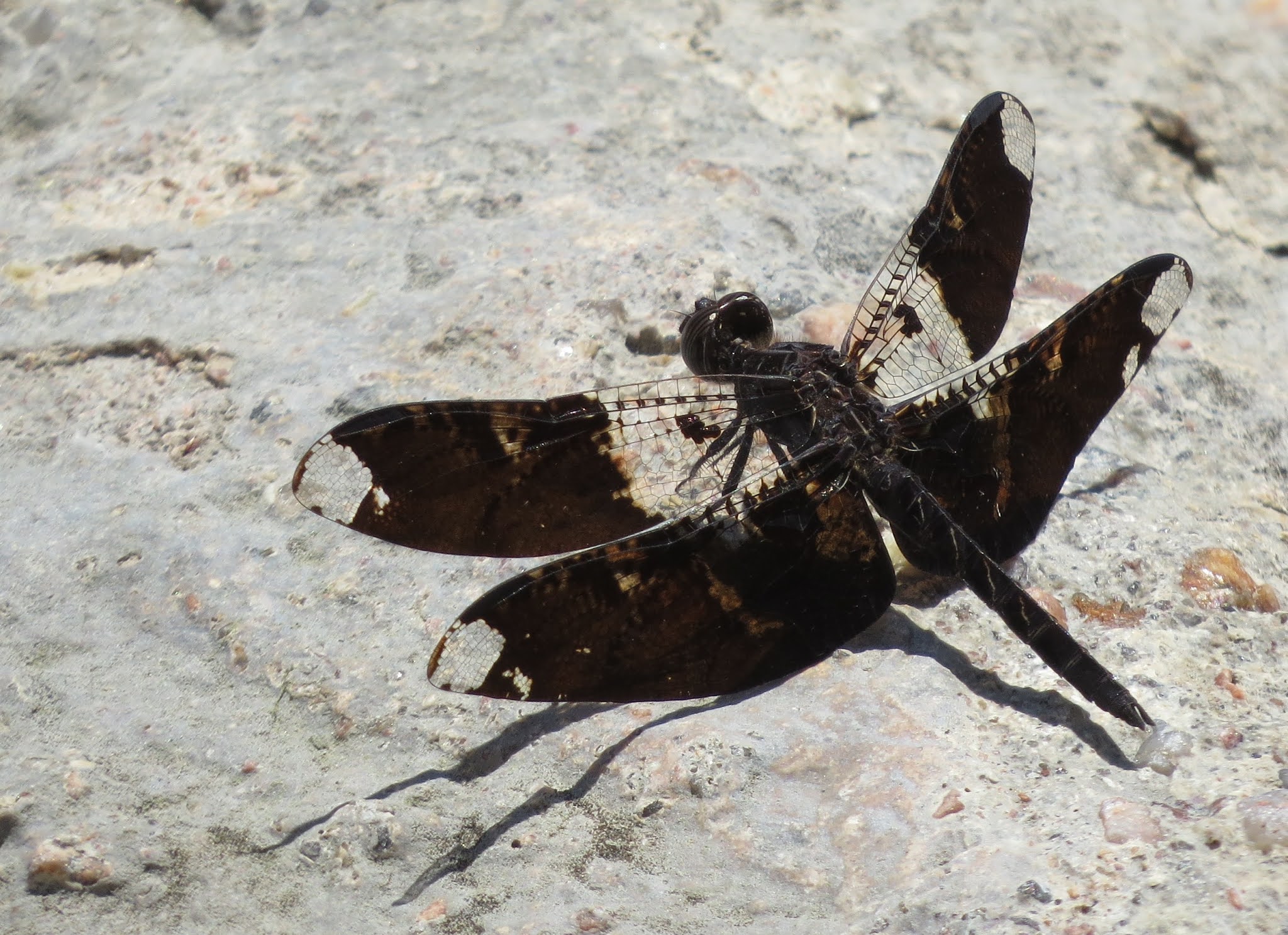
The experience that got me thinking about this was my discovery of the only known breeding population of the Filigree Skimmer dragonfly, Pseudoleon superbus, in Colorado. The documentation of the species just up the hill from my home in Colorado Springs represented a significant northern range extension for the species. I am using past tense because it is almost certain that the population will perish during or after a stormwater mitigation project slated for execution by Colorado Springs Utilities.

This situation was at the forefront of my mind in deciding whether to vote in favor of the reintroduction of the Gray Wolf to Colorado. The citizen-generated initiative made it onto the ballot in November, 2020, and passed by the narrowest of margins. It represents an attempt at restoration of historical ecosystems, and the historical range of Canis lupus in the Lower Forty-eight states. It could also be interpreted as contingency planning should wolves re-establish on their own, which seems to be the trend since the re-introduction of the species to the Greater Yellowstone Ecosystem.

In the absence of reliable predictive modeling for shifts in the geographic distribution of organisms, and therefore shifts in the composition of ecosystems, it is prudent to be as immediately responsive as possible when changes arise. The more preemptive actions that can be taken to facilitate those responses, the better. The wolf reintroduction bill at least forces the hand of Colorado Parks and Wildlife to manage wolves one way or the other, with the advantage going to the wolf and its human advocates. Similar legislation is needed at an ecosystem level to guard against both continued exploitation of natural resources by business interests, and to mitigate probable climate-driven catastrophes such as prolonged drought and wildfires.

A male Filigree Skimmer, Pseudoleon superbus

Back to the dragonfly for a moment. The Colorado Springs occurrence could be viewed as a disjunct population, far removed from the historical range of the species in canyons of the deep southwestern U.S. It could be that this is the “new normal” for the species. If the species is progressing northward, is something happening farther south that is driving it northward? Such outlier populations deserve consideration of protection, regardless of whether the species is currently listed as threatened or endangered in any part of its existing range.

I explored every recourse I could think of to get protection for the dragonfly population up the hill, but to no avail. It is tragically ironic that we demand a species to be already in peril before we give authority for its interests to be considered. Thus, the rights of a given species do not matter until the very last minute. What of the rights of humans to other species? What of our rights to experience other species in nature, in a passive fashion? Why do those rights not count at all? Many a human being would elevate the experience of immersion in wild ecosystems above mere recreation and into the realm of necessity for one’s mental health and physical well-being.

The time has come to raise the bar in proper stewardship of a constantly changing landscape, and give priority to preservation of not just species, but populations of each species. The maintenance of genetic diversity has never been so critical. There has never been such an urgent need to preserve as much remaining habitat as possible because climate change is diminishing viable ecosystems wholesale.

Conservation organizations and environmental law professionals, take note. The old standards and methods no longer apply. It is time to be creative, with innovative approaches to legislation, the forging of new partnerships with indigenous peoples to restore the “history” in “natural history,” and the assertion of urgency to preserve wildlands not for future generations, but to honor present and previous generations of ecological advocates. Get to work.

Monday, August 3, 2020

Book Review: A Season on the Wind

Kenn Kaufman does something ingenious in A Season on the Wind: Inside the World of Spring Migration (Houghton Mifflin Harcourt, 2019). He compares and contrasts the way migratory birds harness the wind to propel them northward versus the bumbling attempts of our own species to capture the wind to meet our energy needs. He and his wife, Kimberly Kaufman, live in a unique location where these powerful phenomena clash head on, quite literally. To his credit, Kaufman exercises remarkable restraint in addressing the downside of renewable wind energy, while exhorting the miracle that is spring migration at Magee Marsh in northwest Ohio, U.S.A.

The book is a brilliant and colorful chronology of the history of tracking bird migration in the Americas, and northwest Ohio specifically. While many birders recoil at the notion that anything good can come from hunting, the author reminds us that the first major strides in bird conservation came about as a result of preservation of wetlands by waterfowl hunters. The organization of hunters into a cohesive unit of persuasion and legislation is something birders should take note of and emulate to achieve more widespread measures to preserve and protect our avian fauna.

From the almost primitive practice of bird banding, to next generation radar, citizen science initiatives, and birding festivals like the Biggest Week in American Birding right there at Magee Marsh, we are constantly improving our collective and individual understanding of spring migration. Kaufman deftly walks the line between what is often seemingly dispassionate formal scientific research and the nearly anthropomorphic appreciation of birds by non-scientists. The book, like the author himself, delivers fact, humor, emotion, and honesty in its appraisal of our constantly-changing, nearly schizophrenic relationship to the natural world, with birds at the center.

It would be easy to write effusively about the spectacle of bird migration as if it exists in a vacuum, a historical constant, a changeless exercise that goes on relentlessly regardless of our own existence. Most writers would simply paint a rosy picture that serves to recruit new birders and birdwatchers, and entertain readers without ever hinting at the negative impacts our species can have on migrant fauna.

Likewise, it would be easy to write a downer of a narrative that focuses solely on the perils birds face during their aerial journey north. There is certainly enough material for one to take a full manuscript in either direction. Balancing the joys with the sorrows, anger, and frustration is no easy task, but that is clearly what Kaufman set out to do, and he executes it flawlessly. When you think you cannot recover from the devastation of the previous chapter, the next one renews your enthusiasm and optimism.

One of the most significant points illustrated in A Season on the Wind is the growth of birding as a social activity. Thanks to advances in communication, formerly isolated naturalists and leisure birders can connect with each other to any degree they wish. Some still prefer “alone time” communing with the nature, but that no longer has to be the default setting. The speed of learning about birds has increased by several orders of magnitude, and the diversity of the birding community has the potential to explode as well.

Kaufman, his wife, and their contemporaries in the ornithological community are as relentless in their pursuit of justice for birds and birders as the birds are committed to their instinctive drive to move seasonally. The birds must navigate both the constant starlit sky above and the radically shifting landscape below. Climate change is a force we are attempting to mitigate for ourselves and other species, yet it is also the driving force behind wind turbine technologies that are cutting birds out of the sky.

This conundrum forces us to confront problems of scale. Bird migration is not a stream of birds like a river in the sky. The birds are widely dispersed and the grand scale of migration guarantees that migrants will confront lethal obstacles wherever they exist. The scale of wind farms, in both height and breadth, is the problem. Bird-safe technologies exist, but offer little profit for utility companies, so they remain neglected. By now we should have reciprocal power grids, mostly localized, where individual households and businesses can feed a centralized source with surplus energy in sunny, breezy times and draw from it on cooler, calmer days.

I am already anxious for a sequel to A Season on the Wind, as the emerging discipline of aeroecology recognizes the complex web of organisms that exists overhead, and seeks to unravel those aerial interactions. Meanwhile, you will find this current book a thoughtful, stimulating, and optimistic read.

Tuesday, July 30, 2019

Of Science and Reverance

Last night I stumbled upon the documentary Inventing Tomorrow, directed by Laura Nix, on our local PBS (Public Broadcasting System) here in Colorado Springs. One of the things that struck me about these young women and men was how much they are motivated by reverence for nature and human history. I found the cultures these students live in to be a welcome, but stark, contrast to the culture and society American children are raised in. Science has informed their emotional attachment to nature, amplified their ability to empathize, and offered them real hope for a brighter future, one they can create.

© Quotation.io

Here in the U.S., children barely connect with their elders, let alone respect them. In many other cultures, several generations reside under one roof, or live next door, or no more than a few blocks away, the better to teach their children and grandchildren well. Personal stories are a powerful source of inspiration and action when told to children. Do we relate our own experiences to our children these days, or do we fear embarrassment, or risk empowering our youth to try daring things like peace marches, or poetry? Do we invite our children to sacrifice instead of feeling entitled to material things? Most children who excel have families that go above and beyond mere support. Fathers and mothers may leave jobs or drive their child for hours to participate in activities or meet with a mentor. Sometimes entire families uproot to be in a location that is optimal for the next step in the child's path to greatness.

While the family is usually at the core of a child's developing sense of values, the community, the "village," is also important. Surrounding a child with influential people outside the familial circle further expands the child's realm of experience and knowledge. This happens routinely in non-American cultures, and it once happened here in the U.S., too, but today we are told that every adult is a stranger, a potential pedophile, rapist, scam artist, or other devious criminal. We assume the worst now, and trust no one. We fear that sending the gifted child to university prematurely will forever stunt their growth in the social sense.....

Religion should be working in concert with science to develop young minds. Science can show what is possible. Religion, ideally, creates the bedrock of reverence for creation and cautions against a completely dispassionate approach to research, especially in the biological sciences. That is not what is happening in American Christianity. Extreme conservatism has put itself at direct odds with scientific advancement, even questioning practices like immunization inoculations that have protected humanity from illness and disease for decades (centuries in some cases).

One could argue that the religious practices of indigenous peoples reflect a much greater reverence for the natural world, but Christianity has dismissed such belief systems as "paganism," seeking to convert other cultures at every possible opportunity. Missionary programs offer poverty relief, but with the strings of Jesus attached. Meanwhile, Christianity pays lip service to a reverence for creation, even when it could claim that Noah was the first wildlife conservationist. Prayer is the only action needed to save the world, while you continue your over-consumptive lifestyle.

I have personally exposed myself to both science and religion, and found that science creates a greater reverence for the natural world. It does at times demand a detachment from your (research) subject that I find distasteful, sometimes outright wrong, but it is generally a far less judgmental community, and getting better by the day. It does not retreat into outdated doctrines that have proved toxic to scientific progress, impeded the advancement of women, and suppressed minorities. It is embracing the entire spectrum of gender identity, and continues to welcome immigrants who bring new insights, skills, strategies, and vision in meeting the challenges of the future.

In short, science is what religion should be. Go ahead and pray, it cannot hurt, but please stop wasting energy attacking science. The two should complement each other, not antagonize one another. Practice restraint in your lifestyle, be conservative in your carbon footprint, and joyful in your celebration of all things wild and free. Feed your curiosity, fascination, and sense of wonder. Support your local science fair, as well as the vacation Bible school bake sale.

Tuesday, February 12, 2019

Book Review: Never Home Alone Embraces the Wild Indoors

The New York Times review of Rob Dunn's new book Never Home Alone: From Microbes to Millipedes, Camel Crickets, and Honey Bees, the Natrual History of Where We Live (2018, New York: Basic Books, 307 pp.), calls it "a book that will make you terrified of your own house." To the contrary, it is a celebration of the biodiversity of the indoors. Presented here are solid scientific arguments for re-thinking how we approach our daily lives.

Dunn is among the most prolific science writer of our time, but the rigor and research he applies to each book is beyond reproach. He is also captivating in his delivery, a master at never talking down to the reader, but instead elevating the reader into a participant role in the storytelling. Indeed, my reaction to some passages was "why didn't I get invited to help with that study?" or "how do I get to help in the next research project?" Dunn's enthusiasm and sense of wonder are far more contagious than any of the pathogenic microbes he discusses in Never Home Alone.

About those bacteria, yeasts, molds, fungi, and viruses. Turns out that there is untold diversity among them, and the overwhelming majority are beneficial to us rather than malignant. In the course of surveying homes around the world, from his own neighborhood in Raleigh, North Carolina to Russia, and even the international space station, Dunn and his minions discovered new species of microbes. Probably new genera and families, too. How is it that we still have so much to learn about the places we spend ninety percent of our lives? He has a theory, but you will find no spoilers here.

Dunn puts the "history" in "natural history" in all of his books, and it is often a history we do not learn of in school, certainly not to the depths that various historical figures and episodes deserve. Here, that history demonstrates where science has been confronted with choices, and how civilization has progressed, or potentially strayed, as a result of the paths we have taken.

The overall message of Never Home Alone is a positive and encouraging one. It is always the disasters and exceptions that make the headlines. How black mold turns homes into lethal chambers for the human residents. The latest epidemic of Staphylococcus bacteria in the local hospital. Not publicized are the numerous microbes, insects, fungi, and other organisms found in the average home or workplace that are essential to our human lives. We are overzealous in our efforts to rid our homes of harmful creatures, eradicating the helpful and inert species with far greater success, albeit inadvertently. The dangerous critters prosper through evolved resistance to chemical treatment, and the absence of the good creatures that would outcompete them if we did little or nothing to intervene.

Dunn stops short of stating the ultimately obvious: "Product" and "service" are rarely the answer to any problem, especially an ailing household. Something is already out of balance, and applying chemical treatments is only going to exacerbate the situation rather than solve it. Your home, workplace, and even your body are ecosystems, mostly at a microscopic scale, and failure to treat them as such, to cultivate the beneficial species, is asking for trouble.

Never Home Alone concludes with a chapter about bread, specifically sourdough, which results from fermentation processes conducted by yeasts in concert with other microbes. Bread is a living thing, or more properly a collection of living things, like an orchestra, bread being the musical product. It is an apt metaphor for how we should approach every aspect of our lives. We should be striving to be a complement to other species, fostering diversity at every level. When we seek to understand, ask questions first, and hesitate before reaching for the cleansing fluid, we begin to truly flourish. Our potential as stewards of the planet begins, literally, at home. Stop with the apologies, the "excuse the mess" greeting you give your guests. You are not a messy housekeeper, you are promoting biodiversity. Read this book and free yourself.

Sunday, November 18, 2018

Book Review: The Humane Gardener Offers Lawn Alternatives

Nancy Lawson was not always one to garden beyond her self-interests, but The Humane Gardener (Princeton Architectural Press, 2017) represents her own horticultural metamorphosis through careful research and the experiences and results of others. She deftly avoids sermons and diatribes, instead letting common sense and examples speak to her points. The result is a thoughtful, captivating, and motivational book.

Do not let the cover, which brings to mind the Old Farmer's Almanac, fool you. This is not an old-fashioned throwback to romanticized rural life and how to achieve it. The book is well-illustrated and well-organized. Chapter breaks are punctuated with real people experiences of gardening with native plants, coping with sometimes unwelcome wildlife, and successfully enhancing or restoring natural landscapes. Lawson is unwavering in her focus on the whole, yet still paints vivid portraits of the people behind the process of converting desolate deserts of lawns and exotic botanicals into something not only sustainable and more diverse biologically, but that ironically often takes less work to manage.

The text is gentle, rarely admonishing any reader who may be practicing the "normal" style of manicured turf and media-dictating plantings of the latest and greatest cultivar of this or that. Lawson herself describes once shopping for various varieties of commercial roses, for example. She readily admits her failures and what she learned from them, as well as demonstrating how others have overcome obstacles to reinstating a more natural look to their properties.

I fully expected a much more forceful....activist....voice, with one-sided arguments, and was pleasantly surprised by the fairness of Lawson's approach. When I was certain that she was going to give only one side of an incident involving dead bumble bees and linden trees, she came through with further explanation. Notes in the back of the book cite the sources for her assertions of statistics and academic studies. Nowhere does she claim to have all the answers, nor advocate a one-size-fits all mentality.

The whole point of the book appears to be that our spectrum of urban to rural landscapes are works in progress, usually resilient, with a memory for what they once were. Still, each location has its own peculiarities and deserves a reverence for its history as a precursor for whatever comes next. Changes do not happen overnight, but your efforts are often, if not usually, rewarded more quickly than you would imagine. Patience and forgiveness are recurring themes in the book. No one in the selected examples between the chapters is raised to sainthood, and each readily admits their shortcomings.

While there are numerous photos throughout the book, most are exceptionally dark, and the matte finish of the paper makes it difficult to discern the subjects of the images in many cases. That matters little, as the prose paint their own imagery. I found only one error in the entirety of the 204 pages of text. There are no "Grey herons" in North America, let alone my home state of Colorado. I am rather certain she meant "Great Blue Heron." Zero spelling, punctuation, or grammatical errors did I detect.

Lawson's previous work at the Humane Society of the U.S. prepared her well for writing and marketing this book. She recognizes that the shift toward more wildlife-friendly gardens is in its infancy and that a book is only a snapshot on a timeline. To that end she has erected a website, The Humane Garderner, to continue the conversation and explore specific topics more in depth. The website also lists author appearances and other events, provides an opportunity to sign up for her e-mail newsletter, and gives readers a portal for feedback. Lawson is also aware of the mobile digital age and so the book itself is available in e-reader formats as well as the hardbound copy that I have.

The Humane Gardener is an ideal introduction to gardening with natural history in mind, and I look forward to a sequel or two that might give more tips applicable to those of us in townhouses, home owners associations, apartments, and similar residential situations. The same might go for office and industrial parks. We all need to get on the same page, though how we get there could be a radically different journey.

Thursday, July 19, 2018

A Deep Desire to Live Somewhen Else

© MountainCrossingsAtNeelGap.wordpress.com

Many people are not happy with the place where they live. Maybe the neighborhood is bad. Maybe the climate does not agree with them. Maybe they are just restless. I have concluded that I would rather live in a different time. I have no desire to return to my childhood. This is not about a re-do on a personal level. We make the best of the cards we are dealt. This is about something bigger. This is about a longing for what was never allowed me because it was gone before I was born.

There is increasing evidence, if only anecdotal, of an "insect armageddon," which suggests the abundance and diversity of insects and related organisms are plummeting. We have already lost many once-populous species to the greed and ignorance of previous human generations. A planet devoid of even insects raises a specter that I am unwilling to contemplate, and a life I would not be able to endure, psychologically if not physically.

That is the thing about history. You will eventually learn about what you will never have the opportunity to experience.

You better believe I am angered that I have been deprived by my forefathers of the vast flocks of Passenger Pigeon, the antics of Carolina Parakeets, and the jaw-dropping icon that was the Ivory-billed Woodpecker. I can only see Bison on preserves and ranches, and on the ranches one suspects it is actually the hybrid "beefalo" that one is seeing. Meanwhile, I have a hard time looking at a salmon or trout without seeing a fish hatchery. There are still California Condors, but so few that each bird is fitted with huge, numbered tags, radio telemetry devices, and who knows what else. The bird's "recovery" is not a success story. Maybe it will be once they are no longer wearing the accessories of science, and are truly free to fly.

We have not just tamed the wild, we have diluted it beyond recognition in the name of risk assessment and public safety and public grazing, to name but a few agents of wilderness simplification. The national forests are national tree farms, and it should come as no surprise that the U.S. Forest Service is in the Department of Agriculture rather than the Department of the Interior where it ought to be.

Back to the past, the long ago that I long for. It would be wonderful to know the truth of the landscape that surrounds me today, to see what a riparian corridor looks like without Russian Olive everywhere. What is a foothills meadow without mullein? What is your eastern deciduous forest without an understory of Japanese Honeysuckle? Do I wish we could resurrect mastodons and mammoths? No. I draw the line at being a potential meal for a saber-toothed cat or a Dire Wolf. Furthermore, those were the days when our ancient ancestors were just surviving, without understanding of the ramifications of their actions.

Naturally, I would still want to bring my binoculars, digital camera, first aid kit, and waterproof jacket on the Lewis and Clark expedition.

Perhaps I am guilty of romanticizing the age of the old growth hardwood bottomland forests with their gargantuan oaks and hickories before we started logging and draining the good kind of swamp. Old photographs and artwork paint pictures that are hard not to idealize when you are passionate about the natural heritage of this country. That is the thing about history. You will eventually learn about what you will never have the opportunity to experience.

Ah, but what would I give up in exchange for that bygone era? I do believe I would sacrifice the internet, television, maybe even electricity, especially because I would never know those innovations were on the horizon. Naturally, I would still want to bring my binoculars, digital camera, first aid kit, and waterproof jacket on the Lewis and Clark expedition. Sure, I would likely have a shorter lifespan, but at least I would enjoy that life more fully. Today, instead of California Condors gracing the skies, I am subjected almost daily to extremely loud military aircraft overhead. I would gladly trade noise and neon and traffic and the illusion of choice in the marketplace for something a lot simpler, with fewer losses of species.

© DWParkinson.com

We can reverse some of this, turn back the clock if you will. The grand experiment of reintroducing the Gray Wolf to Yellowstone National Park proves decisively that Mother Nature has a memory, and that when you bring back a piece of the puzzle, the whole thing fits together tighter and smoother. We need a historical spectrum of nature, from the initial stages of succession to the "finished" product, because we know there is no such thing as a permanent climax ecosystem. Even natural communities are ephemeral, but until now there have been multiple, continuous habitats that feed each other. They are now so isolated that there is no transfer of species and so invasives take command. We need to link the wild spaces with corridors to facilitate healing of the landscape.

It remains to be seen if I can continue to be as resilient as that landscape, how many times I can come back healthy, vibrant, committed to making the world a better place, acting on my vision of wholeness in every sense of the word. For now I am misplaced, a pioneer naturalist and writer in a domain that I had no conscious hand in architecting.

Sunday, March 11, 2018

King of Pain

© BaltimoreSun.com

Movies and television have long given advanced warning of graphic content before showing or broadcasting to audiences. Social media, and the internet in general, are lagging a bit and so less savvy users are occasionally startled by content they were not expecting and that they would deem inappropriate for themselves or younger members of their family. Personally, I count images and videos depicting graphic violence between animals as something I would like to be warned about rather than suddenly confronted with in social media. It does not stop there, though, and people who voice their discomfort are often shamed by others for not being "man enough" to take it. That needs to end.

We could probably debate the true meaning of the song "King of Pain," by The Police from their Synchronicity album, but what I take away from it is that the singer feels intensely the suffering of every other living creature. It is inescapable, much as he longs for relief. I can empathize with that. Indeed, empathy is the whole point of this blog post. My brain, for whatever reason, is acutely sensitive to graphic violence and gore. I sometimes find myself involuntarily recalling horrible images or movie scenes without prompting, just suddenly, randomly, and for no apparent reason. Meanwhile, I have much more difficulty conjuring peaceful, pleasant images. Maybe you are wired differently. I hope you are wired differently. It is not any fun to be a King of Pain.

Professional wildlife photographers should be committed to documenting life with honesty, and predation, territorial battles, and other violent conflicts are a part of life, no question. It is difficult for me to communicate my understanding of that to my camera-toting colleagues while at the same time arguing against what amounts to nature violence pornography. It may come down to intent. Sex sells. If it bleeds it leads. You know the drill. Networks and their executives who pander to a perceived public bloodlust are also failing to be honest, let alone fair and balanced. They may need more diverse focus groups, or simply stop making assumptions, or otherwise take responsibility for their content instead of claiming that a steady diet of violence is what audiences want. This includes Discovery Channel and Nat Geo.

Online, I have finally noticed that the more responsible outlets for natural history content, and/or my friends, are prefacing videos at least with text warnings if the content is of a violent or graphic nature. I appreciate having the choice to click or not. When someone shares a graphic video or image then I will comment that I do not like to see that kind of thing without warning, thank you. Sometimes, if their reply is impolite, I unfollow them.

I have been told that if I don't want to be exposed to certain things then I should get off the internet. I have been told to "man up," implying that if I find certain things distasteful then I am somehow being a baby or too sensitive or some other judgmental epithet. No, I am not a child or some other kind of innocent, but I am vulnerable. Some people are not comfortable with being vulnerable, but we don't shame them for having a hardened heart. I would not advocate that we should. There is no place for shaming anybody except, perhaps, those who perpetrate cruelty, shame, discrimination, and other acts of wanton, needless hostility.

This is another kind of divide in our country, one of conflicting personality traits. It is not necessary that we all think alike, or "feel" alike, either. We need diversity in all aspects of our life: biologically, psychologically, and socially. What we must have in order for that diversity to flourish is respect and acceptance. You want to watch animals killing each other? Fine, but do not admonish me for not desiring the same thing, or objecting to it when you gave me no choice but to see it. Understand the difference between someone standing up for themselves, and someone berating you for whatever excites you.

Sunday, February 4, 2018

The Geometry of Luck

Birding and wildlife observation in the digital age means that our experiences in nature are defined more than ever by GPS (Global Positioning System) coordinates, maps, and other geography-based intelligence. The wildcard is always time. Your personal success or failure, if you frame it that way, will always come down to the matter of "when."

Immature Golden Eagle

The old philosophical question of whether a tree falling in the forest makes a sound if no one is around to hear it is an apt comparison. Had no one seen the Rufous-necked Wood-rail at Bosque del Apache National Wildlife Refuge back in July, 2013, had the bird really been there at all? Were it not for video evidence, and personal experience, professional ornithologists would no doubt still be skeptical.

These days, sightings of rare birds, stray migrants, and aberrant color forms seem to cross social media intersections monthly, if not weekly. Our historical perceptions have suffered from too few data points, it appears, and too few observers in too few places. Today, the likelihood of a birder intersecting something spectacular is greater than ever. Thanks to instant communication, that birder can also greatly increase the likelihood that other birders will have the same exciting encounter, provided they get there in time. However, the odds of the flight path of a Golden Eagle crossing my vehicle's path on my way to look for Mountain Plovers is still infinitesimal.

"Everyone" has been seeing that wayward Varied Thrush. Right here. How could I have missed it? Then again, I hadn't seen Bill and Ashley in about two years....and I got to meet Jeff in person for the first time. Maybe that is why I was supposed to be here, right now, without any birdy distractions. Sometimes, your interpretation of a situation makes all the difference.

Varied Thrush

The frequency with which you are out observing, or even attuned to possibilities of witnessing nature, the greater the chance of memorable encounters. Storm chasers know this better than anyone else, and they also accept defeat more readily than most of us even aspire to. Few of us commit to regular outings. We have jobs, family obligations, and fuel costs to consider, among other variables that directly or indirectly conflict with birding and wildlife watching.

Opportunities still abound. We recruit other members of the carpool to birding. We can bird ourselves during our commute, during lunch. When you least expect it, you may notice birds and other animals in the midst of major, unrelated events. I recall attending a Cincinnati Reds game when the team was still playing in Riverfront Stadium. Admittedly, I am not much of a base ball fan, but I enjoy the atmosphere and people-watching. I happened to glance up at the same time that a sleek bird swooped into the arena, alighting on the foul pole. It was a Peregrine Falcon. At the precise instant I was attempting to draw my seatmate's attention to the bird, Barry Larkin belted a home run. As the ball departed the outfield, fireworks were detonated, launching the falcon on its own departing trajectory.

Even people normally unmoved by birds can have unique and thrilling experiences. A video that went viral in April of 2017 was shared by a businessman who was joined on his Chicago commute by a Yellow-bellied Sapsucker that clung to his window as he drove to work. He dutifully pointed out the major attractions to his feathered friend along the way. Eventually, the bird ends up inside the car, on the man's collar or shoulder. "I think he's a woodpecker" the man utters matter-of-factly as the video concludes. There is little doubt the bird was injured and disoriented, and may or may not have survived, but in a matter of minutes it had left an indelible impression on thousands of humans.

Mountain Plover

Is it mere coincidence that the specifics of latitude and longitude are measured in minutes and seconds? That recognition of time is telling. Where you are is made important to you by when you are. The intersection of Kingbird Highway and Bluebird Lane is where crisscrossing vectors meet improbability on the axis of time. Birding is ultimately the geometry of luck. Take your chances, as many as you can.

Wednesday, January 3, 2018

"Chasing" Owls, and Saying What You Mean

Social media is nothing if not a lightning rod for raging arguments and polarizing opinions. Take for example a frenzy of commentary that erupted last week when the administrator of a wildlife photography group on Facebook announced that no one would be permitted to disclose the geographic location of any image taken of any animal species posted to the group. I had intended to include quotes from some of the replies to that post, but I have always been much more interested in what remains unspoken, and the motivations behind a person's stance on any topic.

Snowy Owl, El Paso County, Colorado
© Heidi Eaton 2010

The directive from the wildlife photographer's Facebook group stemmed from the throngs of people pursuing Snowy Owls that have strayed far south of their normal range and are showing up even in Kansas this winter. Each spotting ignites the bird equivalent of what one might call Princess Diana Syndrome. Hordes of camera- and phone-wielding citizens descend upon the place the bird was reported from. Many people are protesting that crowds are endangering the owls, causing them to expend energy in fleeing instead of hunting rodents. That may be true, but what constitutes harassment of wildlife is debatable. Maybe the people complaining just don't like crowds themselves. The point is that the public conversation is always the tip of the iceberg.

I have my theories. Given what is happening in the natural range of the Snowy Owl, I can understand wildlife professionals and enthusiasts wanting to limit impacts on individual birds. Between climate change, and the U.S. actively seeking to drill for oil in what are now protected Arctic refuges, it may be a matter of decades before the Snowy Owl goes extinct and no one has the privilege of seeing one, anywhere. The interesting thing is that few, if any, advocates for the "rogue" owls in the lower forty-eight are making this point.

You may have legitimate concerns, but claiming to speak on behalf of another species is usually done to avoid speaking selfishly, though selfishness is not a crime. Dishonesty is a crime, and that is the kind of dialogue we have with each other daily, on almost every issue whether personal or public. We fail to speak frankly. That dishonesty leaves the recipient on the other end free to make wild assumptions about your motives.

Assigning the proper location to a specimen, be it the actual organism or an image of it, is standard for the scientific community. Each data point is crucial to our understanding of distribution, behavior, and other aspects of a species. Not including that information could be construed as you having no interest in science, or furthering our collective knowledge in a era when one could argue there is a war on science.

Posting an image and then not disclosing the location can be interpreted as "I got my photo, but I'm not helping you get yours." It is an attitude of smugness and snobbery that you probably never intended, but because you did not honestly explain your motivations, we are free to make assumptions about your character.

Then there is flat-out irony. By driving any distance to see a Snowy Owl, or any other organism, you burned fossil fuels directly or indirectly, and may even have killed some other animal on the road along the way (insects at the very least). One could argue that the process used to get your image is part of the problem. You have added to the demand for fuel that is driving the encroachment into Arctic habitat. Your vehicle's exhaust is adding pollutants that are hastening global warming. The people that don't chase might claim the higher moral ground in this scenario.

We may have to come to peace with not getting "our" shot, our own personal trophy. Instead, maybe we should explore closer to home. In my Bug Eric blog I talk all the time about the potential for discovery in one's own backyard, or neighborhood. You can make a big splash with little if any negative impact. You can find something never seen before in your city, county, or state. You can observe behaviors previously unknown.

Most of all, in your speech and actions, strive to be honest no matter how selfish, strange, or surprising it sounds. It will be refreshing, and maybe it will catch on. Who knows, maybe even members of Congress will have the courage to speak truthfully. No, I'm not holding my breath.

Wednesday, December 13, 2017

Book Review: Wait Till it Gets Dark

The subtitle of this wonderful 2017 book is "A Kid's Guide to Exploring the Night," but parents, naturalists, camp counselors, and other adults will find it a captivating read; and it is full of activities designed to enthrall children of all ages. This book is a perfect vehicle for leaving no child indoors, no matter where you live.

Wife and husband authors Anita Sanchez and George Steele, with the help of illustrator John Himmelman, examine life after dark through the heightened senses of a variety of non-human animals. The writers invite the reader to become the eyes of an owl, ears of a frog, nose of a deer, and so forth, chapter by chapter. We are invited to embrace our own animal-ness and train our senses and faculties to become more acute. It is an ingenious strategy for any book about natural history.

The layout of the book is occasionally difficult in that one never knows whether to continue from one page to the next and then go back to read the "You Can Do It" activity box, or stay on the page and then pick up the storyline after reading about the activity. This minor drawback does nothing to compromise the quality of the text and illustrations; and there are few other bones to pick at all.

What does perplex me is the chapter "A Tongue Like a Gila Monster." Nowhere does it mention that this is a venomous lizard, not to be approached or handled. That this warning is absent when the text is discussing organs inside the mouth of the reptile strikes me as not just an oversight, but highly irresponsible.

One other thing I would appreciate clarification about is the chapter on the ability of many animals to perceive and utilize the Earth's magnetic field with "The Mysterious Sixth Sense." When mention is made that perhaps human beings may have a latent ability to relate to the magnetic field, this becomes "A Seventh Sense?" Considering that Homo sapiens is also an animal, I fail to see the distinction.

Again, these are rather minor quibbles considering that this is otherwise an excellent 60-pages of exciting natural history observation and exercises. The back matter talks about the need to preserve true darkness, general safety precautions when doing the activities, and citizen science projects that the whole family can participate in. There is a glossary (omits defining GPS, though), and valuable bibliography to conclude.

Wait Till it Gets Dark would make an outstanding holiday gift to any young naturalist in your life, or anyone who works with children in an outdoor setting. I can hardly wait for the next book by Sanchez and Steele, courtesy of muddy boots™, an imprint of Globe Pequot publishing.

Wednesday, January 29, 2014

The "History" in "Natural History"

Much is made of the need to conserve wildlife and preserve wildlands for the sake of future generations. I would argue that there is just as strong a need to be good stewards of the planet for the sake of past generations. We talk of “natural history” with an emphasis on “natural.” We practically ignore the “history” involved.

Here in the United States, we have a legion of icons who built the foundation for our modern environmental movement. Do we owe them nothing for their unique visions, legislative action, scientific research, and passionate protests? What about artists like Ansel Adams who brought images of wilderness to the masses who had never seen Yosemite? Aldo Leopold gave us a “land ethic.” Rachel Carson cautioned against the indiscriminate use of DDT. We would not be where we are today were it not for the likes of these heroes and heroines.

We can erect monuments to such people, honor their work in film documentaries and written biographies, but what better way to leave a legacy than to insure their efforts were not in vain? Yes, more wilderness has been preserved, more parks created, and more species discovered, but then there are challenges like the reintroduction of predators into parts of their historic geographical ranges.

The debate over wolf introductions is incredibly volatile, but I have heard no one speak of how doing so would bring history back to life. The national park system, at the very least, should be dedicated to preserving a historical spectrum of habitats and ecosystems. There is Colonial Williamsburg, there are civil war re-enactments, and countless other examples of “living history” in the human context of the term. What about the history of wildness?

Recreating in a museum diorama that which used to be is not enough. Resurrecting the mammoth, or even the Passenger Pigeon, may be a bit too much, as we also need reminders of our extreme human mistakes. Still, I feel impoverished that I have been deprived of even the opportunity to see a Carolina Parakeet, a Great Auk, or a Sea Mink. The California Condor once flew over the Columbia River, according to Lewis and Clark. We should consider restoring its presence there.

Once my own mentors pass away, you better believe I will remain dedicated to making sure their voices carry on, that their fights go on. I owe it to them. Another natural landscape destroyed by needless development, a dam, or pollution? Not on my watch. Allow another species to go extinct due to human greed or neglect? No way. I’ve got your back, John Muir, Theodore Roosevelt, Bob Marshall, Dian Fossey. Your missions didn’t die with you.

Thursday, February 17, 2011

Urban Wildlife in the News

The subject of urban wildlife has always been near and dear to my heart because of my own experiences with various birds, mammals, herps, and invertebrates in the various cities where I have lived. I am delighted that more focus is being directed to our wild neighbors lately, as evidenced by a couple of articles brought to my attention recently by friends on Facebook.

Dr. Douglas Tallamy, a professor at the University of Delaware, made ”A Call For Backyard Biodiversity” in a recent issue of American Forests. The article is a condensed version of Tallamy’s brilliant book, Bringing Nature Home, where he makes the case for landscaping with native plants. He then articulates a strategy for creating wildlife corridors by linking backyard habitats.

Another recent article in the New York Times highlights the surprising diversity of mammals and birds to be found in both urban areas and natural forests. The surprising subject of this study is the Fisher, a large mammal in the weasel family that had for decades been on the decline due to excessive trapping and conversion of its habitat to agriculture and subdivisions. A secretive predator, it is apparently now adapting to human presence and reclaiming some of its historical distribution patterns.

All this causes me to reminisce about the days when I was part of a volunteer team at the Audubon Society of Portland (Oregon) that worked together to publish a quarterly magazine called The Urban Naturalist. I joined the effort in about 1984 at the invitation of the editor, Mike Houck. Mike was already a friend and mentor, so I welcomed the chance to contribute to what became an award-winning journal. I wrote and illustrated articles on insects, and occasionally short pieces on a specific park or greenspace.

The Urban Naturalist frequently had themes for a particular issue, so I wasn’t always able to get a story in, but I always felt respected and welcomed at editorial meetings. Eventually the “staff” all went our separate ways and the publication ceased to exist. It was not soon to be forgotten, though.

In the late 1990s, the Oregon Historical Society approached us with the idea of compiling some of our best essays in a book. Wild in the City: A Guide to Portland’s Natural Areas was published in 2000. I was honored to have several of my stories included, and also some new illustrations to complement articles authored by other people.

At some point I will be sharing some of those old stories in this blog and my “Bug Eric” blog. I also hope to make available species lists for insects and arachnids I have observed and collected in Portland, Cincinnati, and Tucson. I encourage my readers to do the same. Your observations over time can be of great significance. The National Phenology Network can certainly make good use of them.

Friday, August 6, 2010

Brown Canyon

Last Tuesday, August 3rd, I had the privilege of joining my friends Philip Kline, Margarethe Brummermann, and Fred Heath in Brown Canyon on the Buenos Aires National Wildlife Refuge in western Pima County, Arizona. I also made new friends in Ken Kertell, Jake Mohlmann, and a couple from Cincinnati: John and Samantha.

Recent rains left Brown Canyon anything but “brown.” Wildflowers, butterflies, and dragonflies all added dashes of color to this unique landscape. In fact, reds, pinks (like the Fendler’s Globemallow below), oranges, and yellows were among the dominant colors of the surprisingly lush blooms of flowers.

There was still water in the upper reaches of the canyon, and a succession of pools in the scoured bedrock were patrolled by dragonflies including the Filagree Skimmer, a Giant Darner, and this Meadowhawk (Sympetrum sp.).

Most of those on this trip were looking for birds and butterflies and they were richly rewarded. Fifty-two species of butterflies and skippers were observed, including this Fatal Metalmark, Calephelis nemesis.

The canyon itself is very scenic, and steeped in a rich human history. Buildings, rusting cattle tanks, and even an old windmill are strewn throughout the landscape, and an old road and rock walls run parallel to the streambed. Not all the human habitations are derelict, however, as there is a very nice environmental education center complete with lodging for visitors.

The U.S. Fish & Wildlife Service is quite serious about regulating tourist traffic in Brown Canyon, and it cost our party $40 to visit for the day. We had to obtain a code for the keypad that opens the gate, and it took two tries to get all three of our vehicles through before the gate closed automatically behind us!

I heartily recommend a visit to this wonderful area, but strongly suggest that you watch the weather reports and make your trip after a good monsoon rainfall if you want to see the best of the flora and fauna. Remember to take plenty of water, sunscreen, sunglasses, and a broad-brimmed hat for maximum comfort during your hike.

Monday, June 28, 2010

In Praise of Shade

The city of Tucson, Arizona could use many things, like mid-level jobs to fill that void between rocket science and “Do you want fries with that?” Another crying need for people and wildlife alike is a Shade Initiative. During the searing heat of late spring and summer, there is nary a place to escape to. Sunscreen only does so much for Homo sapiens, and other animals take refuge where they can find it.

Many desert animals have simply become nocturnal, hiding in burrows or crevices in rocks by day. Even creatures that don’t actively dig will use the abandoned burrows of animals that do. Rattlesnakes will hole up in an old ground squirrel tunnel. Sometimes occupant and interloper will grudgingly share space, such as the many mammals, birds, other reptiles, and invertebrates that are frequently found cozying up to desert tortoises in their dens.

My own experience has showed that even insects will seek respite from the midday heat. One recent excursion to an artificial riparian area in Fort Lowell Park revealed an amazing spectrum of sheltering insects among the dense stands of cattails along the edge of the lower pond. Even butterflies like the Leda Ministreak, Great Purple Hairstreak, Empress Leilia, and Fiery Skipper work their way into the cool heart of the emergent vegetation.

Other insects present include an abundance of bees, wasps, and flies. You have to look closely. The wasps and bees are often tiny. On this day, June 21, 2010, I tallied wasps in the families Bethylidae, Chalcididae, Braconidae, Ichneumonidae, and Sphecidae. Sweat bees, especially males in the genus Lasioglossum (family Halictidae) were also common.

In the past I have observed fair numbers of “tarantula hawk” wasps, and even cicada killers in the ranks of roosting Hymenoptera.

The habit of seeking midday shelter does not escape the predators of these insects. Robber flies (family Asilidae) weave their way in and out of the cattails and pounce on unsuspecting prey of all kinds. Meanwhile, jumping spiders prowl each leaf and lynx spiders (Oxyopidae) lie in ambush to catch unsuspecting flies and other insects.

As I leave the park, I try and stay in the shade, but the mesquite, cottonwood, and ornamental pecan and eucalyptus trees are planted sparsely in the landscaped lawns. Once out of the park altogether, shade is even harder to find. There is no mandate to plant shade trees here, though Tucson Clean and Beautiful is perhaps slowly changing that through its ”Trees for Tucson” and Home Shade Tree programs.

The hot sidewalk, where there is a sidewalk, nearly melts the soles of my shoes. I grow hot and thirsty quickly. I pass by a sign in the flowerbeds warning not to drink the “reclaimed” water from the drip irrigation system. Fine, but then give me a public drinking fountain every few blocks. The bus stop is one of the few that do offer meager shelter. Most have no shelters, or the shelters are oriented such that “shelter” is rendered meaningless. I make a note to myself to consider leaving Tucson and relocating to a place with both shade and water.

Wednesday, May 19, 2010

Remembering Mount St. Helens

Today (okay, yesterday, I’m always behind in this kind of thing) marks the 30th anniversary of the major eruption of Mount St. Helens in Washington state. I remember May 18, 1980 vividly, and I recall the mountain before and after that day, too.

It was a Saturday, and I woke up late at my fraternity house in Corvallis, Oregon. As I approached the breakfast table a fellow Delta Chi asked if I’d heard that “Mount St. Helens has been going [off] all day.” A major eruption had been expected for some time, since flurries of minor earthquakes and steam and ash plumes had riveted the attention of geologists, politicians, and emergency personnel months earlier.

Everyone in the frat house was gathered in the television room of our house mom, with their jaws on the floor. No wonder. The aerial footage of the ongoing cataclysm was mind-boggling. What I recall most is seeing an entire forest, or what used to be a forest, barreling downstream on the Tuttle River, which had become a wall of water, mud, and volcanic ash. It looked like the Devil had thrown everything into the Blender From Hell.

Later, we learned of just how immense the event was, and how widespread the damage. The ash cloud had blown east, plunging Spokane, Washington into total darkness at midday, and threatening to suffocate anyone who ventured outside. The “blast zone” was marked by trees mowed over like….well, it defies words.

Seventy-one people perished in this nature-gone-nuclear event, most still officially “missing” because recovery was just impossible. One individual, reporter Dave Crockett of KOMO TV in Seattle, miraculously escaped death, but he couldn’t believe it himself. “At this moment,” he huffed and puffed from the ash-thickened air, “I honest to God believe I’m dead.” The images from his video camera actually seemed to verify that conclusion. A dim, distant light in an otherwise totally black screen suggested that characteristic “tunnel” that those who have near-death experiences report on the other side of their ordeal.

The aftermath of the eruption was felt throughout the Pacific Northwest. Volcanic ash, which amounts to pulverized glass, fell everywhere; and prompted outdoor workers to don filter masks throughout the summer when diminished rainfall let the dust become airborne once again. I had to do that myself, working the summer installing office furniture.

The show was not over, either. The mountain spouted off again in the late afternoon of July 22, 1980. While the May 18 event had been shrouded in the usual overcast skies, the July display was visible for miles. Rush hour traffic came to a standstill as motorists gawked in amazement at the mushroom cloud over the summit (now nearly 2,000 feet lower in elevation than before the May 18 eruption). Indeed, I was in the car with my mother and stepfather, and we decided we’d dash up I-5 for a better look (Mt. St. Helens is roughly fifty miles North-Northeast of Portland).

Beyond the horrors of the natural disaster, the chronicling of the story introduced us all to a myriad of human characters, like the cantankerous Harry Truman, resident of Spirit Lake, who refused to obey evacuation orders prior to the eruption. The story educated us by explaining terms like “pyroclastic flow” and “lava dome.” To this day the mountain landscape demonstrates the resilience of nature, even after it is quite literally paved over. It also inspired artists and writers. I wrote this poem sometime after May 18, 1980:

The Last Day of Mount St. Helens

Peaceful sloping hill in May
With somber tones of brown and gray
That do not fortell
Of disaster yet to come this day.
Eight twenty-nine and all is well,
Then gentle, sleeping mountainside
Comes unglued in massive slide.
A giant terrestrial tidal wave
Lays seventy-one in an ashen grave.
Sandy taste and sulfur smell
Hands each of us a piece of Hell.

I sometimes still prefer to remember Mount St. Helens from a trip to the “Ape Caves” led by my high school biology teacher, Karen Wallace, one Saturday in 1978(?). It was still the familiar “ice cream cone” summit back then, still a forested wilderness. There is no going back now, of course, and I have to wonder how many people get to witness a volcanic eruption in their lifetime. Geologic events generally happen on a geologic time scale, and one has to appreciate the natural and historical elements of such phenomena.

I am very interested to hear about your memories of that monumental day, or your memories of the mountain in general. Please share them here.

Sunday, February 28, 2010

Pronghorn

Back on February 17 I had the good fortune to be invited on a road trip to Sierra Vista, Arizona by my friend Margarethe Brummermann. We were on our way to visit our mutual friend Pat Sullivan, and his wife Lisa Lee, when we were delighted to spot a small herd of pronghorn, Antilocapra americana.

Most of us here in the U.S. grew up learning this animal as the “pronghorn antelope,” but the truth is that this mammal is in a class by itself. Well, a family at least, and is not at all a true antelope.

Margarethe spotted this herd along Arizona state route 83, just north of the welcome sign for Sonoita. They are probably the subspecies known as the Chihuahuan pronghorn, A. a. mexicana, according to this wonderful article on the ”Firefly Forest” website run by T. Beth Kinsey. Reintroduced to Arizona from Texas, they seem to be acclimating well here.

One aspect of pronghorn biology not in dispute is their legendary speed. The fastest thing on four legs in North America, they can run well over forty (40) miles per hour (70+ km/hr), and sustain that sprint long enough to outlast any potential predator. In fact, one of their few enemies is the golden eagle. Reports of pronghorn clocked at over 60 mph may be an exaggeration, but not by much.

We expected that the herd we were observing would bolt as soon as one saw us, but such was not the case. It was sometimes even difficult to get their attention by whistling at them, so intent were they on grazing. The backdrop of the snow-dusted Santa Rita Mountains made the whole experience even more spectacular.

Back to pronghorn biology for a minute. Both genders can sport horns, er, antlers….Well, there you go again, another enigmatic aspect of this animal. Technically speaking they do have horns, but they are covered in black sheaths that are shed like antlers. Males have the forward-projecting “prong,” while the female lacks this feature. She sometimes lacks the horns altogether, in fact.

One of the best accounts I have ever read about pronghorn is by Daniel Mathews in his book Rocky Mountain Natural History (Raven Editions, 2003). He details the evolution of the species, and the maternal strategies of the females, in literary prose I cannot hope to duplicate. If it is possible to push the pronghorn mystique beyond the level of western grassland icon that it already is, Mathews has achieved that.

I, for one, am deeply grateful to state and federal wildlife agencies and personnel for insuring that this species is sustained as a piece of living history, reminding us of the true meaning of freedom and open spaces. Pronghorn truly exemplify the term “natural history.”

Thursday, November 12, 2009

Field Notes with Laurie Sanders

I had the pleasure of attending a seminar on Friday, October 23, featuring Laurie Sanders, host of Field Notes on WFCR, a public radio station here in Amherst, Massachusetts. Laurie offered some great insight into what it takes to produce a weekly radio show, and I have a much better appreciation now for how hard these journalists and producers work.

Radio and television are media outlets that I wish to branch out into, so I was excited to hear how Laurie has managed to succeed there.

I was intrigued to learn that like me she is an “only child.” It is my belief that having no siblings tends to make an individual even more driven toward success. My mother tells me that I put away my toys at age ten and told her I had to make something of my life.

Laurie has been fearless in the pursuit of her own dreams. Just prior to grad school, she pitched an idea for a nature television show to a commercial station near her hometown of Cheshire, Connecticut. There was interest in the concept, but grad school took precedence. After achieving her degree, she cold-called the local Public Broadcasting Service affiliate WGBY. This time the idea took wing and Laurie ended up producing 36 short television segments on natural history over a four year period. Television is an expensive medium, however, and she eventually turned to radio, and the local National Public Radio affiliate WFCR, 88.5 FM. What materialized was a six month, grant-funded series of two- to three-minute weekly radio pieces for WFCR.

Ten years later, Field Notes shows no sign of slowing down. Laurie strives to present timely pieces that are meaningful to her New England audience. She has only six minutes and eighteen seconds to captivate her loyal followers and hook new listeners in her Monday morning niche.

Gone are the days of lugging heavy tape recorders into the field to record both natural sounds and dialogue with human subjects. The emergence of compact digital recorders has meant that editing interviews and whittling the whole affair down to the allotted time limit has also become easier. No more splicing magnetic tape! There is even freeware like “Audacity” that facilitates the editing of sound files.

Still, it takes a great deal of time to produce a quality presentation. While radio is vastly cheaper than television, with a faster turnaround from recording to broadcast, it still takes twenty to twenty-five hours of production for a five minute piece. Some shows, like NPR’s This American Life, are highly produced, while others take less time and resources.

Laurie is delighted when a national show like Living on Earth wants to use one of her productions. I have a feeling that syndication could be in the offing for Field Notes if Laurie wants to make the next leap. Stay tuned.

Tuesday, September 29, 2009

Black Racer


My friend Lynn Harper and I happened upon one of the more regal of New England reptiles on Saturday, September 26, while taking a walk through the Montague Plains Wildlife Management area in Franklin County, Massachusetts . The northern black racer, Coluber constrictor, is normally quick to flee from the slightest disturbance, but this snake was an exception.

Strolling down the sandy trail I froze in my tracks when I spotted the serpent. So did Lynn. So did the racer. We all seemed mesmerized by each other. I did manage to bring my camera up to try and get an image, and despite the obligatory foliage between me and most of my photographic subjects, I got off a few respectable shots.

Black racers are not uncommon this far north (they even range into southern Maine), but the best observation one usually gets is a glimpse of a shiny black snake slithering quickly out of view. They are known to occasionally take refuge among branches and other vegetation, but in my experience they seem to vanish into thin air, or at least down some unseen rodent burrow.

I was also taken aback by the size of the snake. At first I thought it might be a black rat snake, but that species is state-listed as endangered in Massachusetts, and it does not frequent the dry habitat of the Montague Plains. Racers range between thirty and sixty inches, or 90-150 centimeters. This specimen was on the upper end of the spectrum. I am more familiar with the smaller, blue-gray or yellowish brown versions of this species that can be found in Oregon.

As I moved behind Lynn to try and get a better angle for photographing it, the snake began to test the air with its tongue in earnest. It turned and beat its retreat, vibrating its tail as many harmless snakes are wanton to do in imitation of venomous rattlesnakes. As suddenly as it had appeared it slipped away through the swishing dry grass.

Friday, July 24, 2009

High Ledges


Thanks to my friend Steve Gingold I have had the pleasure of visiting the High Ledges Wildlife Sanctuary on two occasions so far this year. The refuge is located just outside of Shelburne Falls in Franklin County, Massachusetts and operated by the Massachusetts Audubon Society (“Mass Audubon” as they call it here). It is a property rich in both history and natural history.

Dr. Ellsworth “Dutch” Barnard grew up on the family farm established here in 1790. Portions of that property were included in the original 400 acres donated to Mass Audubon. Dutch taught English from 1930-1933 at what was then Massachusetts State College. He would return after decades of other professorial positions to teach at UMass from 1968-1973. He and his wife Mary spent the summers in a rustic cabin at the summit of the “Ledges” for more than fifty years. The cabin burned down a few years ago, but the chimney and a couple rock walls remain. Here is the view they enjoyed of the Deerfield River valley:

Dutch and Mary didn’t take it easy, either. They actively constructed the trails that are maintained to this day, and also identified the many plants and animals that call the sanctuary home. Twenty orchid species are known from the nearly 600 acres now encompassed by the boundaries of the reserve, and thirty species of ferns have been found there as well. I confess I didn’t even know there were that many kinds of ferns.

I saw my first pink lady’s slipper orchid there on our first trip, June 6, and this brilliant wood lily on July 11:

If you can’t visit the area yourself, and I highly recommend it, consider reading Ellsworth Barnard’s book In a Wild Place: A Natural History of High Ledges, illustrated by Charles H. Joslin, and published by the Massachusetts Audubon Society in 1998. You can also see some of Steve’s magnificent nature images from High Ledges and elsewhere at his photography website here. Thank you, Steve, for the transportation and sharing your special places with me.