Sunday, April 25, 2021

Misplaced Again

My wife and I are moving, from Colorado Springs, Colorado to Leavenworth, Kansas. I kid that we are moving to Leavenworth voluntarily, not as the result of incarceration, but the truth is that I am still not a willing participant. Her parents live there, and she wants to spend more time with them. I like my in-laws, so no problems there, but I also spent most of my adult life avoiding my own parents. Even now that both are deceased, I have zero interest in “going home” again.

Like most men, I don’t do well when I interpret a situation as one in which I have no choices. This is especially true when it comes to expenditures that are required for home and car repairs, insurance, medical costs, and other non-elective expenses. Having no choice can also apply to relocation when you either agree with your spouse’s decision or start looking for a divorce attorney. In no way do I “blame” my wife, but I see the window closing on a more optimal retirement scenario for us.

I would have preferred moving farther south, at least. The more I age the more intolerant I have become of extended periods of cold, or rollercoaster weeks like we have here in Colorado. At least we have plenty of sun. Meanwhile, Leavenworth is best known for prisons, the fort, and churches, three institutions that I largely abhor. Mostly, I want to live in a place that reflects my identity, my appreciation of, and dedication to, equality, justice, and inclusiveness.

Over the years we have accumulated far too many material goods, and purging them has been painful. Going through my own parents’ belongings, journals, and keepsakes, and discarding most of it, has left me feeling like I have betrayed them once again. At a visceral level I can’t help but think I am erasing their existence, rendering them invisible and irrelevant. I know that is not the case, but my entire childhood was one of denying that their tumultuous marriage, and eventual separation and divorce, had no impact on me. Then, as an adult, the PTSD asserted itself and I became a crusader for the rights of children of divorce.

The pictures, the household objects, they all symbolize the anger, the longing for stability and peace, and the resentment of the absence of anything resembling normalcy. In retrospect, neither my mother nor father were properly equipped to be parents. My mother did astoundingly well in spite of that, but she was overprotective. My father was just flat-out angry all the time, or on the verge of it. “Mamma’s boy” and “you’re just like your father” were not compliments, and I could not do right by one parent without insulting the other.

My wife put their cremated remains in the same suitcase. I thought they were already there, and was surprised they had not burst into flames all over again. Not funny, really, but they had no reverence for me, either. Yes, I am spiteful. I can be mean and hateful, though I am more aware of the triggers now.

What has been even more painful is what we cannot find in the course of cleaning and packing. The self-portrait in graphite that I did in college is nowhere to be seen. I am most devastated at losing my own creations. I already sacrificed my insect collection, an endeavor of forty-some years. It was the right thing to do, donating it to a museum where it will be properly cared for indefinitely and made available to scientists around the world. Still, I can’t point to it and say “I did that.” That is hugely demoralizing. Like most men, I don’t do well with intangibles, either. There is no observable value to them. My identity is closely tied to what I have produced, if only because that is what our society demands. We must demonstrate concretely our accomplishments. That can be a topic for another blog post.

What am I left with? Where, exactly, am I going, apart from a small town? Why is it not enough to be taking my person with me? Why do I assume I no longer have freedom, in any sense of the word? What do I have left to do, to be? Where would I rather be? When would I rather be? Who am I really, and how do I reconcile the past and the future?

Wednesday, March 31, 2021

Real "Cancel Culture" Harms Real People

In yet another spectacular display of incompetent leadership, democrats in the U.S. have allowed republicans to define “cancel culture” as a series of trivial matters in the marketplace, while those same republicans initiate and enact legislation that represents true cancellation of human rights. The electorate should be intolerant of this, and act accordingly.

© NewRepublic.com

The world is not going to fall to pieces because we have fewer Dr. Seuss books. In fact, the decision to discontinue printing some of those titles was made by the publisher, not driven by democrats or any other political entity. Socially responsible corporations are a rare thing these days, and should be applauded and rewarded.

Compliments also to toy manufacturer Hasbro for re-branding Mr. Potato Head as Potato Head in recognition of the reality of non-binary people and transgendered persons. These landmark decisions, without interference from politicians, without threats of litigation, and in the face of potential consumer backlash, represent bravery and compassion. Could we only say the same for our elected officials.

No, at the state level, legislatures and governors are waging war against the most vulnerable and underrepresented citizens, actively encouraging continued discrimination, violence, and poverty. It is utterly transparent that the measures being taken constitute a power grab, or a means of perpetuating toxic power. White, cis, straight, patriarchal supremacy (“white supremacy” fails to convey the full scope of this paranoid, colonial mindset) no longer bothers to cloak itself in the flimsiest of disguises.

In Georgia, new legislation aims to not only make voting more difficult, but a downright punishing exercise for anyone but conservative whites. One highly-publicized initiative would make it illegal to serve water or food to voters standing in line awaiting their turn to cast a ballot. Gerrymandering, reduction in the number of polling places, and restrictions on mail-in ballots are already crippling minority populations in their ability to exercise their right to representation.

Similar voter suppression laws are pending in forty-two (42) other states. This would appear to be an abuse of Article I of the Constitution that gives states the right to oversee federal elections, not to mention flagrant violation of the Voting Rights Act of 1965. Cancel culture is very real in these instances. Republicans are trying to cancel your voting rights, pure and simple.

Meanwhile, in Arkansas, the governor signed a bill that prohibits medical professionals from providing care to transgender minors. Considering the suicide and attempted suicide rates of youths who identify as non-binary, or as different from the sex they were assigned at birth, this bill can be considered a death sentence. It also violates the hypocritic oath to “first, do no harm.” Harm is exactly what such legislation does. It is an attempt to literally cancel someone’s identity, to erase them from existence in the legal sense.

Cancel culture. Real cancel culture is colonialism, slavery, failure to ratify the Equal Rights Amendment, red-lining, gentrification, cultural appropriation, immigrant detention, a less-than-living wage, student loan debt, the examples given in previous paragraphs. Please, feel free to add to the list. It is appalling, intolerable, and worthy of revolution.

It seems apparent that we cannot rely on even “blue” allies to stand up for the most vulnerable among us. Fine. Let us unleash our creative energies. Take to social media. Meme the hell out of this on Facebook with examples of real cancel culture. Hashtag the crap out of this on Twitter. Instagram this until that is all anybody sees. Overwhelm everything until we have justice.

We can also reward truly inclusive businesses. Donate what you can to organizations standing up for BIPOC, LGBTQ+, and other vulnerable demographics. Buy Potato Head for every toddler you know. Read them Dr. Seuss.

Saturday, March 27, 2021

Armed, Angry, Male, and White

By now you have no doubt tired of worn-out arguments for and against increased control over accessibility to firearms. I will spare you those in the wake of the latest mass shooting events in Boulder, Colorado and Atlanta, Georgia. This is a complicated, tangled issue, but it boils down to a pattern of dysfunctional upbringing in a societal sense.

White males in the United States are reared by a collective culture that constantly pits them against everyone else. The implication of white, cis, straight male superiority is so pervasive and subtle that it is almost never questioned. When groups representing different demographics begin asserting the same rights enjoyed by white men, they are framed as threatening, demanding “special rights” that would somehow usurp the rights of others.

Immigrants are taking “your” jobs, we are told. A black man would not have been promoted were it not for affirmative action. A woman’s place is in the home. These statements, these terribly destructive traditions, stubbornly endure and color the perspective of white male experience and expectation. Your economic success, your place as the head of household, your entire self-worth are yours for the taking, even at the expense of others.

We have been utterly convincing in our indoctrination of white male youths in their birthright of superiority, but have failed absolutely in providing coping strategies when they are inevitably defeated in their attempts to achieve their “destinies.” American men are horrible at dealing with intangible pain. Many of us are instilled with the idea that in order for others to understand our (internal) heartbreak, humiliation, and suffering, we must (externally) inflict physical pain on others. This is how domestic violence happens. This is how mass shootings happen.

What we lack in providing healthy, introspective, mindful solutions to disappointment and frustration, we more than make up for in products of violence, from political rhetoric to automatic weapons. Products are seldom the solution to any problem, but they are critical to economic engines, so are not only tolerated but actively encouraged. Let me repeat: externalizing your internal pain is currently acceptable, even if it kills or maims other people in the process. This is the message being sent loud and clear, on an infinite loop.

Who benefits from broadcasting such vitriol? Those with even more white privilege than you enjoy. We have allowed ourselves to be divided by an excessively privileged minority that knows it cannot endure if the illusion of differences between everyone else evaporates. As long as we are blaming the “other” demographic category, we are ignoring the man behind the curtain, to borrow from The Wizard of Oz.

A just society requires the exact opposite of what the United States has espoused throughout its history of colonization, slavery, racism, oppression, and suppression. Individual success is not dependent upon the defeat of everyone else. Indeed, our definition of success has been strictly material since….forever.

How do we end violence? How do we finally unite? We must immediately reject, erase, and rescind every message purporting the superiority and entitlement of white males. The irony is that in the sacrifice of false supremacy, we will all gain materially, have a greater sense of self-esteem, and lose the stress inherent in artificially propping up a worthless model of what it means to be a white male.

Yes, we need sensible regulation of firearms in this country, but we must demand more of ourselves as white males in accountability for violence of any sort. We must learn appropriate behaviors for expressing emotional and intangible pain instead of externalizing it inappropriately. No, we have not been taught how to do that. It can be our legacy to figure that out. Our non-white brothers can help us get there if we let them. Our gay brothers, too, and our wives, our sisters. Listen to them.

Wednesday, February 24, 2021

Mars, Thylacines, Ferrets, and Defending Science

The last few days have been full of headline-making science stories. We landed another rover on Mars, cloned an endangered species, and may have rediscovered a species believed to be extinct. If this is all great news, why are some scientists so defensive? The Twitterverse is a strange entanglement of overlapping galaxies, and this week is bringing out the best and worst in the scientific community.

© USFWS National Black-footed Ferret Conservation Center via Phys.org

Depositing a self-propelled data-collecting rover on a distant planet is a technological achievement for which the creators and support personnel should rightly be proud. Among the congratulatory and celebratory voices, however, were those who complained immediately that such milestones unleash an inevitable flurry of public resentment over tax dollars being spent on the “luxury” of space exploration. Public perception, they claim, is that interstellar endeavors are a waste of time, money, and other resources when we have urgent problems affecting flesh-and-blood people here on planet Earth. Landing a rover on Mars while citizens in Texas and other southern states were freezing in the wake of a polar vortex was a coincidence of, dare I say, astronomical proportions.

At the other end of the spectrum came news that is igniting excitement from the public, but criticism from scientists. A video announcement was released suggesting that a trail camera had possibly detected a family of three thylacines, the infamous “Tasmanian tiger,” a large carnivorous marsupial that vaguely resembles a dog. The thylacine was last documented conclusively with the last wild individual captured in 1930. The man in the video has turned over the trail cam images to experts for their evaluation, rather than posting them immediately to the internet. That cautionary act enhances his credibility.

Unfortunately, the immediate reaction of the scientific community was overwhelmingly negative. The consensus seems to be that hunting for thylacines is a fool’s errand, a waste of time, money, and other resources when we have urgent problems affecting endangered species that we know for a fact exist, if by a thread. Sound familiar?

Conservation scientists appear threatened by competition from those still looking for thylacines, Ivory-billed Woodpecker, and other species believed extinct. However, the Formosan subspecies of the Clouded Leopard was declared extinct as of 2013 and yet rediscovered in Taiwan last year. We are, in fact, still discovering new species of mammals every few years. Criticizing scientists engaged in those efforts amounts to a form of bullying and is at best unprofessional.

Meanwhile, it was also announced that scientists in Colorado successfully cloned a female of the highly-endangered Black-footed Ferret. Rarely has anyone been able to spin the science of cloning in a positive fashion, but here we are. At first blush, this does not appear to be cause for elation because it means the youngster is a genetic duplicate of its “parent.” In this case, the female she was cloned from died back in the mid-1980s, so this little one does represent an enhancement of the gene pool.

The only criticism anyone can level at the ferret story is that the species still needs intact prairies, and a prey base of prairie dogs, to sustain and increase its numbers. Here in Colorado, anyway, agricultural interests (to include ranching) and developers, and fossil fuel extracting companies all seem hell bent on eradicating prairie dog towns.

All of us, scientists and the general populace, at least here in the U.S., are guilty of accepting the idea of scarce resources for which we must compete. This is especially true of federal budgets that allocate only so much to each public concern. Pressure needs to be exerted on Congress, and the corporate sector, to be more responsible in budget decisions. What good is a bloated defense budget if we don’t have a country worth defending? Why are only majority shareholders and executive officers of publicly-traded companies the beneficiaries of corporate wealth?

We vote for government representation at some level at least every two years, but we vote in the marketplace daily. We need to make our spending dollars count in both our consumer choices and in our private donations to causes we believe in, from civil rights to endangered species to space exploration. Let’s stop complaining reactively, and be more proactive instead.

Thursday, February 11, 2021

Contingency Planning in Conservation

Wildlife and plant conservation is more complicated than ever in the twenty-first century. Outright habitat loss from agriculture, urbanization, resource extraction, water diversion, the introduction of non-native species, and other endeavors continues nearly unabated. Now, we have the added effects from climate change. Consequently, habitat protection is less predictable. We know change is going to happen, probably more rapidly than anticipated by our government, business, and cultural institutions. How best do we cover our bases?

Habitat of the Filigree Skimmer dragonfly in Colorado Springs, ironically enhanced by an aging drop structure in the streambed.

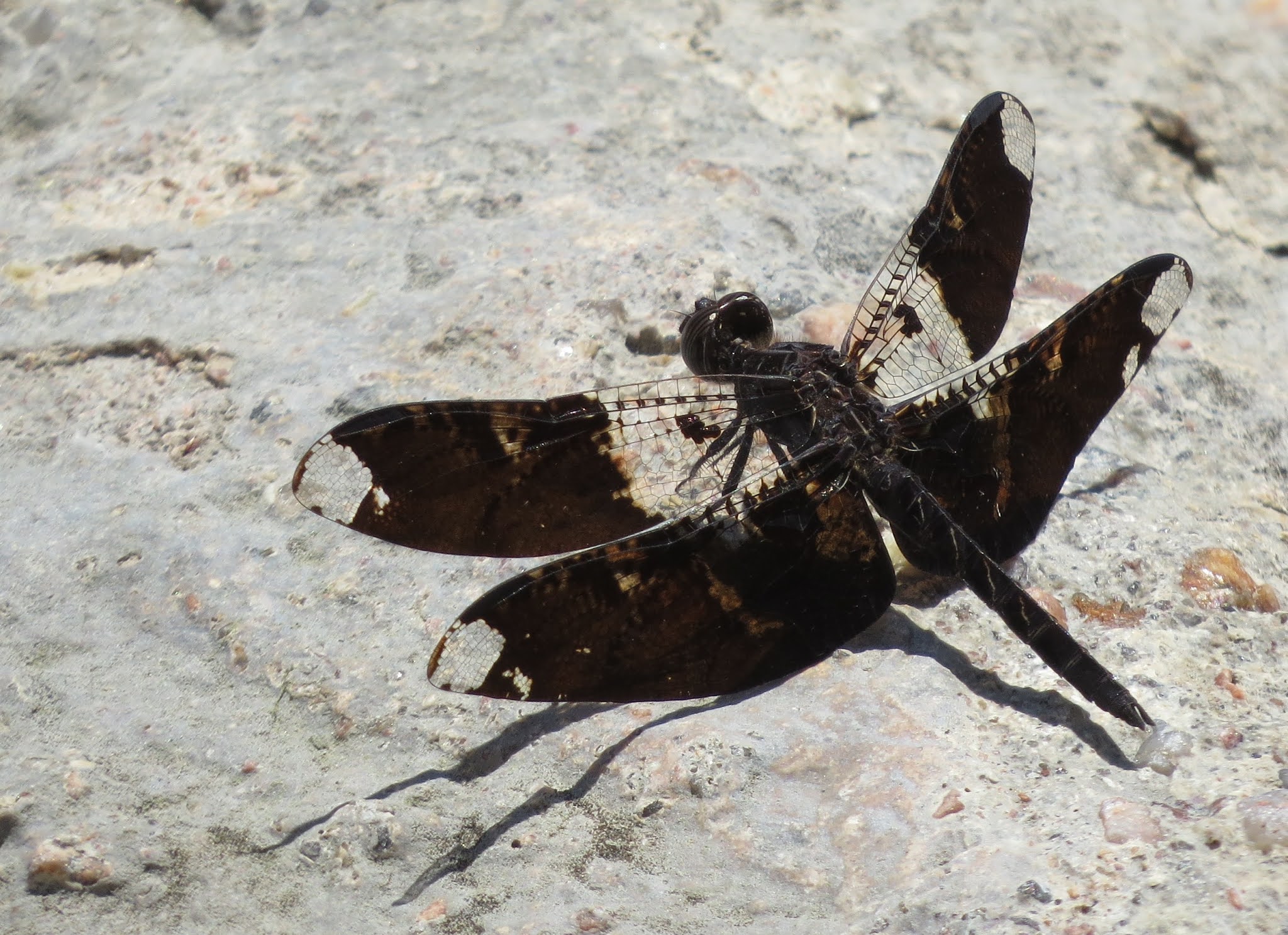
The experience that got me thinking about this was my discovery of the only known breeding population of the Filigree Skimmer dragonfly, Pseudoleon superbus, in Colorado. The documentation of the species just up the hill from my home in Colorado Springs represented a significant northern range extension for the species. I am using past tense because it is almost certain that the population will perish during or after a stormwater mitigation project slated for execution by Colorado Springs Utilities.

This situation was at the forefront of my mind in deciding whether to vote in favor of the reintroduction of the Gray Wolf to Colorado. The citizen-generated initiative made it onto the ballot in November, 2020, and passed by the narrowest of margins. It represents an attempt at restoration of historical ecosystems, and the historical range of Canis lupus in the Lower Forty-eight states. It could also be interpreted as contingency planning should wolves re-establish on their own, which seems to be the trend since the re-introduction of the species to the Greater Yellowstone Ecosystem.

In the absence of reliable predictive modeling for shifts in the geographic distribution of organisms, and therefore shifts in the composition of ecosystems, it is prudent to be as immediately responsive as possible when changes arise. The more preemptive actions that can be taken to facilitate those responses, the better. The wolf reintroduction bill at least forces the hand of Colorado Parks and Wildlife to manage wolves one way or the other, with the advantage going to the wolf and its human advocates. Similar legislation is needed at an ecosystem level to guard against both continued exploitation of natural resources by business interests, and to mitigate probable climate-driven catastrophes such as prolonged drought and wildfires.

A male Filigree Skimmer, Pseudoleon superbus

Back to the dragonfly for a moment. The Colorado Springs occurrence could be viewed as a disjunct population, far removed from the historical range of the species in canyons of the deep southwestern U.S. It could be that this is the “new normal” for the species. If the species is progressing northward, is something happening farther south that is driving it northward? Such outlier populations deserve consideration of protection, regardless of whether the species is currently listed as threatened or endangered in any part of its existing range.

I explored every recourse I could think of to get protection for the dragonfly population up the hill, but to no avail. It is tragically ironic that we demand a species to be already in peril before we give authority for its interests to be considered. Thus, the rights of a given species do not matter until the very last minute. What of the rights of humans to other species? What of our rights to experience other species in nature, in a passive fashion? Why do those rights not count at all? Many a human being would elevate the experience of immersion in wild ecosystems above mere recreation and into the realm of necessity for one’s mental health and physical well-being.

The time has come to raise the bar in proper stewardship of a constantly changing landscape, and give priority to preservation of not just species, but populations of each species. The maintenance of genetic diversity has never been so critical. There has never been such an urgent need to preserve as much remaining habitat as possible because climate change is diminishing viable ecosystems wholesale.

Conservation organizations and environmental law professionals, take note. The old standards and methods no longer apply. It is time to be creative, with innovative approaches to legislation, the forging of new partnerships with indigenous peoples to restore the “history” in “natural history,” and the assertion of urgency to preserve wildlands not for future generations, but to honor present and previous generations of ecological advocates. Get to work.

Sunday, January 24, 2021

Critical

© newhopepdx.org

”Everyone’s a critic,” the saying goes. This is perhaps truer now than it has ever been, and the intensity of criticism, and reaction to it, is at fever pitch. Why is this so? Why is criticism so argumentative? Do we even know what criticism is anymore?

To be clear, the criticism addressed here is not the same thing as what a movie, theatre, or restaurant critic does for a living. That kind of criticism is more a matter of shared personal taste and opinion, and perhaps public service. In the case of eating establishments, the health department is the only critic that really matters. A bad-tasting burger is one thing, a case of botulism is quite another. Matters of accreditation are likewise much more institutionalized and standardized, as they should be in the interest of accuracy and safety.

It is quite apparent that criticism in the traditional, personal sense suffers from confusion with disrespect, jealousy, betrayal, political correctness, and a whole host of other negative associations. Indeed, the interpretation of criticism by the receiver, and the intent of criticism on behalf of the critic, are often wildly different. This is a profound failure of communication because the conversation ends with unexpressed resentment, hostility, defeatism, and other emotions, plus assumptions about the character of each individual that may or may not have validity. There is seldom clarification of intent, let alone reassuring words that you are not out to assassinate someone’s character.

This is not to say that criticism is never generated from ego, or an attempt to assert power by demeaning others, subordinate or not in the formal sense of a professional hierarchy. Criticism is frequently viewed as a tool of persuasion. It is assumed to have an agenda behind it. Maybe it is a desire to invalidate a belief system, or discredit a competing hypothesis, or, worst of all, diminish someone’s self-worth and realm of experience to further an established but destructive political, social, or judicial system.

It is this last scenario, the one revolving around white privilege and patriarchal societies, criticism must be leveled and respected as a means of advancing reforms in equality, social and environmental justice, and leadership. We must speak honestly and fearlessly, and sometimes fiercely.

If you come from a place of white privilege and are compelled to start acting to advance the rights of others less fortunate, you must be prepared to accept criticism for every word and every thought you express. A baby does not come running out of the womb. It crawls and walks first. Your initial efforts at empathy and action are going to be laughably awkward. You may need to lower your expectations of yourself, and do more listening in the meantime. There is no shortage of women, BIPOC, and LGBTQ+ leaders to follow and learn from.

Many of us have a visceral reaction to criticism because it triggers negative emotions from our childhood. These are the “buttons” that your parents and teachers and peers pushed. They bypass the logical intersections of your brain like a car running a red light. Conclusions are jumped to that no longer serve your interests and it takes extreme conscious effort to put the brakes on, stop, and think again. It is worth the work, but you once again have to accept that you won’t get it right every time. It takes years, even decades, to get rewired, realigned.

Criticism, at its most brilliant and loving, is delivered with the intent to make you a better person, not turn you into someone different from who you are already. The best critics are people who make this clear from the outset and don’t leave you to wonder. When offered from a perspective of empathy, criticism is a powerful tool for change. Recognition of human insecurity, of imposter syndrome, and ego fragility is necessary in communicating criticism effectively and honestly. The goal should be to elevate the other person in their perspective, knowledge, understanding, skills, talents, and other personal attributes.

The worst criticism comes from a place of self-defense, desperation, dominance, aggression, disrespect, or dismissiveness. This serves no one, including the critic. It is not even criticism at its most extreme, it is violence. If you are so obsessed with preserving your own opinion, perspective, or insulated position of power, you probably need to be more self-critical instead of putting others down.

We come to every place, physical, intellectual, and emotional, with expectations and fears, promise and pessimism. This is human nature. We are gifted with the ability to overcome the inertia of protectionism by the plasticity of our minds, but we are unfortunately too often inflexible in that regard. Let your guard down, a little at least. Bend your ego. The more you do, the less the pain. I promise.

Wednesday, January 13, 2021

Sixty

That is how many years I have now persisted. About 720 months, or 3,128 weeks. Twenty-one thousand, nine hundred days. Five hundred twenty-five thousand six hundred hours. Over thirty-one point five million minutes. Tick-tock, tick-tock. Not that I am counting, I never have. It does seem as good a time as any for recollection and realignment, though.

Time and stress appear to be accelerating. I do not like what I have allowed the events of the last few weeks alone to turn me into: a soul with increasing suspicion and distrust of even close friends. I now assume the worst and am surprised by acts and signs of empathy and validation. Those defense mechanisms yank me back to my childhood, the separation and ultimate divorce of my parents, when I was a “momma’s boy” but also “just like your father.” Neither was a compliment. As an only child, I had no witnesses to call. The lies. Trick talk.

School was no escape. Bullying back then, the “dainty” kid with the butterfly net, the “fairy,” the other epithets suggesting I was a wimp who deserved ridicule and shunning. There was no refuge but isolation in the woods, and in my room where I drew pictures, read books. Did my few friends empathize, or pity me?

What saved me were mentors. Out-of-family adults who assign you self-esteem and connect you to scholars or hobbyists in your field of passion are critical to advancing your youthful well-being, if only through momentary distractions punctuating your misery. It can be enough to keep you going. It can be enough to steer you away from drugs, alcohol, suicide, or simply running away.

In college, my affinity for natural history collided with the realities of academia. I was no longer rewarded for simply having an interest and appreciation of other organisms. The mathematical abstraction, and obsession with quantification, walled me off from the flesh-and-blood animals that got me interested in science in the first place. I felt betrayed, and carried that resentment for four years before dropping out.

Fast forward to adulthood. I almost certainly had PTSD from my tumultuous childhood, like the concussion I got in high school football practice. Back in the day they didn’t know the true symptoms of either condition. A concussion does not have to knock you out cold. I thought I was fine (the divorce didn’t affect me, I proudly claimed), then everything got blindingly bright, I felt a bit light-headed, and maybe slightly nauseous. I went to tell the coach who was still running the drill, but in thirty or forty seconds I felt fine again and walked away (probably from therapy, too). Tick-tock.

I have always been at least one step behind in the best medical and psychological solutions available. Old school antidepressants prevented me from becoming too sad, but they didn’t allow me to be happy, either. I was emotionally flat-lining through life during that period. Eventually, I found two twelve-step programs that reached my subconscious and revealed the buttons I was letting people push. I began re-wiring my mind, but it is an ongoing process and I am still not up to code. Trick talk still echoes now and then.

All of this is not to say that I have had a morose, unremarkable life. Far from it. I have witnessed two total solar eclipses, seen the aurora borealis (in rural Indiana of all places), a comet (Hale-Bopp), and a volcanic eruption (Mt. St. Helens on July 22, 1980). The Vietnam War ended, and the Berlin Wall fell during my lifetime. Glimpses of hope. I got married, in spite of the horrible example of my parents. My wife has made me a better man, but still less than she deserves.

In some ways I long to be older still, at least sixty-five. I could get the vaccine faster. I could contemplate retirement, qualify for senior discounts. The thresholds for each seem to always be just out of reach. Mostly, though, I do not want to witness any more s***. If I think too long, I can’t die fast enough. I have lost all optimism, but that will never be an excuse to stop trying to influence others in positive ways. One day at a time, indeed. Sometimes one hour, one minute. Tick-tock, tick-tock.