Thursday, June 16, 2011

Point Vincente Interpretive Center

One of the points of interest that I visited in southern California last month was the Point Vincente Interpretive Center in the City of Rancho Palos Verdes. This building, originally opened in 1984, was expanded and re-opened in 2006. While the focus of the center is the migration of the Pacific Gray Whale, there is much more to the facility.

It is surprising and pleasing to see that the majority of interpretive centers in southern California are city parks, rather than county, state, or privately-run. I think it improves civic pride and helps bond residents when they have a real public attraction to take ownership of. Like many of the centers in the Greater Los Angeles area, this one has art and landscaping around the exterior that creates an aesthetically-pleasing first impression.

Once inside, the first thing one sees is a open habitat diorama of the Palos Verdes Peninsula, and a fiberglass model of a Pacific Gray Whale suspended from the ceiling. A gift shop is on your immediate right, beyond which is the front desk, manned by both staff and volunteers. On our visit we were greeted by a volunteer anxious to explain the unique geology of the peninsula. This point of land is a tectonic fault block that has risen from the sea floor within the last two million years. That is quite recent by geologic standards. It was actually uplifted twice, with pronounced erosion in the interim, and obvious erosion visible today. Continual landslides make traversing the peninsula, even by vehicle, a bit dicey.

A good portion of the exhibit space in the center is devoted to man’s relationship to marine mammals, and whales in particular. Many historical artifacts related to whaling are on display, but equal time is given to the evolution of public opinion regarding cetaceans, and how research on these leviathans has progressed. It is quite an impressive collection considering how local the facility is.

Another surprise was the exhibit on the previous tenant of this piece of real estate. Remember Marineland of the Pacific? I recall it from my childhood. Many of my friends in elementary school made it down to that aquarium/theme park, though I never did. I had always thought that Marineland became Sea World, and indeed the owners of Sea World purchased Marineland in 1987, shutting it down shortly thereafter. The orcas, porpoises, and other animal performers were relocated to the San Diego park. The oceanarium known as Marineland had a good run, though, having opened in 1954.

Back outside, the gardens surrounding the nature center along the edge of the bluff attract a variety of insect and bird life. The behavior of wind and air currents along the bluff also means this is a premiere spot for watching soaring seabirds, especially Brown Pelicans. The odd Red-tailed Hawk may join them, spiraling on the thermals that seem to originate there.

I highly recommend a visit to this landmark the next time you find yourself in the vicinity of Los Angeles. Remember that the Pacific Gray Whale migration usually occurs from December through April. The bluff offers a spectacular view of the ocean below, the kelp forests waving in the crests and troughs of the tides. Whales would be easily visible, too.

Thursday, June 9, 2011

Wildflowers of Charmlee

I have to start by thanking Kim Moore and Emile Fiesler for offering their expertise on our hikes through various southern California parks last month. As promised, here is a little sample of the wildflowers we saw at Charmlee Wilderness Park in Malibu.

Besides the profusion of Bush Monkeyflower, Mimulus aurantiacus, perhaps the most abundant, and certainly fragrant, flowering plant was Purple Sage, Salvia leucophylla. The scent was quite overwhelming, but in a pleasant, intoxicating way. It can bloom anytime between May and July (our hike was on May 19), and is commonly seen in coastal sage scrub habitat, oddly enough.

This was not the only species of sage to be found at Charmlee, either. The amazing Crimson Pitcher Sage, Salvia spathacea, also goes by the name Hummingbird Sage. Indeed, the red flowers must be a real draw for those nectar-feeding birds. It blooms from March to May in chaparral, coastal sage scrub, and oak woodlands. Sages are in the mint family, by the way.

Another fairly common plant was Spreading Phlox, Phlox diffusa. These are pretty large flowers compared to what I think of when I think of a Phlox. This species blooms between May and August on dry slopes and flats.

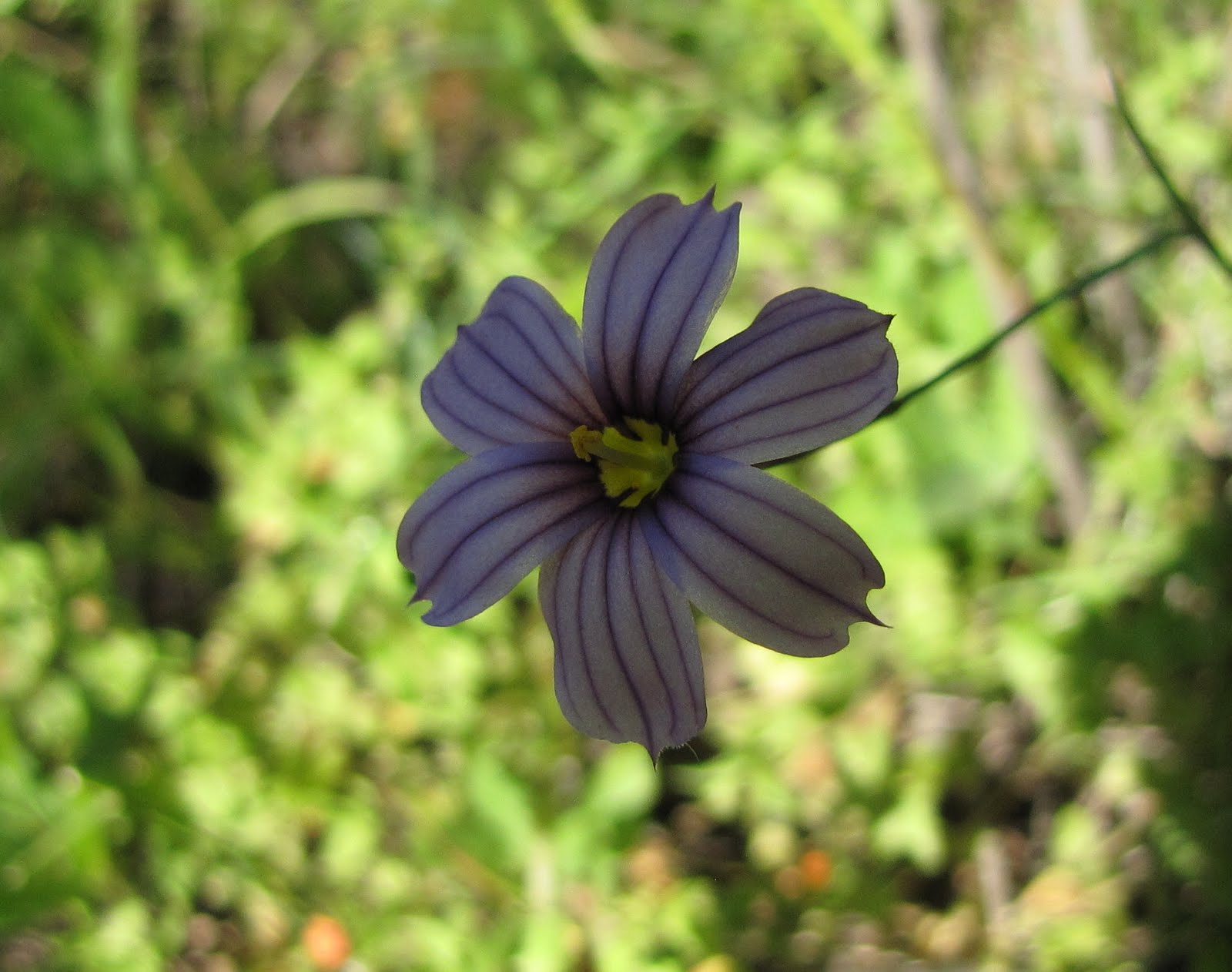
Blue-eyed Grass, Sisyrinchium bellum, is not really a grass at all, but it does have long, narrow leaves that look like grassblades. It also grows in meadow habitats. Blooming between March and May, the flowers are a composition of three petals and three sepals fused at the base. They can vary greatly in color, and probably by age. This one was pale enough that in bright sunlight I could not get a detailed image. So, I shadowed the flower in order to get the “pinstripes” to show.

Coast Paintbrush (“Indian Paintbrush”), Castilleja affinis, was also blooming. Its flowering period is generally March to May, and it occurs in drier habitats up to 3, 500 feet elevation. Paintbrushes are in the figwort family Scrophulariaceae.

I am familiar with globemallows here in southern Arizona, where they can sometimes be viewed as “weeds,” but I was blown away by the Bush Mallow, Malacothamnus fasciculatus. This perennial can grow to be a fifteen foot tall shrub! It blooms from April to July and like its relatives can occupy disturbed habitats as well as dry, pristine native niches up to 2, 500 feet.

Different flowers are to be found in the more moist, shady, wooded sections of Charmlee. The most conspicuous flower we came across there was the Canyon Sunflower, Venegasia carpesioides. The large and profuse blossoms can’t be missed. They have a long blooming period, too, from February to September.

Wedge-leaf Horkelia, Horkelia cuneata, is in the rose family, though I never would have guessed that. It is characteristic of the ecotone where the woodland meets the drier, more exposed parts of the coastal sage scrub habitat; it blooms between April and September.

Last but not least, Leafy California Buckwheat, Eriogonum fasciculatum foliolosum, was especially prominent near the park entrance and restroom facilities. It may bloom anytime between May and November. It is a favorite with some bees, including honeybees that can create a good honey from the nectar they harvest from these flowers.

There are certainly more wildflowers to be found in Charmlee and in the surrounding mountains. A good website for identifying most of them is Wildflowers and Other Plants of Southern California by Michael L. Charters. It does help to know at least what family the plant is in, however, as there is no color-coded search option for this comprehensive website.

Tuesday, June 7, 2011

Charmlee Wilderness Park

Charmlee Wilderness Park should probably be re-named “Charming” because it will become a favorite for anyone who visits there. Located at 2577 Encinal Canyon Road in the Santa Monica Mountains above Malibu, California, the woods, fields, and scenic views are sure to delight all hikers.

I had the pleasure to visit this city park (yes, a city park!) on May 19 with my new friends Kim Moore and Emile Fiesler. Both are first-rate naturalists intimately familiar with the flora and fauna of the area. There were plenty of plants and animals to keep me entranced, despite an unusually cool and wet spring this year.

One of the first animals to greet us was a Spotted Towhee. Normally, these birds are busy literally scratching out a living in the leaf litter under shrubs and trees. What a treat to be serenaded. We did see other birds, including the California Towhee, a much more drab cousin to the Spotted Towhee.

Wildflowers were in abundance, especially Bush Monkeyflower, Mimulus aurantiacus. It was the dominant shrub along wooded edges and ridgelines throughout the park. Mimulus of other varieties and colors were also to be found throughout the many parks I visited.

Another wildflower that caught my eye was this Mexican Pink, Silene laciniata. Plants in that genus are also known by the name “catchfly” because their sticky foliage often entangles insects. Apparently this particular species is common on the grassy slopes in coastal scrub habitat.

The East Meadow Trail at Charmlee is a must see if you like scenic views like this:

Hard to beat an ocean overlook on a reasonably clear day.

We hiked up the ridge to the Reservoir, now empty but on this day with a rock art peace symbol decorating its floor, and encountered two hilltopping butterflies. One was likely a Funereal Duskywing, Erynnis funeralis. The other was a magnificent male specimen of the Anise Swallowtail, Papilio zelicaon.

Coming down off the East Meadow Trail takes you through the Oak Groves on your way back to the parking area. The woodland offers pleasant relief after walking the hot, dry, open meadows. The flora and fauna are substantially different, too (stay tuned for an upcoming post on wildflowers of Charmlee).

As we pulled our car out of the parking space, we happened to notice a Calilfornia Whiptail lizard, Aspidoscelis tigris stejnegeri, break cover at the edge of the parking lot. The car idled while we debated whether to bother trying to get pictures of this regal reptile. Ultimately, we grabbed our cameras, got out of the vehicle, and approached the lizard ever so slowly. I fully expected the animal to bolt for the next county if I even blinked, but to my amazement it was incredibly tolerant, even allowing close-ups. As Kim put it, that was the “icing on the dessert of the day.”

Charmlee is open 8 AM to sunset, every day. There is a $4.00 parking fee. The modest nature center, not open when we were there, is normally open Saturdays and Sundays, 8 AM to 5 PM.

Saturday, June 4, 2011

Aquarium of the Pacific

One of the many places I visited in southern California last month was the Aquarium of the Pacific in Long Beach. I was accompanied by Kim Moore who is a volunteer at this impressive facility. The aquarium is only thirteen years old (as of this June 20, 2011), and they just opened a new exhibit, “Arctic & Antarctic: Our Polar Regions in Peril.”

Located in the Long Beach Shoreline Rainbow Harbor Marina, the aquarium is flanked by restaurants and tour boats, with the Lions Lighthouse for Sight just around the corner (left of the above image). Kim and I took one of the harbor tours to break up the visit to the aquarium.

The first thing you encounter upon entering the aquarium is a life-size model of a female blue whale and her calf (hidden in this image), suspended from the ceiling. The adult fiberglass facsimile is “only” eighty-eight feet long, which it turns out is about average for the current population of this species. He name is “Edie,” and her male calf is “Edison.” The accuracy of these models is impressive, and one gets to truly appreciate the streamlined bodies of these leviathans.

Beyond the whale is a two-story window on a tank called the “Blue Cavern,” in the Great Hall of the Pacific. This tall exhibit is an excellent introduction to the kelp forest habitats common along the southern California coast. In this case, the inspiration was Blue Cavern Point along the northeast edge of Santa Catalina Island. Among the denizens of the exhibit are some impressive California moray eels, Gymnothorax mordax.

Adjacent to the Blue Cavern is the Amber Forest and other “galleries” depicting the marine life of southern California and the Baja peninsula. One small aquarium features a captivating colony of Garden Eels (Heteroconger sp.).

The indoor portion is just one facet of the whole complex. The aquarium also boasts outdoor exhibits that include shark and ray touch tanks where visitors can gently stroke harmless cartilaginous fishes like Bamboo Sharks and Bat Rays. Visible from both above the water and below are Sea Otters and California Sea Lions.

Yet another outdoor exhibit is the Lorikeet Forest, a 3,200 square foot aviary where visitors can feed these stunning birds. Five of the 32 subspecies of the Rainbow Lorikeet are on exhibit.

Native to Australia, New Zealand, and islands in the South Pacific, lories are under pressure from the black market pet trade and from farmers who view the birds as pests in fruit orchards.

Back indoors, the Tropical Pacific Gallery features fish and invertebrates from faraway places. A Northern Pacific Gallery holds animals (including birds like puffins and auklets) from the cold waters of British Columbia and Japan.

It is impossible to communicate in one blog entry all of the exhibits and entertainment opportunities afforded by the Aquarium of the Pacific. It is not a cheap attraction (admission is $24.95 for adults, $21.95 for seniors age 62 and over, and $12.95 for children 3-11), but well worth the price. You should plan on spending the whole day watching the birds, mammals, invertebrates and fish. Don’t be surprised if some of them watch you in return.

Tuesday, May 17, 2011

Blogger is himself misplaced....

"Bug Eric" is out of the office temporarily, and Sense of Misplaced will be on hiatus until he returns. Thank you for your patience and understanding. Many new posts will follow in the coming weeks.

Friday, May 6, 2011

Haiku

Haiku seems to be making a resurgence in literary circles these days, as well as among naturalists (and friends) like Susan J. Tweit, Julie Zickefoose and Abigail Parker. Abby once committed to one haiku a day, and her verses are wonderful.

My most recent attempt to date is this:

Flaming clouds at dusk
Sear the sunset sky to black
Embers glow as stars

A previous attempt yielded something silly, based on watching traffic one morning while waiting for the bus:

Speeding trees go by
Riding in truck flowerbed
Destination home?

I would love for readers of this blog to share their own haiku poems; and also share their secrets for writing regularly in an age that eats your time before you know it is gone. Take care, friends.

Tuesday, April 19, 2011

Mental Illness

The headline on the front page of the Sunday Arizona Daily Star this week asked “Why don’t we help those with mental illness?” Talk about a population that is misplaced, the unfortunate individuals diagnosed with mental illness are probably at the top of the list. I think there are several reasons why we don’t help the mentally ill, and the first one is because we call it “mental illness.”

I am not a doctor, but given what I know, there really isn’t any such thing as mental illness. All diseases have a physiological cause, at least at the level of biochemistry, so it would seem more appropriate to call diseases of the mind by a name that reflects this. Perhaps “neurological disorders” or “cerebral anomalies” would be a better phrasing of such conditions. Our minds are not something disconnected from our brain and nervous system. Indeed, our mind originates from those sources.

Adding to the difficulty of diagnosing mental illness are the media stereotypes of those disorders. We continue to perpetuate myths such as schizophrenic people being violent. What does legitimately concern our society is the unpredictability of mental disease episodes. A manic or depressive period may come at the worst possible time for an employer, spouse, or friend to deal with. We are generally an impatient and selfish culture that gets frustrated (at the least) when we don’t know if we can count on someone to be there for us and our needs.

There is the stigma of mental illness to be sure, but we are also wary of being fooled. Don’t those with Multiple Personality Disorder just turn it on and off at will? There is this mistaken belief that the mentally ill still have some choice in their state of mind at any moment, because those of us without any affliction know how we are presenting ourselves to the world.

Another barrier to addressing mental illness is the notion that people bring on mental illness themselves. Drug use, for example, often leads to symptoms of mental illness such as hallucinations and erratic behavior.

Treatment is often an exercise in futility because the patient is not the best source of information on their state of well-being. Patients who are doing well because of medication may decide they no longer need the drugs, which then leads to cycles of sickness and recovery.

Patients therefore need “management,” but we have painted ourselves into an ethical corner because of our previous sins in committing mentally ill people to asylums where they were horribly abused. We are loathe to repeat such crimes, so dismiss the idea of institutionalizing “mental patients” in a society that celebrates freedom above all else.

We are also reluctant to intervene when we suspect someone may be suffering from mental illness. I see this in the entomological community whenever someone broaches the topic of “delusory parasitosis.” This condition is usually manifested by the sensation that insects are crawling on the person, or beneath their skin. The patient often brings bags of lint and dust to an entomologist, insisting that the bugs are “in there,” when even microscopic evaluation of the fibers and particles reveals there is no insect, mite, or other creature to be found. The entomologist then tries his or her best to pacify the patient or pawn them off on another expert, which leads to frustration for the patient, too, who can never get a straight answer.

What do we do, then? What is the answer? There is no single answer, but the first step is for us to become better educated on just what constitutes “mental illness.” We need to learn how to recognize it, especially in its early stages when treatment might have a better chance of success. Mostly, we need to have compassion for those who suffer from mental illness, as we do for those who have more obvious physical handicaps.

Let’s not let the mentally ill remain misplaced in our society. Let us find ways to integrate them into our places of employment, social circles, and our healthcare system.